Imagine a breakthrough drug passing every clinical trial with flying colours, winning regulatory approval, and then... sitting on a shelf because healthcare systems refuse to pay for it.
It happens more often than you think.
Why? Because regulatory approval is only half the battle; patient access is the other.
Once a drug proves safe and effective, healthcare systems ask harder commercial questions: What value does it add? How does it compare to existing treatments? What is the cost burden? Will payers reimburse it?
This critical intersection is where Market Access enters the picture.
For a doctor, pharmacist, dentist, life-science graduate or healthcare professional considering a move into pharma, this creates an interesting career possibility: you can use your understanding of medicine while moving closer to strategy, evidence and healthcare decision-making.
What Is Market Access in Pharma?
Market Access is the function that helps pharmaceutical products achieve appropriate access within healthcare systems.
In practical terms, professionals work on questions surrounding:
- Pricing
- Reimbursement
- Health Technology Assessment
- Health Economics and Outcomes Research (HEOR)
- Value communication
- Evidence generation
- Payer and stakeholder needs
- Market and policy analysis
- Launch strategy
Market Access therefore sits between several parts of the pharmaceutical ecosystem.
A simplified pathway looks like:
| Drug development → Clinical evidence → Regulatory approval → HTA/value assessment → Pricing & reimbursement → Patient access |
These stages are connected, but they are not interchangeable.
Regulatory authorities primarily assess whether a medicine meets the requirements for approval. Market Access focuses on the evidence and strategy needed to support access within healthcare systems.
The FDA's drug development framework, for example, involves preclinical work, clinical research and regulatory review before a medicine can be approved for sale.
Market Access comes into the broader commercial and healthcare-system conversation around what happens after or increasingly, alongside the development and approval process.
Major Career Areas Within Market Access
1. Health Economics & Outcomes Research (HEOR) |
|
2. Health Technology Assessment |
|
3. Pricing & Reimbursement |
Pricing and reimbursement professionals work on questions such as:
The exact frameworks differ by country, so global Market Access professionals need strong awareness of healthcare-system differences. |
4. Value Communication |
A major part of Market Access is communicating why a medicine represents value. That requires more than knowing the science. You must be able to translate complex clinical and economic evidence into a clear argument for different stakeholders. |
5. Real-World Evidence |
Clinical trials provide important evidence, but healthcare decision-making can also require understanding how treatments perform in broader real-world settings. This creates overlap between Market Access, RWE, clinical research, biostatistics and evidence generation. |
What Skills Do You Need for a Market Access Career?
Several skills repeatedly appear across Market Access work.
| Skill | What It Involves in Market Access |
| Scientific & Medical Knowledge | Diseases, therapeutic paths, clinical outcomes and medical terminology. Having a healthcare background might be a great starting point to develop Market Access expertise. |
| Critical Thinking | Interpretation of evidence and data, including clinical data, epidemiology, statistics, health economics, outcomes research, evidence synthesis, and economic modelling |
| Communications | Communicating complex scientific and economic evidence clearly to stakeholders of varied professional background through writing, presentations and debates. |
| Commercial Awareness | Understanding how healthcare decisions affect pharmaceutical companies, payers, providers and patients. Market Access requires both scientific and business understanding. |
| Management of Projects | Managing projects with various participants, time frames, sources of proof and deliverables. Good deadline management and continual learning also help career growth. |
| Stakeholder Management | Working with Medical Affairs, Regulatory Affairs, Clinical Development, Commercial teams, HEOR specialists and external consultants. Strong cross-functional communication and collaboration is a must. |
Can Healthcare Graduates Enter Market Access?
Yes.
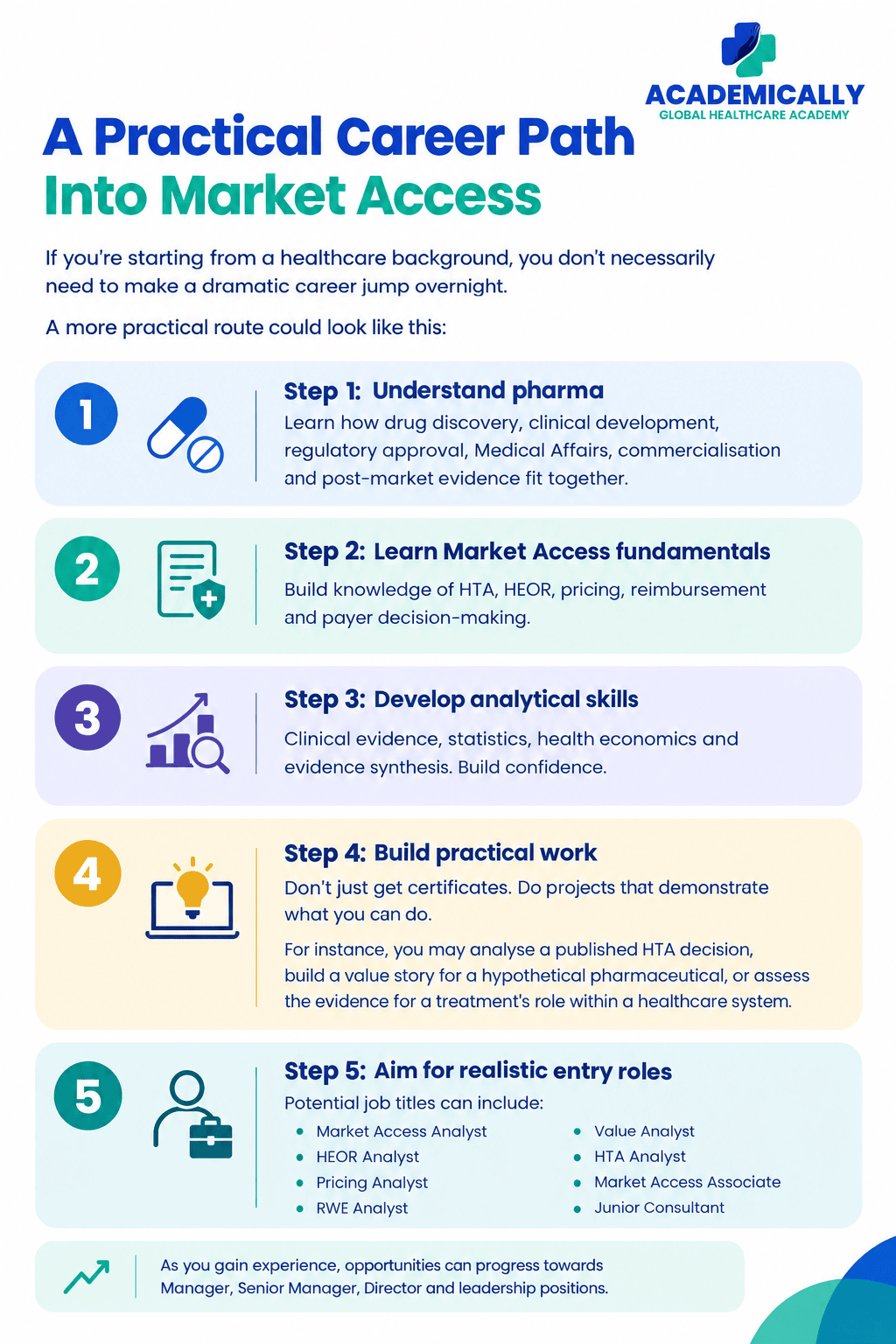
A healthcare or life-science qualification can provide useful scientific context, but you need additional knowledge in areas such as:
- Health economics
- HTA
- Pricing and reimbursement
- HEOR
- RWE
- Evidence generation
- Healthcare policy
- Pharmaceutical strategy
The entry route can also vary according to the employer and role.
Market Access recruitment guidance commonly identifies backgrounds in life sciences and related disciplines, while noting that there is no single universal credential checklist.
How Medical Affairs Skills Connect With Market Access
This is where the career paths become particularly interesting.
Medical Affairs and Market Access are different functions, but they share several capabilities.
| Medical Affairs | Market Access |
| Clinical evidence | Clinical and economic evidence |
| Scientific communication | Value communication |
| Stakeholder engagement | Payer/stakeholder engagement |
| Evidence generation | Evidence generation |
| RWE | RWE/HEOR |
| Disease-area knowledge | Disease and treatment landscape |
| Clinical trial understanding | Evidence interpretation |
Academically's current Executive Programme in Clinical Drug Development includes clinical trials and evidence generation, Health Technology Assessment, scientific communication and stakeholder-related learning. The overlapping skills can be useful if you are exploring adjacent pharmaceutical functions.
How Clinical Drug Development Skills Connect With Market Access
The connection becomes clear when you look at the entire medicine lifecycle.
| Clinical Drug Development | Market Access |
| How do we generate reliable evidence? | How can that evidence support healthcare decisions? |
| Focuses heavily on clinical development and evidence generation. | Focuses on value, access and healthcare decision-making. |
| Studies safety, efficacy, outcomes and patient populations. | Interprets evidence alongside economic, clinical and healthcare-system considerations. |
| Generates clinical and real-world evidence. | Uses evidence to understand and communicate the value of a product. |
| Looks at evidence throughout drug development. | Looks at how evidence can contribute to access and value decisions. |
Academically's non clinical courses cover clinical trials, regulatory affairs, Medical Affairs, biostatistics, medical writing, RWE and post-market studies.
These areas can support a transition because Market Access professionals need to understand evidence quality, clinical outcomes and the wider product-development lifecycle.
However, you would still need to deliberately build Market Access-specific competencies
Market Access Career Salary in India
| Career Level | Typical Experience | Common Roles | Indicative Annual Salary in India |
| Fresher / Entry Level | 0–2 years | Market Access Analyst, Associate, Junior Consultant | ₹4–8 LPA |
| Mid-Level | 3–7 years | Market Access Consultant, Senior Associate, Manager | ₹8–20 LPA |
| Senior Level | 8–12+ years | Senior Manager, Senior Market Access Lead | ₹20–35 LPA |
| Leadership Level | 12–15+ years | Associate Director, Director, Head of Market Access | ₹30–50+ LPA |
Where Can You Find Market Access Jobs?
The Market Access role is a little bit about casting a wider net than just one search term. Because this field sits right at the intersection of medicine, economics, and business strategy, titles vary depending on the type of organisation hiring.
Opportunities exist across pharmaceutical companies, biotech startups, contract research organisations (CROs), specialised healthcare consultancies, and health system organisations.
Key title combinations to search for:
- Market Access Analyst or Market Access Associate
- HEOR Analyst(Health Economics & Outcomes Research)
- HTA Analyst(Health Technology Assessment)
- Pricing Analyst
- RWE Analyst(Real-World Evidence)
Beyond generic job sites, keep an eye on specialised life-science portals like Jobslly. It's a helpful resource if you're building a non-clinical healthcare profile. It has job listings specifically for healthcare graduates and also provides CV assistance.
The main goal is to search broadly enough to uncover positions where your clinical or scientific background gives you an immediate edge over standard business applicants.
Final Thoughts
Is Market Access a Good Career for Healthcare Graduates?
Yes. It can be a strong option if you enjoy evidence, strategy, healthcare systems and problem-solving more than direct patient care.
Market Access focuses on why healthcare systems should consider a treatment valuable and worth funding. If you have a background in pharmacy, or medicine, you already hold transferable skills. Addressing knowledge gaps in HTA, HEOR, pricing, and reimbursement is how you turn a healthcare degree into a thriving pharmaceutical career.