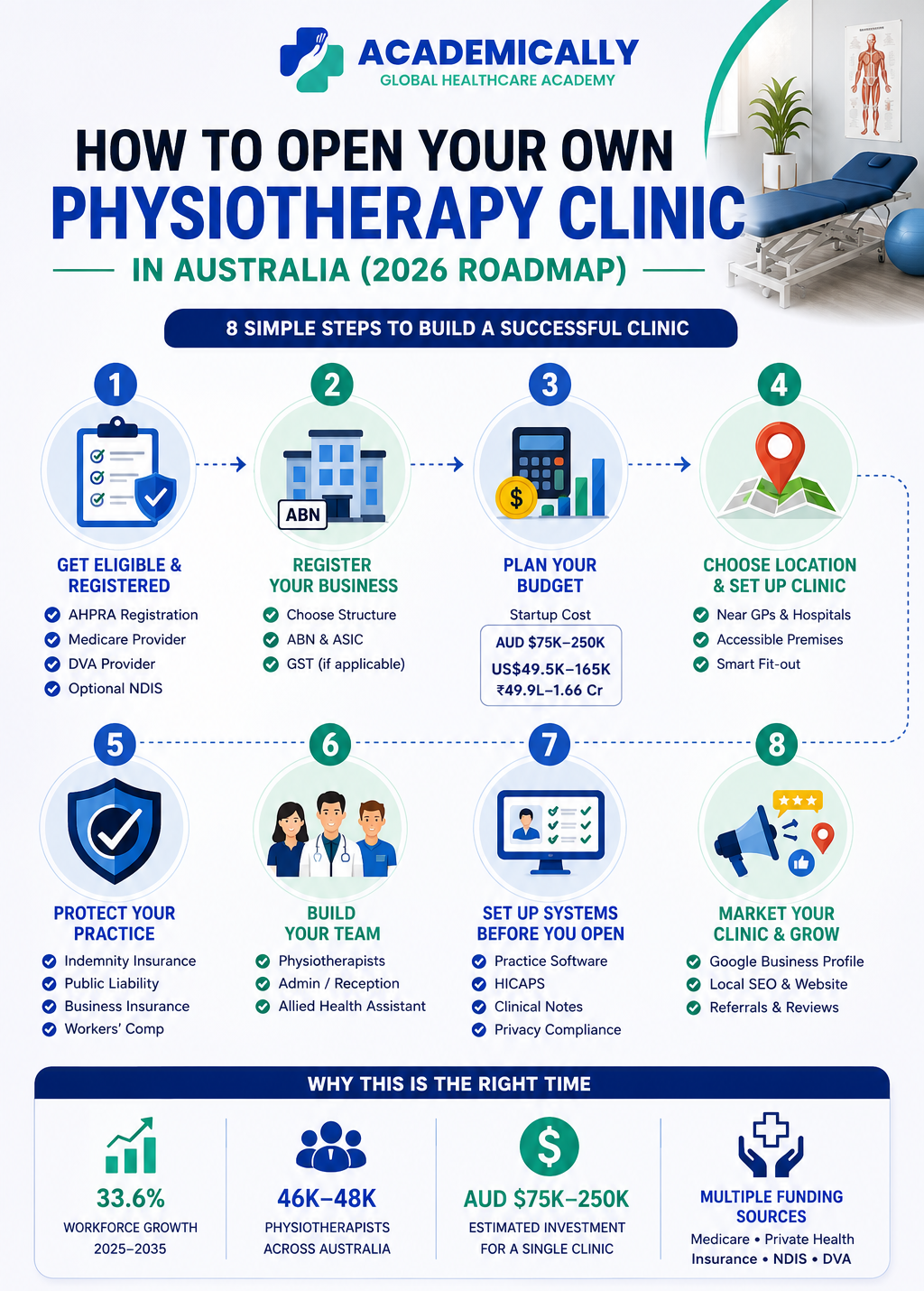
Australia's physiotherapy workforce is forecast to grow 33.6% between 2025 and 2035. One of the fastest expansion rates of any healthcare occupation in the country, according to employment projections published by Jobs and Skills Australia. With roughly 46,000–48,000 physiotherapists currently employed nationwide and demand still outpacing supply driven by an ageing population, the NDIS rollout, and rising chronic disease burden, there has arguably never been a better structural moment to open a private practice.
But opportunity isn't the same as a plan. Opening a physiotherapy clinic in Australia means navigating AHPRA registration, Medicare provider numbers, business structuring, insurance, fit-out costs, staffing, and marketing, all before you see your first paying patient.
This blog walks you through every stage, with realistic, up-to-date costs in AUD, US$, and INR, so you can build a clinic that's compliant, financially sound, and genuinely competitive.
(Currency note: All conversions in this article use approximate rates as of June–July 2026. 1 AUD ≈ US$0.66 ≈ ₹66.5. Rates fluctuate daily; always check a live converter before making financial commitments.)
Why is This the Right Time to Open a Physiotherapy Clinic in Australia
- Structural workforce shortage. Physiotherapy sits on Australia's skilled occupation list, and regional and outer-metro areas in particular report persistent gaps in access to care.
- Ageing population. Falls prevention, joint replacement rehab, and chronic pain management are rising service lines as Australia's over-65 population grows.
- NDIS-driven demand. The National Disability Insurance Scheme has created sustained, funded demand for community-based physiotherapy that didn't exist a decade ago.
- Private health insurance utilisation. Physiotherapy remains one of the most frequently claimed extras/ancillary categories under Australian private health cover, giving private practices a stable non-Medicare revenue stream.
None of this means opening a clinic is easy. It means the underlying demand curve supports it, provided you get the operational and compliance fundamentals right.
Step 1: Confirm You Meet the Clinical, Medicare, DVA & NDIS Prerequisites
Before you sign a lease or design a logo, you need to be a legally practising physiotherapist in Australia.
AHPRA Registration
You must hold general registration with the Physiotherapy Board of Australia, administered through the Australian Health Practitioner Regulation Agency (AHPRA). This requires an approved physiotherapy qualification (either a physiotherapy degree from Australia or an overseas physiotherapy degree and clearing the APEP pathway).
- Annual registration fee: approximately AUD 185-330 (varies slightly by state/territory and year of renewal) → roughly US$122-218 / ₹12,300-21,950
- Registration must be renewed annually (period runs 1 December-30 November), with a signed declaration of ongoing professional development compliance each cycle.
- Overseas-qualified physiotherapists typically go through the APEP (Australian Physiotherapy Examining Panel) assessment pathway before being eligible for general registration.
Medicare Provider Number
Apply for a Medicare provider number through Services Australia so eligible patients can claim rebates (e.g., under Chronic Disease Management/EPC plans referred by a GP). This is separate from AHPRA registration and is issued per practice location.
DVA Provider Registration
If you want to treat veterans and their families, you'll need to be recognised as a provider by the Department of Veterans' Affairs (DVA). The good news is, for most physiotherapists, this step is largely automatic.
- Once you hold a Medicare provider number, you're generally registered with DVA automatically, no separate application needed for standard physiotherapy services.
- A small number of provider types (e.g., lymphoedema therapists) still need to register with DVA directly.
- Make sure your practice address matches exactly across your AHPRA registration and Medicare provider number, since mismatches are a common cause of registration delays.
- DVA operates a no-gap billing system: Gold Card holders are covered for all medical needs, White Card holders for approved conditions only, and you cannot charge veterans any additional "gap" fee beyond the DVA-approved rate.
- Claims are submitted via HPOS, Webclaim, or Medicare Online, with payment issued directly to your account via a Recipient Created Tax Invoice (RCTI).
Full details and the current physiotherapy fee schedule are available on the Department of Veterans' Affairs provider portal.
NDIS Provider Registration
Given the National Disability Insurance Scheme's growing role in funding physiotherapy, it's worth understanding this pathway even if you don't register on day one.
- As of early 2026, NDIS registration is optional for physiotherapists delivering therapy-only supports. You can still treat self-managed and plan-managed participants without it.
- However, only registered providers can treat agency-managed participants, a meaningful segment of the NDIS population, so registration expands your addressable client base.
- Registration also signals to participants, support coordinators, and referrers that your practice meets the NDIS Practice Standards, which can be a genuine trust/marketing advantage in a competitive local market.
- For therapy-only services, you'll typically go through a Verification audit, a desktop document review rather than a full on-site audit via the NDIS Commission Portal. (Delivering early-intervention supports for early childhood triggers a more involved audit pathway.)
- If you do register, update your consent forms and service agreements to reflect NDIS-specific requirements: current NDIS Price Guide rates, cancellation policy, handling of different plan-management types, and what happens when a participant's plan is reviewed or funding changes.
Apply directly through the NDIS Commission Portal when you're ready to pursue registration.
APA Membership (Optional but Valuable)
Joining the Australian Physiotherapy Association (APA) isn't mandatory, but it gives you access to a national Practice Accreditation Program, professional indemnity advocacy, clinical guidelines, and referral-network visibility, all of which matter when you're building trust as a new, unknown clinic brand.
Step 2: Choose Your Business Structure
Your legal structure affects liability, tax, and how easily you can later franchise, bring in investors, or sell the business.
| Structure | Liability Protection | Best For | Complexity |
| Sole Trader | None (personal assets exposed) | Solo practitioner testing the model | Low |
| Partnership | Shared, unlimited | Two or more co-founding physios | Medium |
| Company (Pty Ltd) | Strong-separate legal entity | Most private practices; growth/franchising/investment plans | Medium–High |
| Trust | Varies by trust type | Asset protection, tax planning (needs accountant advice) | High |
Most advisory sources, including legal and business-registration specialists recommend a company structure for physiotherapy clinics, since it separates personal assets from business liability and simplifies future franchising, investment, or succession planning. Speak to an accountant and a business lawyer before finalising this, since the "right" structure depends on your tax position, growth ambitions, and risk tolerance.
Core Registrations You'll Need
- Australian Business Number (ABN): mandatory for invoicing and Medicare billing
- Business name registration (if trading under a name other than your own or your company's legal name)
- GST registration: required once turnover exceeds the threshold (currently AUD 75,000/year); many allied health services are GST-free, but check current ATO guidance for your specific service mix
- Company registration with ASIC (if using a Pty Ltd structure)
Step 3: Build a Realistic Financial Plan
This is where many first-time clinic owners underestimate what's actually required. Below is a grounded, realistic range for a single-site, small-to-mid-sized private physiotherapy practice (not a multi-site or diagnostic-imaging-equipped facility, which would cost substantially more).
Estimated Startup Cost Ranges
| Cost Category | AUD (approx.) | US$ (approx.) | INR (approx.) |
| Clinic fit-out & renovation (1–2 treatment rooms) | 25,000–75,000 | 16,500–49,500 | ₹16.6L–49.9L |
| Clinical equipment (plinths, ultrasound, exercise gear) | 15,000–50,000 | 9,900–33,000 | ₹9.98L–33.3L |
| Practice management software & booking systems | 1,500–6,000/year | 990–3,960/year | ₹1L–4L/year |
| Professional indemnity & business insurance | 1,500–4,000/year | 990–2,640/year | ₹1L–2.7L/year |
| AHPRA registration | 185–330/year | 122–218/year | ₹12,300–21,950/year |
| Initial marketing & branding | 3,000–15,000 | 1,980–9,900 | ₹2L–10L |
| Working capital buffer (3–6 months operating costs) | 30,000–100,000+ | 19,800–66,000+ | ₹19.9L–66.5L+ |
Realistic total startup budget: roughly AUD 75,000–250,000 (US$49,500–165,000 / ₹49.9L–1.66Cr) for a single-site clinic, depending on location, lease condition, and equipment ambitions.
Be cautious of generic "business plan template" sites quoting figures in the millions for a standard single-site clinic, those numbers reflect multi-site chains with advanced diagnostic technology (e.g., 3D motion capture systems), not a typical first practice.
Build your own budget from actual quotes. Your commercial lease, a local fit-out contractor, and equipment suppliers.
Financing Options
- Small business loans (banks require a solid business plan and financial projections)
- Equipment finance/leasing (common for treatment tables, exercise equipment)
- Business line of credit for working capital
- Self-funding or partner investment, particularly if using a company structure that allows equity investors
Step 4: Location, Premises & Fit-Out
Location decisions should be driven by referral pathways, not just foot traffic.
- Proximity to GPs, allied health hubs, and hospitals matters more for physiotherapy than retail visibility, since most patients arrive via referral or word-of-mouth rather than walk-in.
- Accessibility compliance: ramps, doorway widths, accessible bathrooms isn't optional; physiotherapy clinics serve mobility-impaired patients and must meet Australian accessibility standards.
- Lease terms: negotiate make-good clauses and fit-out contribution from the landlord where possible; commercial health-suite leases in Australia commonly run 3-5 years with options to renew.
- Layout: treatment room size, privacy, equipment storage, and a functional reception/waiting area all affect both compliance and patient experience.
Step 5: Insurance & Risk Management
Non-negotiable coverage for any physiotherapy clinic includes:
- Professional indemnity insurance: covers claims arising from clinical treatment or advice
- Public liability insurance covers injury to patients/visitors on your premises
- Business/contents insurance covers equipment, fit-out, and business interruption
- Workers' compensation is mandatory once you employ staff (requirements vary by state)
Most APA members and many commercial insurers offer allied-health-specific packages bundling these, worth comparing at least three quotes before committing.
Step 6: Staffing & Team Structure
Even a solo-practitioner clinic usually needs administrative support fairly quickly, reception, bookings, and billing consume more time than most new owners expect. Common early-stage roles:
- Front-desk/practice administrator (often part-time initially)
- Additional physiotherapists (as patient volume grows)
- Allied health assistants (for supervised exercise programmes)
- Bookkeeper/accountant (often outsourced rather than hired)
All employed physiotherapists must independently hold current AHPRA registration. You're responsible for verifying this before they treat patients under your clinic.
Step 7: Set Up Systems Before You Open
Getting these right from day one avoids costly retrofits later:
- Practice management software: for bookings, clinical notes, Medicare/HICAPS billing, and patient communication
- HICAPS terminal enables real-time private health insurance claiming at the point of treatment, which materially improves patient experience and cash flow
- Clinical documentation standards: aligned with AHPRA's Physiotherapy Board Code of Conduct
- Data privacy compliance: Australian Privacy Principles (APPs) govern how you store and handle patient health records
Step 8: Marketing Your New Clinic (SEO, GEO & Local Visibility)
Physiotherapy is a trust-driven, locally searched service. Most patients search for "physiotherapist near me" or ask their GP for a recommendation. Your visibility strategy should have:
- A Google Business Profile optimised with accurate location, hours, and service categories. This is often the single highest-ROI marketing action for a new clinic.
- A conversion-focused website with clear service pages (sports physio, post-surgical rehab, NDIS services, etc.) rather than one generic "services" page
- Local SEO content: location-specific pages if you serve multiple suburbs or regions
- Referral relationships: GPs, sports clubs, aged care facilities, and NDIS support coordinators remain the strongest referral channel for physiotherapy, often outperforming paid ads
- Patient review generation: Google reviews function as social proof and directly influence local search ranking
- AI/answer-engine visibility: as more patients use AI assistants and voice search to find local healthcare providers, ensure your website clearly states your services, location, and credentials in plain, structured language (FAQs, service descriptions, and schema markup all help here)
Common Mistakes First-Time Clinic Owners Make
- Underestimating working capital needs and running out of cash before reaching break-even
- Choosing a sole trader structure purely to save setup cost, then facing personal liability exposure later
- Delaying HICAPS/Medicare billing setup, which slows cash flow in the first few months
- Skipping a proper business plan when seeking finance, which weakens loan applications
- Treating marketing as an afterthought instead of budgeting for it from month one
- Under-insuring, particularly skipping public liability cover in shared or multi-tenant premises.
To Conclude with...
Opening a physiotherapy clinic in Australia sits at a genuinely favourable intersection. Strong structural demand, a clear (if detailed) regulatory pathway, and multiple funding channels (Medicare, private health insurance, NDIS) that don't all depend on one payer.
The clinics that succeed aren't necessarily the ones with the biggest fit-out budgets. They're the ones that get the compliance foundations (AHPRA, Medicare, insurance, business structure) right from day one, build a realistic financial runway, and treat local visibility and referral relationships as core business functions rather than afterthoughts.
If you're weighing this decision, start with the two things you can validate fastest and cheapest: your own AHPRA registration status, and a real, quoted budget for a location you're seriously considering. Everything else in this guide builds on those two foundations.