When I was first searching ways to transition into a non-clinical healthcare career one piece of advice always kept coming back to me: "You need experience to get a job but how do you get experience without getting a first job?”
I know that feeling well because a healthcare degree can give you scientific knowledge, clinical exposure and patient-facing experience, but pharmaceutical companies often look for additional industry-specific skills that a fresher may lack even with a BDS, BPharm, PharmD, MBBS, MSc or other healthcare-adjacent degree.
In my transition from dentistry into a non-clinical healthcare career I learned the value of understanding my healthcare qualifications. I also learned how my skills could serve as a foundation for building experience, visibility and a professional network to pursue jobs that I want.
That is where networking for non-clinical pharma jobs comes in handy.
Networking is not about messaging hundreds of strangers and asking "Sir/Ma’am please give me a job!” Rather it is about intentionally building relationships with people who understand the industry, learning what pharma, medical affairs or regulatory affairs companies need. It is about getting the visibility you need to be considered for a role.
Why Networking Is Important When You Have No Pharma Experience ?
What many freshers fail to consider when starting their job search, is their visibility to the industry. While healthcare degrees provide exposure, pharmaceutical companies often require specific skills. A professional conversation can help you understand that connection.
An informational interview, for example, is a conversation with an executive whose area of work or professional background matches your own or something you are hoping to achieve. Its purpose is to learn more about the industry not to ask for a job.
I often suggest informational interviews as a networking method for people considering a career change. I personally find this approach better than treating every connection like a potential recruiter!
Your aim should be:
Learn
↓
Build relationships
↓
Become visible
↓
Demonstrate skills
↓
Discover opportunities
↓
Apply strategically
That is a stronger approach than asking every connection to refer someone and hoping that a single referral opens a flood of doors.
Step 1: Choose One Pharma Career Direction First
One networking mistake I see often is trying to network for everything at once.
Imagine putting “Pharmacovigilance | Medical Affairs | Clinical Research | Regulatory Affairs | Medical Writing | CDM” in your job headline. It may show that you are interested in healthcare, but it does not tell people what professional identity you are developing.
Pick one non-clinical job target and work from there. Examples include:
- Pharmacovigilance Associate
- Medical Affairs Associate
- Medical Writer
- Clinical Research Coordinator
- Clinical Data Associate
- Regulatory Affairs Associate
- Medical Information Associate
You can have two closely related options as secondary targets, but your initial networking conversations should have a clear direction.
When asked "What kind of role are you looking for?" I find it much easier to say "I’m hoping to find Medical Affairs" rather than saying "Anything outside clinical practice!”
Which Non-Clinical Pharma Role Are You Networking For?
| Career | What you may work on | People to network with |
| Pharmacovigilance | Adverse-event/safety data | Drug Safety Associates |
| Medical Affairs | Scientific communication | Medical Affairs Associates/MSLs |
| Medical Writing | Scientific/medical content | Medical Writers |
| Clinical Research | Clinical trials | CRCs/CRAs |
| Regulatory Affairs | Regulatory submissions | Regulatory Associates |
| CDM | Clinical data | Data Management Associates |
Step 2: Turn Your Healthcare Background Into a Networking Pitch
Your introduction should not begin with what you lack.
Avoid:
“I am a fresher and I don't have pharma experience. Can you help me get a job?”
You could say something more like:
"Hi I’m a healthcare professional looking to transition into non-clinical pharma roles with a background in clinical care and scientific communication. I am currently building my skills in writing and pharmaceutical industry workflows and I’m particularly interested in understanding how professionals enter Medical Affairs.”
That is a stronger opening than asking a stranger "Please get me a job”.
Step 3: Start With Your Existing Network
This does not mean immediately messaging a VP at Pfizer.
Your first network is probably much closer than you think.
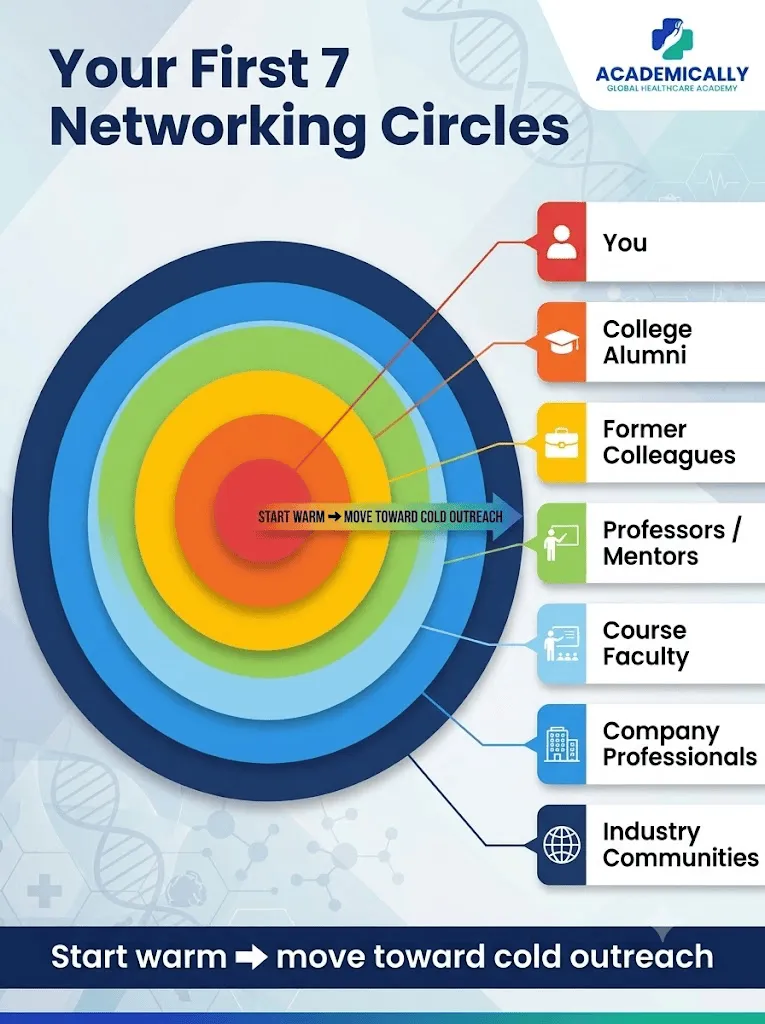
Your dental, pharmacy or medical college alumni can be particularly useful since they often know what kind of healthcare degree you hold. You can even search for combinations such as:
- BDS Medical Affairs
- PharmD Pharmacovigilance
- BPharm Clinical Research
- MBBS Medical Writer
- Healthcare Regulatory Affairs
This can help you find people who have successfully made a career change similar to what you are hoping to achieve. They may share skills, certifications and even entry-level titles that you did not consider.
Step 4: Connect With People One Career Stage Ahead
A lot of people forget that networking is not about connecting with executives. I would actually start my non-clinical pharma job search by connecting with people who are one to five years ahead of me.
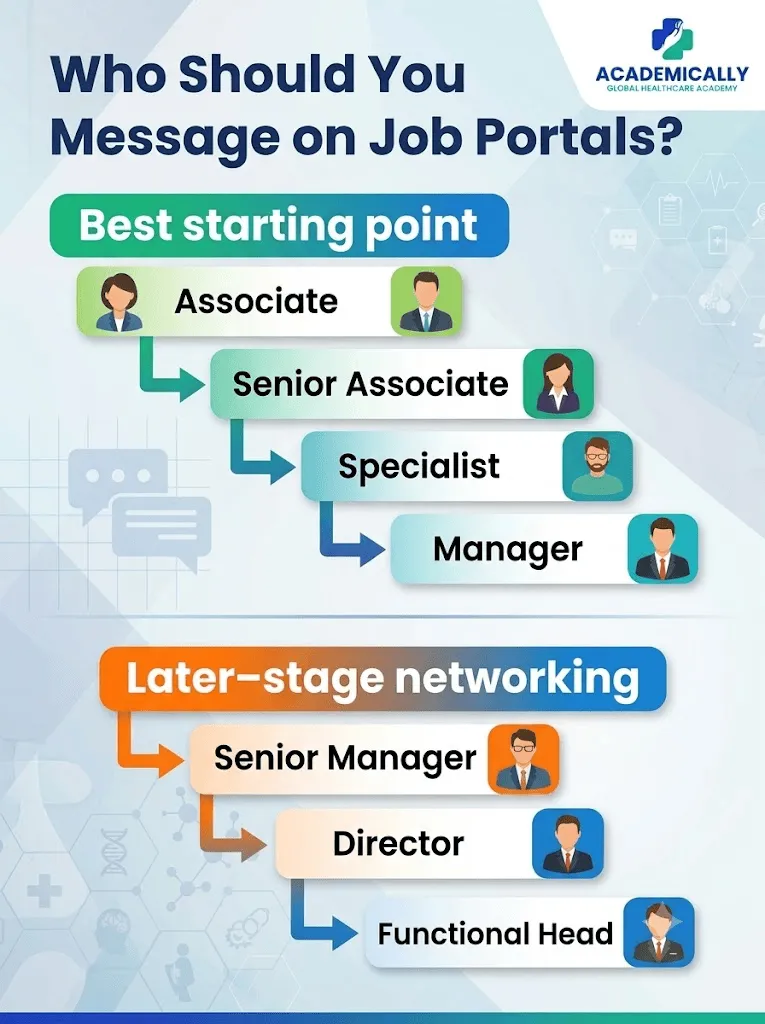
They may provide much-needed advice regarding:
- What their first job looked like
- Which skills helped them get hired
- What interview questions they faced
- Which entry-level titles to search
- How they positioned their healthcare degree
- Which skills they wish they had learned earlier
I personally will recommend starting with existing contacts before branching out strategically to connections, target companies and roles of interest.
Step 5: Don’t Ask "Can You Refer Me?" Too Early
This is probably my tip for freshers who are new to networking.
A referral is not the first objective of networking.
Imagine receiving a message from someone you have never met that begins with:
"Hi please refer me for a job!"
I would rather receive:
"Hi I came across your transition from pharmacy into pharmacovigilance and found it very relevant to the direction I am exploring. I’m currently building my understanding of drug safety careers. Could I ask you two questions about how you approached your first pharma role?”
When a meaningful relationship is built referrals can become much easier to come by!
Step 6: Use Informational Interviews Strategically
You do not need a 60-minute informational interview! In my experience a 15–20 minute conversation with questions is often sufficient.
Research the person and their role thoroughly before contacting them. Ask three or four questions instead of asking them to give an overview of their entire career.
Good questions include:
- What skills do entry-level candidates need most in your function?
- Which job titles should a healthcare search for?
- What made your profile stand out when you entered pharma?
- Is there any skill you recommend I develop before applying?
These types of questions yield information that you can actually use! They can also help identify skill gaps in your non-clinical pharma application strategy so you don’t repeatedly send applications and receive no response.
Step 7: Make Your Job Portal Work Before You Start Networking
When beginning your non-clinical pharma job search networking becomes much easier when your profile reflects what you are trying to become.
Your job profile headline should be specific.
Instead of:
BDS Dentist | Fresher | Looking for Opportunities
Try:
BDS Healthcare Professional | Aspiring Medical Writer Scientific & Healthcare Content | Pharma Career Transition
Your About section should briefly explain:
Your healthcare foundation + transferable skills + target function + current upskilling
Now start demonstrating your interests publicly.
Job Portal Profile Checklist for Freshers
Use a checklist with:
☑ Professional headline
☑ Healthcare background clearly mentioned
☑ Target pharma function
☑ Relevant skills
☑ Certifications/courses
☑ Projects/capstone work
☑ Scientific/medical posts
☑ Updated resume
☑ Professional profile photo
☑ Contact information
You don’t need to be a job portal influencer. Your profile can reflect the professional identity that you are communicating privately.
Step 8: Give Before You Ask
This is one of the genuine parts of networking!
Suppose someone posts about adverse-event reporting. Rather than immediately pitching yourself, add a thoughtful comment.
Suppose a Medical Affairs professional shares an article. Read it and respond with one relevant observation.
Instead of ignoring the career advice of someone you have connected with send a thank-you message and mention what you did based on their advice. That follow-up matters.
That is networking! It is not a service where every conversation has to give you a lead to a job opening. It is a long-term professional relationship.
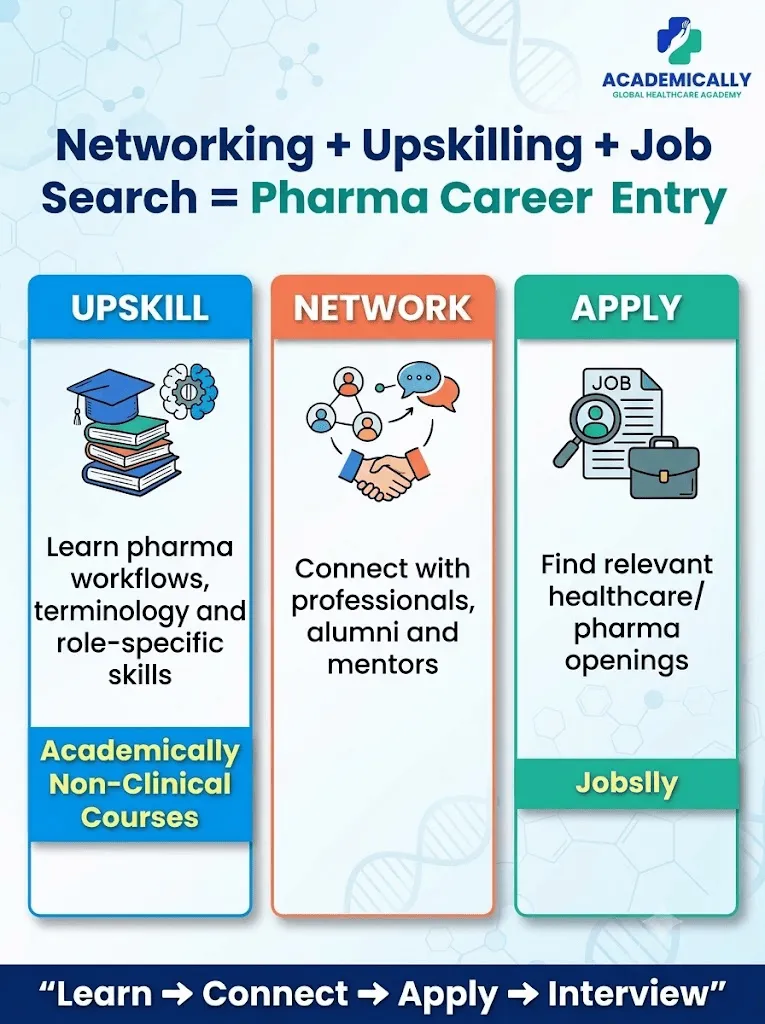
Step 9: Build Skills That Make Your Networking More Valuable
Networking cannot fill every gap in your non-clinical pharma application strategy.
Someone may introduce you to a recruiter, but you still need to demonstrate that you understand the role.
That is why I believe in combining networking with upskilling.
“Networking + Upskilling + Job Search = Pharma Career Entry”
Academically’s Non-Clinical Courses page currently lists programmes that can help understand Medical Affairs/MSL, Clinical Drug Development, Medical Writing, Pharmacovigilance, Clinical Data Management, Clinical Research, HEOR and other non-clinical healthcare pathways.
The value is not simply in completing a certificate. A career-transition programme becomes more valuable when it helps understand industry workflows, develop practical work and communicate knowledge confidently during interviews. Academically's programmes also include capstone projects, industry-oriented training and interview/job-readiness support.
That combination can help answer networking questions such as "What have you actually done to prepare for this field?”
Step 10: Complement Networking With Jobslly
I find that using networking and job search tools together yields better results.
Jobslly allows healthcare professionals to search roles by function and location, create a profile, upload a resume, apply to listed openings. Its current platform includes categories such as Medical Affairs and Non-Clinical Jobs well as healthcare opportunities involving pharma and CRO employers. That provides a workflow:
Find a relevant vacancy
↓
Identify employees from that company
↓
Learn about the role
↓
Build a genuine connection
↓
Improve your application
↓
Apply
Your networking becomes much more targeted.
30-Day Networking Plan For Non-Clinical Jobs
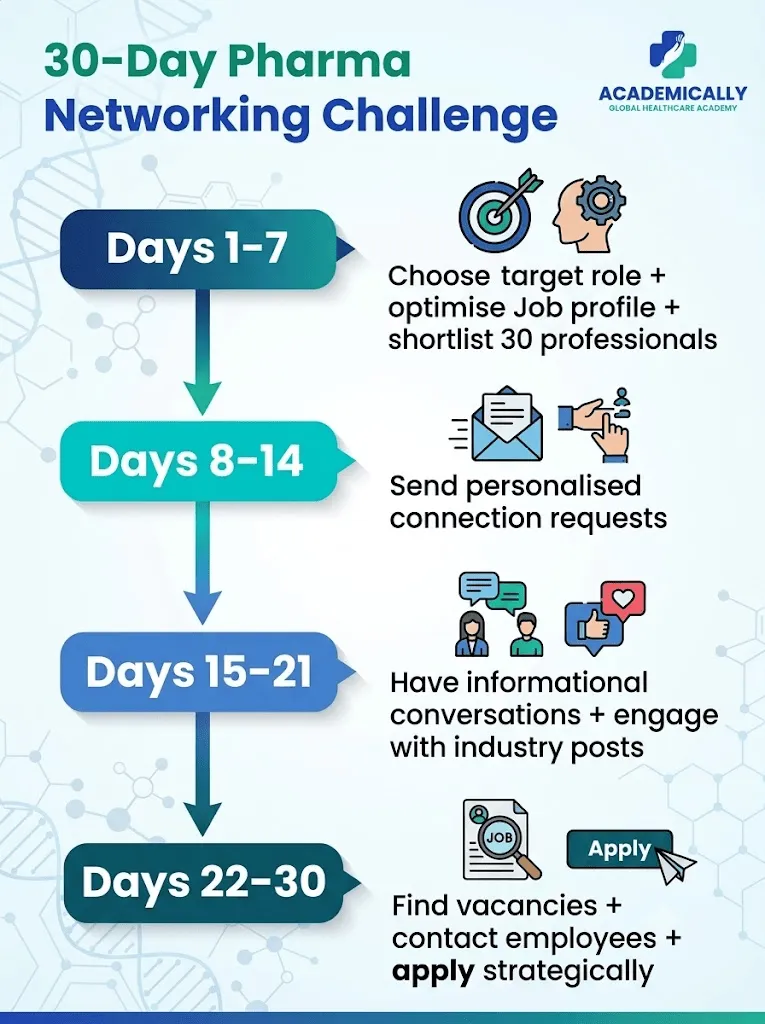
Track everything in a spreadsheet: name/company/role, date contacted, response, advice and next follow-up date. That small system can actually turn your networking activity into a real career strategy!
Add a measurable target such as:
30 professionals | 15 personalized messages | 3–5 meaningful conversations | 5–10 targeted applications
Final Thoughts: Your First Pharma Job May Start With A Conversation
Breaking into the industry without industry experience can seem daunting particularly when every job description asks for experience that no fresher has. I have learned that the answer is not to send the resume to 100 vacancies and hope for the best.
- Build a clear target
- Develop relevant skills
- Improve your professional visibility
- Have meaningful conversations with people already doing the work
- Then connect all of those pieces with a job search.
That is the power of networking for non-clinical pharma jobs. You do not need to know hundreds of people.
You need to know which people to learn from, how to approach them, how to demonstrate that you are serious about building the skills required for the role.
Your healthcare degree is not the end of your career story. It can be the scientific foundation on which you build an entirely new one.