You have passed the first major hurdle.
Your pharmacy qualification has been assessed, you have navigated the Australian registration pathway, and you are finally looking at the next stage: supervised practice.
This is where the journey starts to feel very real. You are working in an Australian pharmacy environment, learning how pharmacy services operate locally, building practical confidence, working under supervision and collecting the evidence needed for general registration.
Then, there is the number everyone talks about: 1,575 hours.
Before you open a spreadsheet and start counting shifts, there is something important you need to know. Your log is part of the evidence supporting your registration journey.
In this blog, I'll explain how to track your practice hours in Australia.
First, How Do You Reach the 1,575-Hour Supervised Practice Stage?
Let's start at the beginning.
Before you start logging hours, you need to understand how you reach the internship stage.
For many overseas-qualified pharmacists outside the countries covered by the Competency Stream, the Australian Pharmacy Council pathway involves clearing the Overseas Pharmacist Readiness Assessment. After the relevant assessment and Skills Assessment Outcome, you move towards provisional registration, approval of supervised practice and your internship.
To help you visualize how an overseas practitioner transitions from initial document verification all the way to supervised practice, here is the step-by-step roadmap:
Overseas pharmacy qualification
↓
APC Eligibility Check
↓
Overseas Pharmacist Readiness Assessment
↓
Skills Assessment Outcome
↓
Apply for provisional registration through AHPRA
↓
Arrange an approved supervised practice site and preceptor
↓
Obtain approval for supervised practice
↓
Enrol in an accredited Intern Training Program
↓
Begin supervised practice
↓
Track and document 1,575 approved hours
↓
Complete the Intern Training Program
↓
Pass the Intern Written and Oral Examinations
↓
Apply for general registration

Australian Pharmacy Council(APC) confirms that supervised practice is an eligibility requirement for general registration and that overseas-qualified pharmacists who complete the Knowledge Stream are required to complete an internship, an Intern Training Program and the relevant registration examinations.
When can you actually start counting hours?
Passing the Overseas Pharmacist Readiness Assessment does not mean every pharmacy shift immediately becomes eligible supervised practice.
APC states that after passing the Overseas Pharmacist Readiness Assessment, candidates move towards provisional registration and supervised practice with the Pharmacy Board through AHPRA. The practice site and preceptor arrangement must be appropriately approved.
What Is the Overseas Pharmacist Readiness Assessment?
The Overseas Pharmacist Readiness Assessment is the current Australian Pharmacy Council examination for overseas-trained pharmacists following the Knowledge Stream.
How should you prepare?
Focus on understanding the science and applying it to pharmacy-related situations rather than relying only on memorisation.
| Area | Preparation focus |
| Biomedical sciences | Disease processes and underlying science |
| Pharmaceutical sciences | Pharmacology, pharmaceutics and pharmacokinetics |
| Clinical sciences | Therapeutics and clinical application |
| Practice questions | Applying concepts to questions |
| Revision | Identifying and revisiting weak areas |
| Exam technique | Timed practice and question interpretation |
To build a rock-solid foundation and pass this critical exam on your first attempt, consider a dedicated course with live interactive lectures, comprehensive study materials, and mock exams designed by registered Australian pharmacists.
What Is Supervised Practice for a Pharmacy Intern?
Supervised practice is pharmacy practice undertaken under the direct supervision of a pharmacist who holds general registration.
Supervised practice is a mandatory period of professional workplace training designed to transition provisionally registered pharmacists into safe, independent practitioners. Under the National Law, the Pharmacy Board of Australia requires all prospective general practitioners to prove their applied clinical skills in real-world environments.
This training ensures that interns do not merely hold theoretical knowledge, but can apply Australian clinical guidelines, handle real-time patient interactions, manage complex dispensing software, and comply with state and territory medicines legislation.
| Aspect | Regulatory Detail |
| Governing Bodies | Pharmacy Board of Australia & AHPRA |
| Primary Requirement | 1,575 total hours of approved supervised practice |
| Target Audience | Provisionally registered intern pharmacists (overseas & domestic) |
| Approved Settings | Community pharmacies, hospital pharmacies, or approved clinical sites |
| Core Framework | AHPRA Supervised Practice Framework (combining direct & indirect supervision) |
Who needs supervised practice?
The exact pathway depends on your qualification and assessment stream, so you should confirm your pathway before accepting an internship arrangement.
| Candidate | What the pathway involves |
| Australian pharmacy graduate | Internship and supervised practice |
| Overseas pharmacist in the Knowledge Stream | Internship, supervised practice, ITP and examinations |
| Overseas pharmacist in the Competency Stream | Board-determined supervised practice rather than the standard internship pathway |
Where Can Pharmacy Supervised Practice Take Place?
Your practice site matters.
The Pharmacy Board's supervised-practice requirements state that at least 50% of the required supervised practice must be completed in a community pharmacy or hospital pharmacy department, unless the Board approves another arrangement. The Board also requires supervised-practice arrangements and premises to be approved.
You need an arrangement that supports the learning and practice requirements attached to registration.
Before accepting a position, check:
- Is the proposed practice site approved?
- Is there an approved preceptor?
- Can the required supervised practice be completed there?
- Will any rotations be properly incorporated into the approved arrangement?
- Will the workplace give you broad exposure to pharmacy practice?
It is also recommended that you network with pharmacists, attend internship events, visit pharmacies and use online employment platforms when looking for opportunities.
There is a reason networking matters.
Networking can put you into rooms where your application won't.
A job application can tell an employer your qualifications.
A professional conversation can help them understand your interests, communication skills and willingness to learn.
You can also watch this supervised-practice explainer as part of your preparation for this stage.
| Requirement / Standard | Official Details & Specifications | Key Checklist Items |
| 50% Rule | At least 50% of the total required supervised practice hours must be completed in an approved community pharmacy or hospital pharmacy department. Any non-standard arrangements for the remaining hours require explicit prior approval from the Board. | • Verify the venue type (Community or Hospital).
• Calculate planned hours to ensure ≥50% is in primary settings.
• Submit alternative site arrangements to the Board for approval prior to commencing. |
| Dual Approval | Both the premises and the supervised practice arrangement (including the preceptor assignment) must be formally approved by the Pharmacy Board before hours begin accruing. Hours worked prior to official approval cannot be counted toward registration. | • Confirm the pharmacy premises are currently approved.
• Submit the Supervised Practice Arrangement application early.
• Await formal written confirmation/approval before logging hours. |
| Preceptor Criteria | The assigned supervisor must meet strict eligibility standards, typically requiring General Registration as a pharmacist, at least 12 months of full-time practice in Australia within that setting, and no adverse regulatory conditions or restrictions on their practice. | • Confirm preceptor holds full General Registration.
• Ensure preceptor meets the 12-month minimum Australian practice requirement.
• Verify preceptor-to-intern ratio compliance. |
What Does the Preceptor Do?
Your preceptor is an important part of your internship.
The Pharmacy Board's requirements define the preceptor as part of the supervised-practice and training arrangement, while day-to-day supervision is provided by a pharmacist holding general registration. The preceptor arrangement and practice premises need Board approval.
A supportive preceptor can help you develop practical skills, receive feedback and understand how Australian pharmacy practice works.
That makes the choice of internship environment important from both a training and documentation perspective.
Guidance Plays A Huge Role
Navigating Australian healthcare culture, employer expectations, and regulatory compliance can feel daunting when working in a new country. Learning directly from professionals who have already navigated this exact path drastically reduces trial and error.
By enrolling with experienced guidance on Academically, you gain access to an extensive alumni network of overseas pharmacists successfully working across Australia. You can learn how to benefit from their personal experience, avoid common logbook documentation errors, and navigate workplace dynamics seamlessly.
You can directly connect with expert advisors through Academically Counselling to book a free consultation call and jump-start your Australian healthcare career.
Your Pharmacy Internship Hours Logbook in Australia
Now we get to the practical part.
The best system is to maintain your personal tracker alongside the Pharmacy Board's official record.
The Board's SPWR-60 Statutory Declaration of Weekly Record of Supervised Practice Hours is structured around weekly entries and includes the week starting and ending dates, hours worked, intern signature, preceptor signature, date of record and progressive total.
Your own spreadsheet can be more detailed.
Use this daily tracking structure
| Date | Workplace | Start | Finish | Break | Hours | Eligible hours | Supervisor |
| Monday | Approved site | 9:00 | 17:00 | 0.5 hr | 7.5 | 7.5 | Preceptor |
| Tuesday | Approved site | 9:00 | 17:00 | 0.5 hr | 7.5 | 7.5 | Preceptor |
| Wednesday | Approved site | 9:00 | 17:00 | 0.5 hr | 7.5 | 7.5 | Preceptor |
| Thursday | Approved site | 9:00 | 17:00 | 0.5 hr | 7.5 | 7.5 | Preceptor |
| Friday | Approved site | 9:00 | 17:00 | 0.5 hr | 7.5 | 7.5 | Preceptor |
At the end of the week, transfer the appropriate eligible total into the official weekly record.
How Should You Track Your 1,575 Hours?
Do not wait until the end of the internship to calculate your total.
Use a three-stage system.
Daily: Record
Write down your shift details while they are fresh.
Weekly: Reconcile
Compare your personal tracker with the official weekly record.
Check:
- Dates
- Hours
- Eligible hours
- Signatures
- Progressive total
Monthly: Audit
Look for gaps or inconsistencies. This habit makes the final declaration much easier to prepare.
| Milestone / Form | Total Accumulated Hours | Core Objective |
| Training Plan Approval | 0 Hours | Formally registers your practice site and principal supervisor with AHPRA. |
| Initial Progress Review | ~184 Hours (4 Weeks) | Verifies initial orientation, safety compliance, and software familiarity. |
| Midway Assessment | 750 Hours | Mid-way competency evaluation; required before sitting oral exams in some jurisdictions. |
| Final Completion Report | 1,575 Hours | Final sign-off confirming full completion of required practice hours. |
What Hours Should Not Be Counted?
This is one of the most important parts of your tracking system.
The Pharmacy Board's supervised-practice documentation states that the record should not include time such as annual leave, sick leave or public holidays that were not worked.
It also excludes clinical training completed as part of a pharmacy course and work at employment sites outside the approved supervised-practice arrangement.
Keep these categories separate
| Activity | Count it? |
| Approved supervised pharmacy practice | Yes |
| Eligible ITP seminar days | Where permitted |
| Annual leave | No |
| Sick leave | No |
| Public holiday not worked | No |
| University clinical placement | No |
| Unapproved external pharmacy work | No |
| Unapproved rotation | No |
What About Working at Another Pharmacy?
Imagine your approved internship is at Pharmacy A.
On a weekend, another pharmacy offers you a casual shift.
That does not automatically mean you can add those hours to your internship total.
The Board's documentation explains that work at another employment site cannot be counted unless the arrangement satisfies the supervised-practice requirements and is appropriately approved.
So before accepting additional work, check the supervised-practice arrangements first.
This is especially important for interns who want experience in both hospital and community settings.
What About Rotations?
Rotations can help you gain broader exposure to pharmacy practice, but they need to fit within the approved training arrangement.
The Board allows approved preceptors to incorporate rotations into an intern's training program, with additional approval required in certain circumstances.
Approved rotation → record the eligible hours Unapproved rotation → do not assume the hours count Keep copies of relevant approvals and training arrangements with your personal tracker. |
What Are the Hour Limits You Should Watch?
The Board's supervised-practice documentation requires supervised practice to be regularly undertaken and consistently.
It provides for a minimum of 80 hours and a maximum of 180 hours in any four consecutive calendar weeks, unless otherwise approved.
That means a four-week audit is especially useful.
Add eligible hours
↓
Review the four-week period
↓
Check the minimum and maximum requirements
↓
Investigate any unusual gap
↓
Confirm the progressive total
Do not try to “catch up” by simply adding every available shift without checking whether those hours satisfy the Board's rules.
AHPRA Supervised Practice Documents
AHPRA has broader supervised-practice resources, so it is easy to assume every supervised-practice document applies to pharmacy internships.
It does not.
AHPRA's Supervised Practice Framework provides a broader National Scheme framework for supervised practice and explains the responsibilities and expectations surrounding supervised practice.
It also publishes a Supervised Practice Report, but this is used in particular supervised-practice circumstances relating to matters such as health, performance or conduct. It is not the ordinary weekly pharmacy internship-hours log.
For pharmacy internship-hour tracking, the relevant document is the Pharmacy Board's SPWR-60 Statutory Declaration of Weekly Record of Supervised Practice Hours.
What Happens After You Complete Your 1,575 Hours?
Completing your 1,575 supervised practice hours is a major milestone, but one final bridge remains before you receive general registration: passing the Pharmacy Board of Australia's registration examinations.
APC confirms that interns become eligible for the Intern Written Exam after completing at least 75% of the required supervised-practice hours, subject to the applicable eligibility conditions.
How to Prepare for the Intern Written and Oral Exams
The Intern Written Exam is delivered by the Australian Pharmacy Council and assesses the knowledge, skills and understanding needed for safe and effective independent pharmacy practice. The current APC guide states that the exam contains multiple-choice and fill-in-the-blank questions across its assessed content areas.
For the Oral Exam, the Pharmacy Board's current candidate guide explains the examination process, assessment approach and preparation requirements. The oral examination forms part of the pathway to general registration for pharmacy interns.
Preparing for these final exams requires a different mindset than initial theoretical assessments. You must demonstrate fast, safe, and legally compliant decision-making in real time.
Joining a dedicated Australian pharmacist written and oral course equips you with structured case studies, mock oral stations, live feedback sessions, and legal practice drills to ensure you pass both examinations on your very first attempt.
Your Complete 1,575-Hour Tracking Workflow
The number on your spreadsheet is only useful when it is backed by valid, properly documented supervised practice.
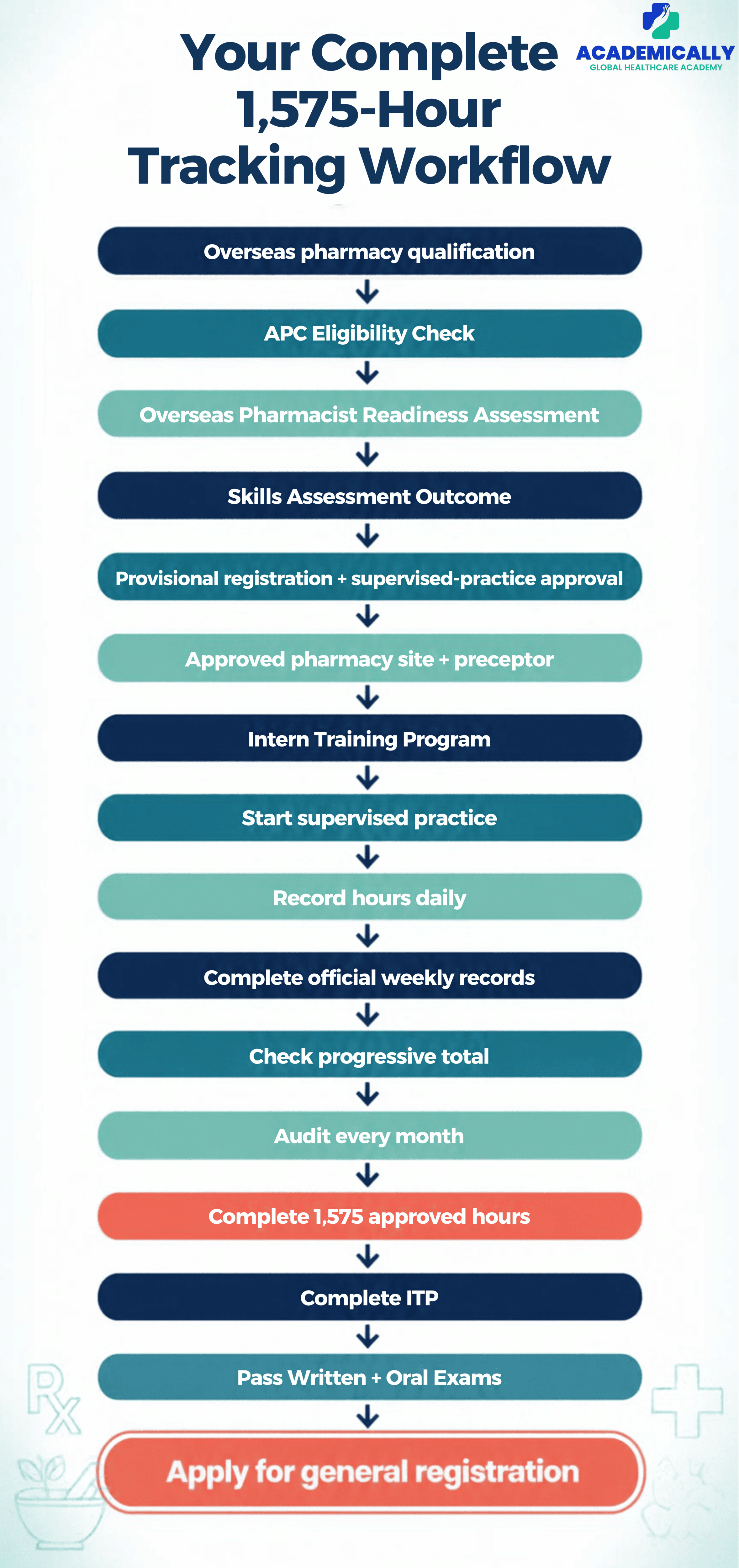
Track the right hours, record them consistently and check your documentation throughout the internship.
That is what turns your pharmacy internship logbook into useful evidence for your registration journey.