
The pharmaceutical industry is booming, and behind every life-saving drug, vaccine, or medical device is a complex web of legalities and compliance standards. If you hold a Bachelor of Pharmacy (BPharm) or a Doctor of Pharmacy (PharmD), you are already equipped with the foundational scientific knowledge required to navigate this space. One of the most promising options is Regulatory Affairs (RA), a field that combines pharmaceutical science, regulatory knowledge, documentation and communication.
A Regulatory Affairs Associate helps pharmaceutical companies navigate the complex requirements involved in developing, registering, manufacturing, and maintaining medicines and healthcare products. From preparing regulatory submissions to reviewing documents and communicating with regulatory authorities, RA professionals play an important role in bringing safe and effective products to market.
If you have completed BPharm or PharmD and are considering a transition into the pharmaceutical industry, you may be wondering how to become a regulatory affairs associate and whether you need additional qualifications or prior experience.
The good news is that BPharm and PharmD graduates can build a strong foundation for an entry-level RA career. The key is understanding the regulatory landscape, developing industry-relevant skills, gaining practical exposure, and targeting the right entry-level opportunities. This guide explains the pathway step by step.
What does a Regulatory Affairs Associate Do ?
Before understanding how to become regulatory affairs associate, it is very important for us to know what the role actually involves.
Regulatory Affairs Associates work on activities that ensure pharmaceutical products comply with applicable laws, regulations, and regulatory guidelines. Their responsibilities can vary depending on the company, product, and geographic market. Common responsibilities include:
- Preparing and reviewing regulatory documents.
- Supporting regulatory submissions
- Maintaining product registration information
- Compiling documents required for marketing authorization
- Reviewing product information and labeling
- Tracking regulatory commitments and submission timelines
- Conducting regulatory research
- Supporting responses to regulatory authority questions
- Maintaining regulatory databases
- Coordinating with teams such as Quality Assurance, Clinical Research, Pharmacovigilance, Medical Writing, and Manufacturing
- Monitoring changes in regulations and guidelines
An RA Associate may work on products intended for markets such as India, the United States, European Union, United Kingdom, Australia, Canada, or other international regions.
Why Choose Regulatory Affairs After BPharm or PharmD?
If you are BPharm or PharmD graduate you already have knowledge that can be relevant to regulatory work.
During pharmacy education, you may have studied subjects such as:
- Pharmaceutics
- Pharmacology
- Pharmaceutical chemistry
- Pharmacognosy
- Biochemistry
- Clinical pharmacy
- Drug safety
- Drug development
- Pharmaceutical analysis
This scientific foundation can help you understand regulatory documentation and communicate effectively with technical teams.
BPharm graduates
BPharm graduates can enter regulatory affairs through entry-level positions such as:
- Regulatory Affairs Associate
- Regulatory Affairs Executive
- Regulatory Affairs Trainee
- Regulatory Operations Associate
- Regulatory Documentation Associate
- Submission Publishing Associate
PharmD graduates
PharmD graduates may also find opportunities in regulatory affairs, particularly because of their clinical and pharmacotherapeutic background.Their knowledge can be useful when working with:
- Clinical documentation
- Safety information
- Product information
- Clinical sections of regulatory submissions
- Drug labeling
- Benefit-risk information
How to Enter Regulatory Affairs After Pharmacy ?
1. Understand the Regulatory Affairs Function
The first step is always to understand what regulatory affairs actually means. Regulatory affairs is much broader than simply "submitting documents."
A pharmaceutical product passes through multiple stages, including discovery, development, clinical research, regulatory review, approval, manufacturing, distribution, and post-marketing monitoring.
Regulatory professionals may support different stages of this lifecycle.For example, during development, RA professionals may help determine regulatory requirements for clinical trials or product development.During registration, they may help with the submission of documents.After approval, they may support variations, renewals, labeling updates, and other lifecycle activities.
Understanding this lifecycle will help you identify which part of RA interests you most.
2. Learn Major Regulatory Authorities
A strong RA professional needs to understand the regulatory environment in the markets they work with.Start by learning about major regulatory agencies, including:
- US FDA- United States
- EMA- European Union
- MHRA- United Kingdom
- CDSCO- India
- TGA- Australia
- Health Canada- Canada
You do not need to memorize every regulation when starting your career.Instead, understand:
- What the regulatory authority does
- What types of products it regulates
- How pharmaceutical products are approved
- What major submission pathways exist
- Where official guidelines can be accessed
3. Learn the Basics of Regulatory Submissions
One of the most important concepts to understand is the Common Technical Document (CTD).The CTD provides a standardized structure for organizing information submitted to regulatory authorities.It generally consists of five modules:
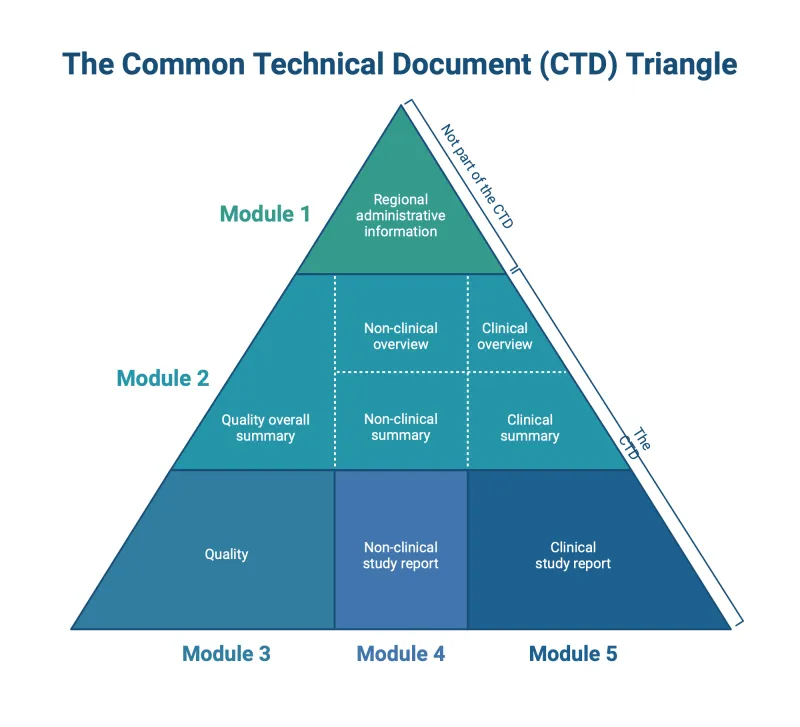
Module 1 – Administrative Information
This module contains region-specific administrative and prescribing information.
Module 2 – Common Technical Documents Summaries
This includes summaries of information presented in other modules.
Module 3 – Quality
This covers pharmaceutical quality information, including areas such as:
- Drug substance
- Drug Product
- Manufacturing
- Quality Control
- Stability
Module 4 – Non clinical Study Reports
This contains non clinical information, including pharmacology and toxicology data.
Module 5 – Clinical Study Reports
This contains clinical information and study reports.
As a fresher, you do not need to become an expert in every section. However, understanding how these modules fit together can significantly improve your interview preparation.
4. Develop Regulatory Affairs Skills
Knowing pharmaceutical science is only one part of becoming an RA professional. Along with that you also need practical skills.
Regulatory research
You should be comfortable finding and interpreting regulatory guidelines.Learn how to identify reliable sources and distinguish official regulatory information from outdated online content.
Documentation
Regulatory work involves extensive documentation.Develop strong skills in:
- Microsoft word
- Microsoft Excel
- Powerpoint
- Document formatting
- Version control
- Data organization
Attention to detail
A small error in a regulatory document can create significant problems.Develop the habit of checking:
- Dates
- Product names
- Dosages
- References
- Tables
- Formatting
- Document Versions
- Cross-references
Communication
RA professionals frequently coordinate with multiple departments.You may need to communicate with:
- Quality teams
- Clinical teams
- Manufacturing
- Pharmacovigilance
- Medical writing
- R&D
- Regulatory authorities
Therefore, written and verbal communication skills are extremely important.
5. Learn Important Regulatory Terminology
As a fresher, you should become familiar with commonly used terminology.Some useful concepts include:
- IND
- NDA
- ANDA
- BLA
- MAA
- CTD
- eCTD
- Marketing Authorization
- Variations
- Renewals
- Labeling
- Regulatory submissions
- Regulatory intelligence
- Post-approval changes
- Drug master files
- Good manufacturing practice (GMP)
- Good clinical practice (GCP)
Focus on understanding what each term means and where it fits into the product lifecycle.
6. Consider a Regulatory Affairs Course or Certification
A BPharm or PharmD degree gives you a strong foundation in pharmaceutical and healthcare sciences, but entering a competitive non-clinical career often requires additional industry-oriented skills. This is where upskilling can make a difference.
If you are planning to move beyond traditional clinical roles, consider exploring non-clinical courses by Academically that can help you understand alternative career pathways and develop skills relevant to the healthcare and pharmaceutical industry. Courses in areas such as Regulatory Affairs, Medical Writing, Pharmacovigilance, Clinical Research, and other non-clinical domains can help you identify the career path that best matches your interests while building practical, industry-relevant knowledge.
A regulatory affairs course can introduce you to:
- Regulatory frameworks
- Submission processes
- CTD/eCTD
- Regulatory documentation
- Global regulatory pathways
- Drug approval processes
- Post-approval activities
When choosing a course, look beyond the certificate. A useful program should ideally include practical assignments, regulatory document exercises, case studies, and exposure to real-world submission processes. A certificate alone will not guarantee employment. What matters is whether the training helps you demonstrate job-relevant knowledge.
For BPharm and PharmD graduates, continuous upskilling can also help bridge the gap between academic knowledge and industry expectations. As the pharmaceutical industry evolves, professionals who actively develop new skills can be better prepared to explore diverse career opportunities.
7. Gain Practical Experience
One of the biggest challenges for fresh graduates is the "experience required" barrier. You can address this by gaining practical exposure through:
- Regulatory affairs internships
- Pharmaceutical internships
- Regulatory documentation projects
- Academic projects
- Research projects
- Submission-related assignments
- Short-term industry training
For example, instead of simply mentioning "completed a regulatory affairs course" on your resume, you could demonstrate that you worked on a mock CTD dossier, researched a regulatory pathway, or analyzed regulatory requirements for a hypothetical pharmaceutical product.
8. Build a Regulatory Affairs-Focused Resume
Your resume should make it immediately clear that you are interested in regulatory affairs. Highlight relevant skills and projects. For example in skills section you can mention about - Regulatory knowledge, Technical skills, Professional skills. If you have completed any projects or internships, place them prominently on your resume.
9. Apply for the Right Entry-Level Roles
Once you have built your regulatory knowledge and updated your resume, the next step is finding relevant opportunities. Instead of limiting your search to generic job portals, you can explore healthcare and pharmaceutical opportunities through Jobslly, a platform designed to help healthcare professionals discover relevant career opportunities.
Jobslly can make your job search more focused by helping you find roles that match your education, skills, experience, and career interests. For BPharm and PharmD graduates, this can be particularly useful when looking for entry-level positions in areas such as Regulatory Affairs, Regulatory Operations.
Do not limit your search to the exact title "Regulatory Affairs Associate."Companies use different titles for similar entry-level functions.Search for positions such as:
- Regulatory affairs associate
- Regulatory affairs executive
- Regulatory affairs trainee
- Regulatory Operations associate
- Regulatory Submission associate
- Regulatory documentation associate
- Regulatory publishing associate
- Regulatory information manager associate
- Junior regulatory affairs associate
If you are a BPharm or PharmD graduate looking to enter Regulatory Affairs, regularly checking Jobslly alongside company career pages and professional networks can help you identify relevant openings and take the next step toward your pharmaceutical industry career.
Regulatory Affairs Career Growth After BPharm or PharmD
Regulatory Affairs can provide several career progression opportunities. Possible career pathway is:
Regulatory Affairs Trainee → Regulatory Affairs Associate → Senior Regulatory Affairs Associate → Regulatory Affairs Manager → Senior Manager → Associate Director/Director
However, career growth depends on the company, specialization, geographic market, performance, and experience. With experience you get to specialise in particular area.
BPharm vs PharmD: Which Is Better for Regulatory Affairs?
Both degrees can provide a pathway into RA.
| Factor | BPharm | PharmD |
| Pharmaceutical sciences | Strong foundation | Strong foundation |
| Clinical knowledge | Moderate | Strong |
| Drug development knowledge | Relevant | Relevant |
| Regulatory Affairs eligibility | Yes | Yes |
| Clinical regulatory work | Possible | Potential advantage |
| Additional regulatory training | Helpful | Helpful |
Your skills, regulatory knowledge, practical exposure, and ability to perform the role can be more important than the degree title alone.
Final Roadmap for Aspiring Regulatory Affairs Associates
If you are wondering how to become a regulatory affairs associate after BPharm or PharmD, think of the process as a combination of education + regulatory knowledge + practical exposure + job-ready skills.
A practical roadmap would look like this:
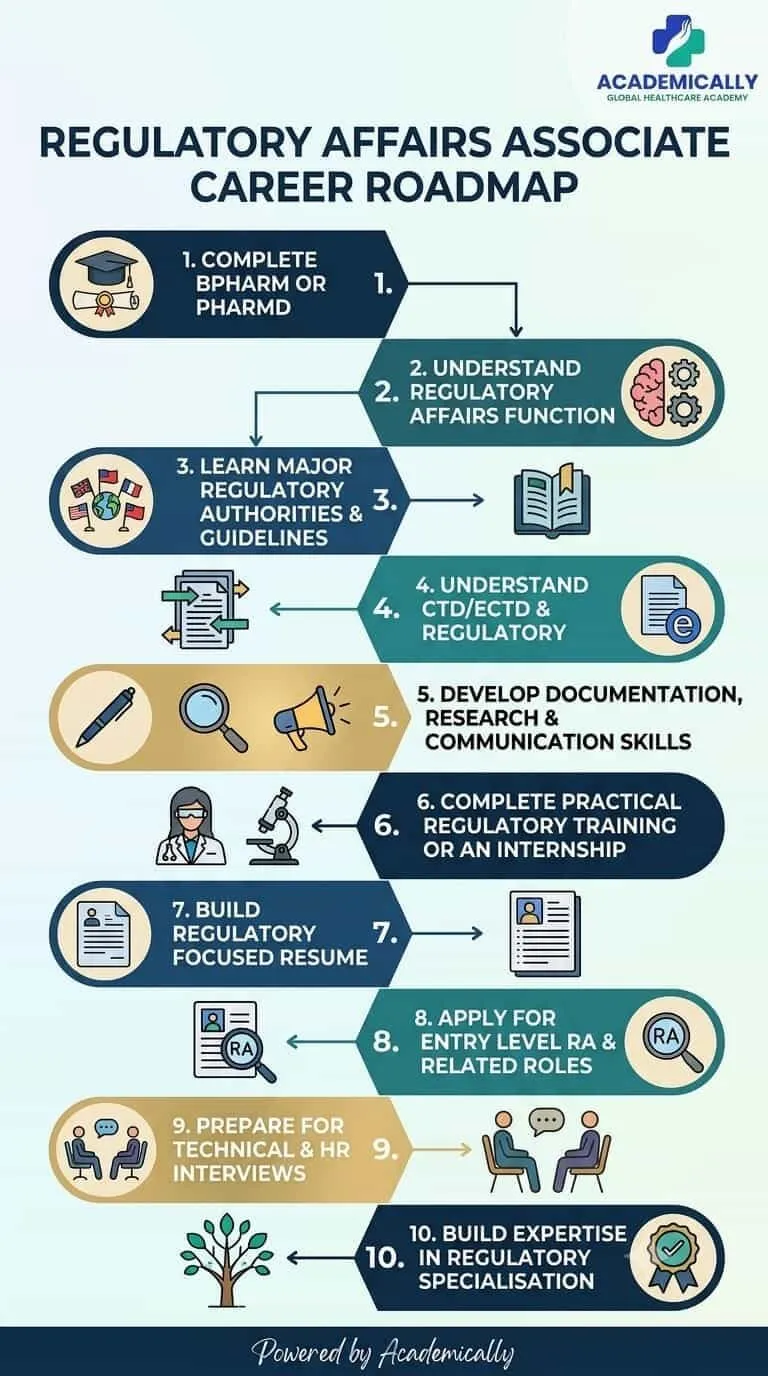
The transition from pharmacy education to regulatory affairs does not require you to know everything from day one. What matters is developing a solid understanding of the regulatory environment and demonstrating that you can learn, interpret information accurately, manage documentation, and work effectively with cross-functional teams.
For BPharm and PharmD graduates who want to build a career in the pharmaceutical industry beyond traditional pharmacy practice, Regulatory Affairs can be a valuable career pathway. Start by learning the fundamentals, gain practical exposure wherever possible, and target entry-level roles that allow you to build real regulatory experience.
With consistent upskilling and industry exposure, how to become a regulatory affairs associate becomes less about finding a single qualification and more about building the right combination of knowledge, skills, and experience.