Singapore offers good opportunities for pharmacists looking to gain international experience or earn higher salaries and work in clinical practice. However, there is one essential eligibility criterion for registering as a pharmacist in Singapore, which a number of overseas graduates fail to consider.
As a healthcare professional, I think that one should research the process of obtaining eligibility as a pharmacist in Singapore before investing in examination, university placements, or migration services.
The Singapore Pharmacy Council (SPC) is the relevant authority that oversees the registration process of pharmacists in Singapore. Contrary to some destinations for pharmacy professionals, there is no generic exam that overseas pharmacists can take and pass to qualify for registration in Singapore. A pharmacy graduate’s overseas qualification must be approved by the SPC initially.
Based on the updated list of overseas qualifications from 1 August 2020, pharmacists with degrees from 61 overseas universities in seven different countries are eligible to apply. The type of qualification and university play a role in determining eligibility, which means that merely graduating from an overseas institution in one of these countries is not sufficient.
This guide will walk you through the requirements, the list of approved universities, the stages of the registration, average salaries, and alternative options if your qualification is not eligible.
Check Whether Your Pharmacy Degree Is Recognised
Before you start planning your move, make sure whether the university you graduated from is on SPC's list of approved higher education institutions and whether the degree course you studied is on SPC's list.
The list contains universities in Australia, Canada, Ireland, Malaysia, New Zealand, the United Kingdom and the United States. However, not all the degrees offered by the listed universities are approved.
SPC notes that the pharmacy course must be completed within the country in which the main university is based. Courses at off-shore campuses and twinning arrangements may not be approved.
Is an Indian B.Pharm or Pharm.D accepted?
The list of published institutions does not include an Indian university. Therefore, an Indian B.Pharm or Pharm.D on its own will not be sufficient to meet this overseas qualification requirement for pharmacist registration in Singapore.
A good academic record, years of pharmacy experience or preparation for the Singapore registration examinations, by itself or together, cannot substitute for an unrecognised basic qualification. Verify your eligibility directly with SPC prior to investing in a proposed registration pathway.
Understand the Eligibility Requirements
Graduating from a listed institution is only the first step. Overseas-trained applicants must also meet SPC’s professional and employment requirements.
Generally, applicants need to:
- Hold the prescribed pharmacy qualification from a recognised institution and satisfy the applicable campus and course-location rules.
- Meet the relevant requirements concerning professional training, registration and a valid licence to practise in the country of study.
- Have at least three months of practical pharmacy experience at an SPC-approved training institution.
- Secure a pharmacist job offer from an SPC-approved training institution in Singapore.
- Pass both the Competency Examination and the Forensic Examination.
Evidence of English-language proficiency may also be required. SPC specifies this requirement for applicants whose pharmacy degree was obtained outside the UK, USA, Canada, Australia or New Zealand. Applicants from Universiti Sains Malaysia have an additional requirement concerning English proficiency within six months before application.
How to Become a Pharmacist in Singapore: Step-by-Step Process
Once you have established that your qualification meets SPC’s requirements, the registration process involves several stages.
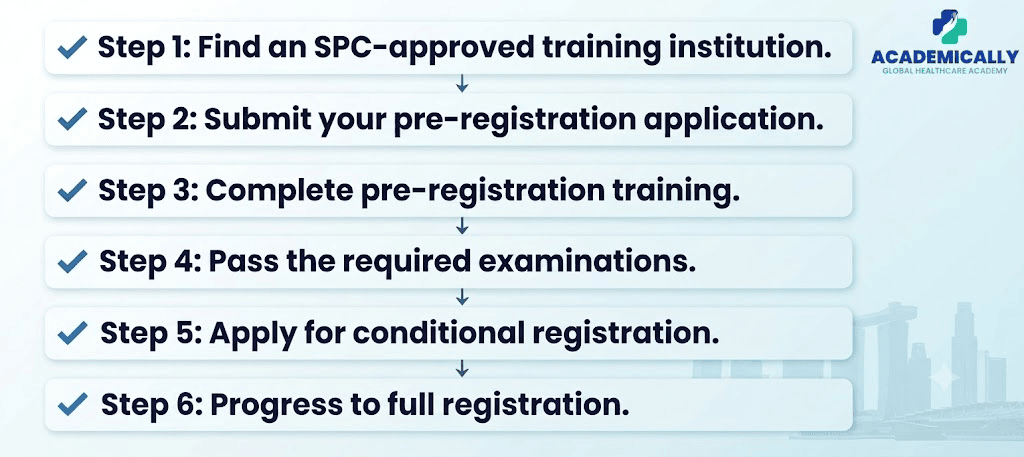
Step 1: Find an SPC-approved training institution
Identify hospitals, healthcare institutions or pharmacies approved by SPC for pre-registration training. You must secure employment as a pharmacist with an approved institution before your pre-registration application can be considered.
This is an important practical hurdle. Meeting academic requirements does not automatically guarantee a job offer, and SPC does not consider an application without one.
Step 2: Submit your pre-registration application
Apply online and prepare the required documents, which generally include:
- Employment offer from the approved training institution.
- Certified identification documents or passport.
- Certified pharmacy qualification certificate.
- Curriculum vitae detailing education, professional registration and work experience.
- Evidence of registration with an accepted foreign authority, where applicable.
- English-language proficiency evidence, where required.
- Academic transcript and verification of the period and location of pharmacy study.
- Certificate of Good Standing from the relevant registration authority, where applicable.
Certain documents including transcript, university verification letter and Certificate of Good Standing must be submitted directly to SPC by the relevant institutions or authorities.
A straightforward application will require between two to four weeks processing once all required documents have been received and are in order. This excludes the time required to secure employment, and obtain an employment pass.
Wait for SPC’s formal Confirmation Letter before commencing pre-registration training.
Step 3: Complete pre-registration training
Pre-registration training takes place at an SPC-approved training institution and lasts three to twelve months.
During this time, you must acquire the professional competencies required for practice in Singapore, and demonstrate that you can work safely within the local healthcare system.
Your training preceptor will assess your performance against SPC’s competency standards and submit the end-of-training evaluation.
Step 4: Pass the required examinations
Overseas-trained applicants must pass two examinations:
Forensic Examination: Tests knowledge of Singapore’s pharmacy laws and relevant professional requirements.
Competency Examination: Assesses the knowledge and competencies required for safe pharmacy practice.
A minimum passing mark of 60 for each examination and a maximum of three attempts for each examination with a fee of S$300 that is approximately 22,790 INR per examination sitting is specified.
Passing both examinations is necessary, but applicants must also complete the minimum training period and meet the applicable competency standards.
Step 5: Apply for conditional registration
Having completed training and achieved a satisfactory assessment of performance, you may then apply for the Conditional Registration upon receipt of directions from SPC.
The published registration fee is S$250 which is approximately around 18,991 INR in addition to the applicable practising certificate fee.
Conditional registration is granted for a period of at least 12 months. During this time, you must work at an SPC-approved training institution under the supervision of a fully registered pharmacist with at least three years of working experience. Supervisory assessment reports must be submitted to SPC at six-monthly intervals.
Step 6: Progress to full registration
Once the required conditional registration period has been satisfactorily completed, you will be informed to apply for full registration.
Full registration grants you the right to practice without the restrictions attached to conditional registration, subject to the applicable practising certificate and professional requirements.
How long does the entire process take?
A realistic time frame must factor in more than just processing of applications.
| Stage | Indicative duration |
| Pre-registration application | 2–4 weeks after complete documents are received |
| Pre-registration training | 3–12 months |
| Conditional registration | At least 12 months |
| Job search, documentation and employment formalities | Additional time; varies by applicant |
The training and conditional registration stages alone can take at least 15 months when the minimum periods apply. Job hunting, examinations, administrative requirements and immigration formalities can add significantly to the time frame.
What Is the Salary of a Pharmacist in Singapore?
Salary is undoubtedly a key factor in any decision to pursue an overseas career option. However, I would weigh up earning potential alongside registration eligibility, living expenses, employment conditions and long-term growth potential.
The following figures are indicative monthly salary ranges:
| Career Stage | In S$ | In USD | In INR |
| Entry-level pharmacist | S$3,500–S$4,500 | 2,735 to 3,517 | 2.65 lakh to 3.41 lakh |
| Mid-career pharmacist | S$4,500–S$5,750 | 3,517 to 4,494 | 3.41 lakh to 4.36 lakh |
| Senior or specialist pharmacist | S$6,000–S$6,500+ | 4,689 to 5,080+ | 4.55 lakh to 4.93 lakh+ |
Actual pay varies by employer, experience, role and practice setting.
Hospital, clinical, community and specialist jobs can pay different amounts and offer great chances to grow. You should also look at benefits, shift times, bonuses and other working rules when you compare offers.
Remember one point: salary numbers matter only if your qualification and situation let you register.
Complete list of overseas pharmacy qualifications approved by SPC
The following overseas qualifications and universities are approved by Singapore Pharmacy Council as of 1 August 2020.
| Country | Institution | Registrable Qualification |
| Australia | School of Pharmacy and Biomedical Sciences, Curtin University | Bachelor of Pharmacy / Master of Pharmacy |
| Australia | School of Pharmacy and Pharmacology, Griffith University | Bachelor of Pharmacy / Master of Pharmacy |
| Australia | Faculty of Pharmacy and Pharmaceutical Sciences, Monash University | Bachelor of Pharmacy |
| Australia | School of Biomedical Sciences and Pharmacy, The University of Newcastle | Bachelor of Pharmacy |
| Australia | School of Pharmacy, The University of Queensland | Bachelor of Pharmacy |
| Australia | School of Pharmacy and Medical Sciences, University of South Australia | Bachelor of Pharmacy |
| Australia | Sydney Pharmacy School, University of Sydney | Bachelor of Pharmacy / Master of Pharmacy |
| Australia | Faculty of Health and Medical Sciences, The University of Western Australia | Master of Pharmacy |
| Canada | Faculty of Pharmacy and Pharmaceutical Sciences, University of Alberta | Baccalaureate in Pharmacy |
| Canada | Faculty of Pharmaceutical Sciences, The University of British Columbia | Baccalaureate in Pharmacy / Doctor of Pharmacy |
| Canada | College of Pharmacy, Dalhousie University | Baccalaureate in Pharmacy |
| Canada | College of Pharmacy, University of Manitoba | Baccalaureate in Pharmacy |
| Canada | College of Pharmacy and Nutrition, University of Saskatchewan | Baccalaureate in Pharmacy |
| Canada | Leslie Dan Faculty of Pharmacy, University of Toronto | Baccalaureate in Pharmacy / Doctor of Pharmacy |
| Ireland | School of Pharmacy and Pharmaceutical Sciences, Trinity College Dublin | Bachelor of Science (Pharmacy) |
| Malaysia | School of Pharmaceutical Sciences, Universiti Sains Malaysia* | Bachelor of Pharmacy |
| New Zealand | School of Pharmacy, The University of Auckland | Bachelor of Pharmacy |
| New Zealand | School of Pharmacy, University of Otago | Bachelor of Pharmacy |
| United Kingdom | Aston Pharmacy School, Aston University | Master of Pharmacy |
| United Kingdom | Department of Pharmacy and Pharmacology, University of Bath | Master of Pharmacy |
| United Kingdom | School of Pharmacy and Medical Sciences, University of Bradford | Master of Pharmacy |
| United Kingdom | School of Pharmacy and Pharmaceutical Sciences, Cardiff University | Master of Pharmacy |
| United Kingdom | School of Pharmacy, University of East Anglia | Master of Pharmacy |
| United Kingdom | Dept. of Pharmacy and Forensic Science, King's College London | Master of Pharmacy |
| United Kingdom | UCL School of Pharmacy, University College London | Master of Pharmacy |
| United Kingdom | Faculty of Biology, Medicine and Health, University of Manchester | Master of Pharmacy |
| United Kingdom | School of Pharmacy, University of Nottingham | Master of Pharmacy |
| United Kingdom | School of Pharmacy, Queen's University Belfast | Master of Pharmacy |
| United Kingdom | School of Pharmacy and Life Sciences, Robert Gordon University | Master of Pharmacy |
| United Kingdom | Strathclyde Institute of Pharmacy and Biomedical Sciences | Master of Pharmacy |
| United States | College of Pharmacy, The University of Arizona | Doctor of Pharmacy |
| United States | School of Pharmacy and Pharm. Sciences, University at Buffalo (SUNY) | Doctor of Pharmacy |
| United States | Skaggs School of Pharmacy, University of California, San Diego | Doctor of Pharmacy |
| United States | School of Pharmacy, University of California, San Francisco | Doctor of Pharmacy |
| United States | School of Pharmacy, University of Connecticut | Doctor of Pharmacy |
| United States | College of Pharmacy, University of Florida | Doctor of Pharmacy |
| United States | College of Pharmacy, University of Georgia | Doctor of Pharmacy |
| United States | College of Pharmacy, University of Illinois at Chicago | Doctor of Pharmacy |
| United States | College of Pharmacy, The University of Iowa | Doctor of Pharmacy |
| United States | School of Pharmacy, The University of Kansas | Doctor of Pharmacy |
| United States | College of Pharmacy, University of Kentucky | Doctor of Pharmacy |
| United States | College of Pharmacy, University of Michigan | Doctor of Pharmacy |
| United States | College of Pharmacy, University of Minnesota | Doctor of Pharmacy |
| United States | School of Pharmacy, The University of Mississippi | Doctor of Pharmacy |
| United States | Eshelman School of Pharmacy, UNC at Chapel Hill | Doctor of Pharmacy |
| United States | School of Pharmacy, Northeastern University | Doctor of Pharmacy |
| United States | College of Pharmacy, The Ohio State University | Doctor of Pharmacy |
| United States | College of Pharmacy, Oregon State University | Doctor of Pharmacy |
| United States | School of Pharmacy, University of Pittsburgh | Doctor of Pharmacy |
| United States | College of Pharmacy, Purdue University | Doctor of Pharmacy |
| United States | College of Pharmacy, The University of Rhode Island | Doctor of Pharmacy |
| United States | Ernest Mario School of Pharmacy, Rutgers University | Doctor of Pharmacy |
| United States | School of Pharmacy, University of Southern California | Doctor of Pharmacy |
| United States | School of Pharmacy, Temple University | Doctor of Pharmacy |
| United States | College of Pharmacy, The University of Texas at Austin | Doctor of Pharmacy |
| United States | College of Pharmacy, The University of Utah | Doctor of Pharmacy |
| United States | School of Pharmacy, Virginia Commonwealth University | Doctor of Pharmacy |
| United States | School of Pharmacy, University of Washington | Doctor of Pharmacy |
| United States | College of Pharmacy and Pharm. Sciences, Washington State University | Doctor of Pharmacy |
| United States | Eugene Applebaum College of Pharmacy, Wayne State University | Doctor of Pharmacy |
| United States | School of Pharmacy, University of Wisconsin-Madison | Doctor of Pharmacy |
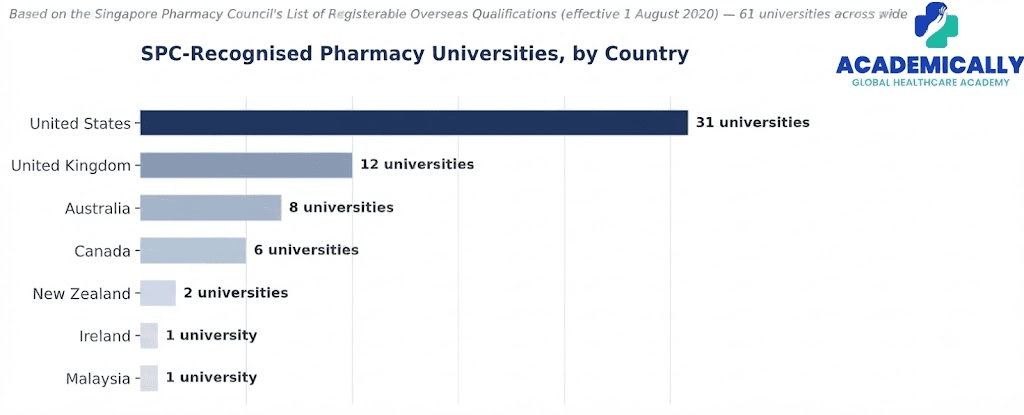
Important: The names above are not a blanket approval of every degree or campus associated with each university. SPC’s list specifies the relevant qualifications and imposes campus and course-location conditions. Its registration guidance also contains transitional provisions concerning the previous list of recognised schools. Applicants affected by changes to that list should seek confirmation from SPC about their individual circumstances.
What If Your Pharmacy Degree Is Not on the Recognised List?
This is where you need to plan your career.
If your qualification is not recognised the official FAQ from SPC says there are no courses or exams that will make that same qualification ready for registration.
You should think about two paths.
Option 1: Check a recognised pharmacy qualification
Some schools on the list give postgraduate pharmacy courses. However, not every Master’s degree or postgraduate program will meet SPC rules.
Before you pay tuition fees, confirm the qualification, university, campus and course layout with SPC. A new qualification should be considered a substantial educational investment, not a guaranteed shortcut to registration.
Option 2: Explore another country’s registration pathway
Your current pharmacy degree might fit better in another country. Many pharmacists look at Australia, New Zealand and Ireland. Germany could also be a choice if you can meet its language and professional rules.
Every country has its own regulator, qualification assessment, exams, training needs and work authorisation rules. You must check eligibility for each country separately and do not assume a degree accepted in one place will work in another.
At Academically Global, our practical approach is to identify the qualification you already hold, establish which destinations offer a realistic pathway and compare the time, cost and professional requirements before committing to a plan.
My advice is simple: pick your destination from eligibility and a real career plan – not just, from salary hopes.
Common Mistakes to Avoid
Before you start your Singapore pharmacist journey, avoid these mistakes:
- Assuming every pharmacy degree from a recognised country is accepted.
- Checking the university name without checking the qualification given.
- Missing campus, course location or twinning program limits.
- Studying for exams before you know you are eligible.
- Assuming a job offer means you will register.
- Underestimating the time needed for pre‑registration training and conditional registration.
- Relying on lists or unofficial advice instead of checking SPC’s present rules.
A careful eligibility check can save you a lot of time, money and worry.
Final Thoughts
Becoming a pharmacist in Singapore can be a worthwhile professional goal, but the pathway begins with a regulatory eligibility check—not an examination booking or relocation plan.
As a healthcare professional, I encourage every pharmacy graduate to verify their exact qualification, review the official SPC requirements and secure an approved employment opportunity before investing in the registration process.
Ready to explore your options?Academically Global can help you assess your existing qualifications and compare realistic international career pathways before you commit to your next step.