Medical graduates and pharmacy professionals often believe that their main career options are limited to a clinical career, residency, hospital, pharmacy or pharmaceutical sales. The healthcare industry has a route for using their scientific knowledge without the need for day-to-day patient care: Medical Information.
Medical Information Officers or Medical Information Specialists work with clinical evidence to respond to medical and product-related questions, conduct literature searches, evaluate and interpret evidence, scientific response writing, content review and other collaborations with Medical Affairs, Pharmacovigilance, Regulatory Affairs and other stakeholders.
Medical Information becomes important for MBBS, PharmD, BPharm, MPharm, BDS, life-science and other healthcare graduates who want to move into pharma or other non-clinical healthcare careers.
How to become a Medical Information Officer after MBBS or PharmD?
The answer is not as simple as putting the degree on a CV. This requires a mix of core pharmaceutical expertise and the skills needed for evidence appraisal, scientific response writing, literature searching, documentation and knowledge of the pharmaceutical industry.
What does a Medical Information Officer do?
Medical Information is a function within the pharmaceutical and healthcare world, which makes sure that there is evidence-based, balanced, current and properly shared information on medicines, diseases, treatments and product-related questions.
Depending on the company, a Medical Information professional can:
- Respond to medical and scientific questions.
- Conduct structured literature searches.
- Review studies, guidelines and regulatory information.
- Prepare evidence-based responses.
- Keep standard response documents, FAQs and scientific content.
- Support medical review and approval processes.
- Collaborate with Pharmacovigilance teams when a safety-related issue comes up from a question.
- Escalate events or product complaints according to company rules.
- Collaborate with Medical Affairs, Regulatory Affairs, Clinical Research and Commercial functions.
- Keep records of medical questions and answers.
Medical Information roles involve evidence-based responses, literature searches, response documents, question recording, content assessment and escalating adverse events or product complaints when needed.
A Medical Information professional basically answers the question: what does the available scientific evidence say about this medicine, disease, treatment or clinical question?
Is Medical Information a good career option after MBBS or PharmD?
Your MBBS or PharmD is a valuable starting point for a career in Medical Information. You already know medical terminology, pharmacology, the science of diseases, treatment principles, evidence and patient considerations.
The difference is that a strong healthcare degree is a base, but not a complete set of skills.
An MBBS graduate may struggle with workflows, medical query management and documentation.
A PharmD graduate may need to build skills in evidence appraisal, literature searching, scientific writing, compliance and corporate communication.
Employers often look beyond the qualification, testing the candidate’s ability to interpret evidence, communicate complex information, learn therapeutic areas and work according to set processes.
Medical Information can be a starting point for a healthcare career, including Medical Affairs, Medical Writing, Pharmacovigilance, Scientific Communications, Regulatory Affairs and Clinical Research.
How to develop skills required for Medical Information Officer?
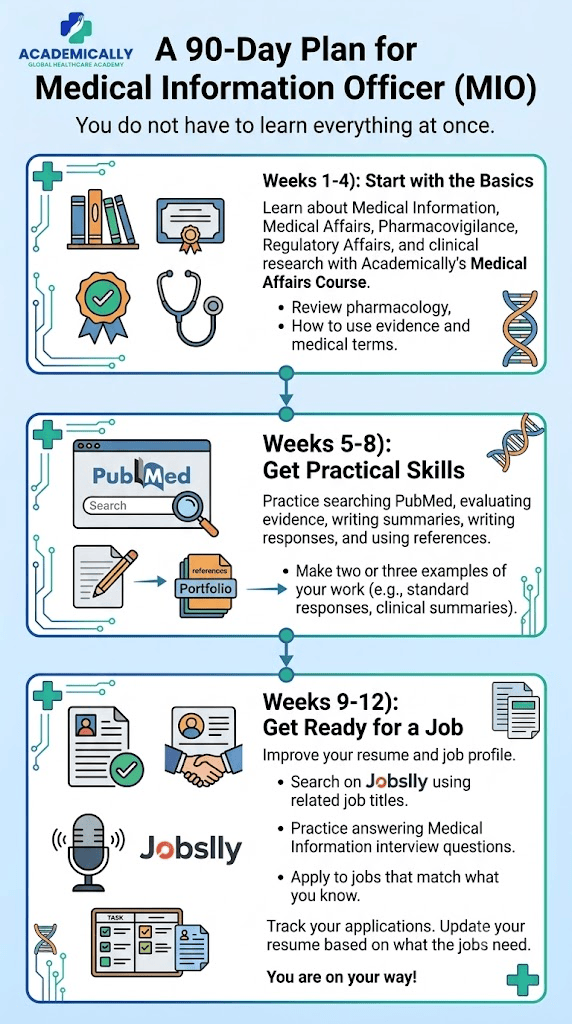
Medical Information overlaps with areas of Medical Affairs which means a structured Medical Affairs training can help you understand how scientific information is handled in the pharmaceutical industry.
Academically’s Medical Affairs Certification Course includes Medical Information and Scientific Communication in its classes along, with Medical Affairs basics, clinical trials, evidence generation, KOL management, insights generation, publication strategy and a hands-on project.
The program can be especially helpful when your challenge is not knowledge but industry readiness.
The course also includes real-life projects training that focuses on your career, help with your resume and preparation for interviews and access to Jobslly as part of its job help system.
Dr. Akram’s perspective adds a practical dimension to understanding what Medical Information professionals actually do. Here is a polished section that can be inserted into the blog:
Expert Insights: What Makes Medical Information Different?
According to Dr. Akram Ahmad, one of the most distinctive aspects of a Medical Information role is the ability to communicate scientific knowledge without directly turning the conversation into a product promotion.
He recalls attending a conference in Sydney where a Medical Information Officer was presenting research and explaining a scientific topic to the audience. Rather than directly promoting the company or its products, the professional focused on presenting the available scientific evidence, explaining the research findings, and helping the audience understand the subject in an objective and educational manner.
Dr. Akram explains that this approach reflects an important characteristic of Medical Information: the emphasis is on scientific evidence and education rather than direct promotion.
This distinction makes Medical Information particularly relevant to healthcare professionals who enjoy research, scientific communication, evidence evaluation, and independent work.
Dr. Akram also highlights another potential advantage of this career path: its suitability for professionals who prefer a relatively focused work environment rather than constant face-to-face interaction. According to his observation, many Medical Information opportunities can be structured as remote or hybrid roles, depending on the organisation and position. This can provide professionals with greater flexibility to work from a comfortable environment while still contributing to scientific and healthcare-related activities.
For professionals who are more reserved, prefer focused work, or enjoy communicating through research and structured scientific content rather than frequent networking, Medical Information may therefore offer a career environment worth exploring.
The role ultimately combines medical or pharmaceutical knowledge, scientific research, structured communication, and evidence-based thinking—making it a potential fit for healthcare professionals seeking a non-clinical career that remains closely connected to science.
How to Become a Medical Information Officer: Step-by-Step
Step 1: Check your eligibility
An MBBS or PharmD provides a relevant scientific foundation for Medical Information careers.
Other healthcare backgrounds can also be relevant depending on the job. Current Medical Affairs and Medical Information pathways include healthcare and life-science professionals although eligibility varies from one employer and position to another.
Your degree should demonstrate that you understand:
- Anatomy and physiology
- Pathophysiology
- Pharmacology
- Therapeutics
- Clinical terminology
- Disease management
- Evidence-based medicine
Your next task is to learn how that knowledge is used in the pharmaceutical industry.
Step 2: Understand the pharmaceutical industry
Moving from a hospital, clinic or academic setting into pharma requires a way of thinking.
Learn how major functions interact:
Research & Development → Clinical Trials → Regulatory Affairs → Medical Affairs → Pharmacovigilance → Commercialisation → Post-marketing Medical Information
Medical Information can be closely connected to the Medical Affairs world.
You should understand concepts such as development, regulatory approval, post-marketing surveillance, pharmacovigilance, Standard Operating Procedures, medical review, scientific communication and compliance.
This knowledge can help you answer an interview question like: where does Medical Information fit within the organisation?
Step 3: Build medical literature search skills
Literature searching is one of the most important practical skills in Medical Information.
You should be comfortable with sources such as:
- PubMed
- Google Scholar
- Cochrane Library
- Clinical practice guidelines
- Regulatory authority websites
- Product labels and prescribing information
- Peer-reviewed journals
- Clinical trial databases
Knowing how to find a paper is not enough. You need to decide if the evidence is relevant, reliable, recent and applicable to the question being asked.
You need to learn to identify study design, population, intervention, comparator, outcomes, limitations and meaningful results.
Step 4: Learn evidence-based response writing
A Medical Information response cannot simply copy information from a research paper.
The professional must understand the question, find evidence, interpret it correctly and share the findings in a balanced way.
A strong response should generally be:
Accurate + Evidence-based+ Clear + Balanced + Relevant + Appropriately referenced
Your clinical knowledge helps you to understand the evidence. Your communication skills determine whether another healthcare professional can quickly understand the answer.
This is why scientific writing and medical communication skills can greatly increase your chance of getting a job.
Step 5: Understand safety and compliance responsibilities
Medical Information professionals may deal with questions involving events, product quality complaints, off-label use or other information that needs to be reported.
You should understand why companies use set procedures for handling these situations.
Learn the basics of:
- Pharmacovigilance
- Adverse event reporting
- Product complaints
- Medical review
- Documentation
- Standard Operating Procedures
- Data privacy
- Regulatory compliance
These basics can make your profile more industry-ready.
Step 6: Develop communication skills
Medical Information is not only about reading scientific papers. You must learn to explain information clearly.
Imagine a doctor asking about evidence around a drug in a specific patient group. Your answer should explain the evidence without exaggerating conclusions or adding opinions.
Practice explaining:
- Clinical trial results
- Drug mechanisms
- Safety data
- Treatment guidelines
- Systematic reviews
- Pharmacovigilance concepts
in simple structured language.
Strong communication becomes essential when working with doctors, pharmacists, patients, internal medical teams and other people involved.
Skills You Need to Become a Medical Information Officer
A strong profile combines scientific knowledge + industry knowledge + communication skills.
Essential scientific skills
You should know pharmacology, therapeutics, disease areas, clinical research, evidence-based medicine and medical terms.
Research skills
Literature searching, evaluating evidence, managing references, reading critically and putting information together are beneficial.
Writing skills
You need to be able to write scientific responses, summaries, FAQs, medical content and evidence-based explanations.
Industry skills
Build knowledge of Medical Affairs, Pharmacovigilance, Regulatory Affairs clinical development, compliance and pharmaceutical processes.
Soft skills
Attention to detail, time management, communication, teamwork, structured thinking and the ability to learn therapeutic areas are important.
What Job Titles Should MBBS and PharmD Graduates Search For?
Learning what the role involves is only one part of the transition. Finding relevant vacancies is the next challenge.
Jobslly is a healthcare-focused job platform that lists opportunities across hospitals, pharmaceutical companies, CROs, health-tech organisations, and other healthcare employers. Its current platform includes categories for Medical Affairs, Pharmacovigilance, doctors, pharmacists, and other non-clinical roles.
Use Jobslly strategically rather than applying randomly. One of the job-search mistakes is using only the exact phrase Medical Information Officer.
Companies can use names for similar or closely related jobs. Search for terms such as:
- Medical Information Associate
- Medical Information Specialist
- Medical Information Analyst
- Medical Information Writer
- Medical Information Executive
- Medical Communications Associate
- Scientific Communications Associate
- Medical Affairs Associate
- Medical Affairs Specialist
Then compare each job description with your current skill set.A focused application to a relevant vacancy is usually more useful than submitting the same CV to dozens of unrelated healthcare jobs.This wider search approach can help you find job openings.
Do you need experience before applying?
Not always.
Fresh MBBS and PharmD graduates can look for entry-level healthcare and pharmaceutical jobs. The exact experience needed depends on the company and job posting.
A common issue is that your degree shows your foundation but recruiters also want proof that you can do industry-specific tasks.
That is where a portfolio can help.
Make three samples:
Sample 1: A literature search on a set clinical question.
Sample 2: A one-page evidence-based response using peer-reviewed studies.
Sample 3: A scientific summary explaining clinical evidence in a particular area.
These samples give you something to talk about in an interview.
MBBS vs PharmD: Who has a chance?
Both degrees can offer advantages.
MBBS graduates often have knowledge of how to think about patients, how to diagnose and how diseases work.
PharmD graduates often know a lot about how medicines work, how to use them and how to manage care with medicines.
Neither degree automatically means a job in Medical Information.
The best person is the one who has their science background and adds knowledge about the industry, how to find information, how to write, how to talk and how to work in situations.
Final thought
The answer to how to become a Medical Information officer is not just finishing MBBS or PharmD and applying. Your degree gives you a science base. Your next step is to learn how that knowledge is used in the Medical Information process.
Get better at searching for articles, judging evidence, writing work, talking about medical issues, knowing about safety, following rules and understanding the drug industry. Add projects to show what you can do and look for jobs that are beyond the same title.
Formal training in Medical Affairs can help you connect what you learned in school with what the industry needs, while a healthcare-focused site, like Jobslly can help you find the jobs more easily.
The goal is not to forget your pharmacy knowledge. It is to use that knowledge to do work that is based on evidence and can change how healthcare is done.