Moving to Canada as an Indian healthcare professional does not always have to mean starting the licensing journey immediately. When I started exploring the non-clinical side of healthcare, I realised that my professional degree could be useful beyond direct patient care. The same way a dentist can use clinical knowledge in medical writing, research or healthcare consulting, doctors, pharmacists, nurses, physiotherapists and life-science graduates can also build careers outside the clinic.
That is why non‑clinical healthcare jobs Canada for Indians have become a career path for people who want to engage with healthcare without depending entirely on Canadian clinical license.
I also believe that many international healthcare professionals miss: immigration, licensing and employability are three different things. A healthcare professional may not have a licence to practise as a clinician but may qualify for specific industry roles depending on the employer, requirements and work authorization.
This guide explains how to approach the Canadian market, which roles to target, the skills to develop and how platforms such as Academically and Jobslly can intersect.
Can Indian healthcare professionals work in Canada without a clinical licence?
Yes, potentially. It depends on the role.
Canada requires internationally trained professionals to complete credential recognition and licensing requirements when entering a regulated occupation. The country specifically advises trained professionals to check the regulator for the province or territory where they plan to work.
That is different from aiming for an industry role such as writing, clinical research, regulatory affairs or healthcare analytics.
I would therefore avoid asking, "I am a dentist so I can only work as a dentist in Canada." A useful question is:
Which Canadian healthcare roles value my clinical knowledge without requiring me to practise as a licensed clinician?
That shift in thinking opens possibilities.
Non‑clinical healthcare jobs in Canada that Indians can explore
The roles I would consider vary depending on my background, previous experience, communication ability and additional industry skills.
| Career area | Relevant Indian backgrounds | Skills that matter |
| Medical Writing | MBBS, BDS, PharmD, life sciences | Scientific writing, literature review, evidence interpretation |
| Clinical Research | Doctors, dentists, pharmacists, nurses, life sciences | GCP, clinical trials, documentation, research coordination |
| Pharmacovigilance | MBBS, BDS, PharmD, B.Pharm, life sciences | Drug safety, adverse-event processing, MedDRA, ICH guidelines |
| Regulatory Affairs | Pharmacy, medicine, dentistry, life sciences | Regulatory documentation, submissions, compliance |
| Clinical Data Management | Healthcare and life-science graduates | Data quality, EDC, documentation, database processes |
| Medical Information | Doctors, dentists, pharmacists | Literature evaluation, scientific communication |
| Health Policy & Research | Healthcare, public health and life-science backgrounds | Research, analysis, policy writing |
| Healthcare Content | Healthcare professionals with writing skills | SEO, medical communication, patient education |
| Medical Devices | Doctors, dentists, pharmacists, biomedical backgrounds | Product knowledge, clinical interpretation, communication |
Each has entry requirements and an employer can still ask for Canadian experience, a specific qualification or previous industry exposure.
Medical writing: one pathway I would seriously consider
Medical writing appeals to me because healthcare professionals already know medical terminology, disease processes and scientific literature.
A medical writer may work on content, scientific documents, technical material, manuscripts, regulatory documents or healthcare communications depending on the organisation.
When I started medical content writing I realized that clinical knowledge alone is not enough. I had to learn to turn information into content that is accurate, easy to read, well organized and useful.
The medical writing job requires writing skills, digital literacy and reading comprehension. Therefore an Indian healthcare professional can strengthen the transition by building a portfolio rather than simply putting a degree on a resume.
I would create examples such as:
- A literature‑based healthcare article
- A patient education piece
- A scientific summary
- A clinical research explainer
- A drug‑safety sample
A portfolio can give Canadian employers evidence of what you can actually produce.
Clinical research is another important route
Clinical research can be especially relevant for healthcare professionals because the transition does not cut ties completely with medicine.
Possible roles include Clinical Research Coordinator, Clinical Research Associate, research assistant and clinical trial support positions.
I would learn the basics of:
GCP→ clinical trial phases → informed consent → study documentation → protocol compliance → safety reporting → data integrity.
My healthcare degree gives the foundation. Industry‑specific training shows how research operates within an environment.
Pharmacovigilance and drug safety
Pharmacovigilance is another career I would explore for a pharmacist, PharmD, doctor or healthcare professional who cares about medication safety.
The work can include adverse‑event case processing, medical assessment, safety narratives, signal detection, risk‑management activities and regulatory reporting.
An international healthcare professional can strengthen the profile by understanding:
ICH guidelines, MedDRA, adverse‑event terminology, case processing, causality assessment and safety reporting workflows.
The important point is that I would not assume that my clinical qualification automatically makes me job‑ready. Canadian employers may look for candidates who understand how pharmaceutical companies and CROs actually operate.
That is where targeted upskilling can make a difference.
Regulatory affairs can be a strong industry option
Another area I would keep on the shortlist is regulatory affairs.
Regulatory professionals work with product submissions, compliance requirements, documentation and interactions with frameworks. Pharmaceutical, biotechnology, medical‑device and healthcare companies all have functions.
The current national wage data places the median hourly wage at CAD 44.10 for regulatory affairs role.
Someone targeting this area should learn the basics of strategy, documentation, compliance and the Canadian healthcare product environment instead of relying on clinical credentials.
Health policy and healthcare research are worth exploring too
My career research has also made me look beyond pharmaceutical companies.
Healthcare professionals can explore research institutes, public‑health organisations, consulting firms, universities and government‑related roles.
Different roles like health‑policy research, consulting and programme‑officer roles are listed across Canada. The national wage data for this occupation shows a median of CAD 43.08 per hour. Compensation varies by location, experience and employer.
Research skills become especially valuable here. I would focus on literature review, evidence synthesis, data interpretation, healthcare systems and professional writing.
How Upskilling can help Indian Healthcare Professionals
I personally believe structured upskilling can make the transition easier because healthcare professionals often know medicine but have limited exposure to industry workflows.
Academically’s non‑clinical programmes cover areas such as Medical Affairs, Pharmacovigilance, Medical Writing, Clinical Drug Development, Clinical Research, HEOR, Clinical Data Management and Market Research. These programmes focus on industry skills, capstone projects, mentorship and job assistance. Completion awards 180 CPD points that are valid for five years according to Academically’s current programme information.
The useful part of this training is that it helps me understand the terminology, workflows and expectations of industry roles before I apply internationally.
This can be especially important for a doctor, dentist or pharmacist whose existing CV is heavily clinical.
Separate licensing process from career planning
This is one of the biggest lessons I would pass to an Indian healthcare professional planning Canada.
Clinical licensing should be a separate decision from non‑clinical career planning.
Suppose I am an Indian BDS graduate. I may eventually decide to pursue Canadian dental licensure. That does not mean I have to sit idle until every licensing step is complete.
I can simultaneously develop skills in writing, clinical research, pharmacovigilance, healthcare content or medical devices.
The Canadian government states that foreign credential recognition and licensing requirements depend on occupation and province or territory. An Educational Credential Assessment can be required for immigration pathways such, as Express Entry.
That distinction can save international professionals a lot of confusion.
How to build a Canada-ready resume
One mistake I notice healthcare professionals make is creating a CV that reads like a clinical resume even when they apply for an industry role.
A Canadian non‑clinical resume should link my healthcare experience to the actual requirements of the employer.
Instead of writing:
"Diagnosed and treated patients."
I would translate that experience into skills such as:
"Reviewed clinical information, kept accurate records explained complex medical concepts and supported evidence‑based decision‑making.”
That shift does not mean exaggerating experience. It means presenting existing experience in a language that fits the target role.
I would also include:
Target job title + technical skills + relevant certifications + research/writing projects + measurable achievements + portfolio links.
Where to search for non-clinical healthcare jobs in Canada
I would use Jobslly as part of my job‑readiness strategy.
Jobslly describes itself as a healthcare‑focused job platform that covers doctors, pharmacists, nurses, BDS dentists and other healthcare professionals. It includes categories such as pharmacovigilance, medical affairs and other non‑clinical roles. Its current listings are mainly focused on opportunities in India.
That detail matters.
I would use the platform to learn what employers are currently asking for in non-clinical healthcare roles, identify skill gaps and gain relevant industry experience before applying to international positions.
Academically’s non‑clinical programmes also link learners to Jobslly for job assistance.
That creates a practical sequence:
Healthcare degree → industry upskilling → relevant project or experience → stronger resume → targeted applications → international career move.
Along with that, I would also explore government-based websites and some company career pages to stay updated.
Canada Job Bank: useful for labour‑market information, occupational requirements, wages and current vacancies.
Company career pages: pharmaceutical companies, CROs, biotechnology companies, medical‑device organisations, healthcare technology companies, universities and research institutions can all be relevant.
Professional networking: informational conversations can help me understand how a role actually works in Canada before I apply.
My search terms would also be specific. Instead of simply typing "healthcare jobs Canada " I would search for:
- Medical Writer Canada
- Clinical Research Associate Canada
- Clinical Research Coordinator Canada
- Pharmacovigilance Associate Canada
- Regulatory Affairs Associate Canada
- Medical Information Specialist Canada
- Clinical Data Manager Canada
- Health Policy Analyst Canada
That approach gives me a much clearer picture of the actual market.
Work authorization matters as much as your qualification
A strong resume cannot compensate for missing work authorization.
Canada has different categories of work permits, including employer-specific and open work permits. An employer-specific permit generally requires a job offer, while an open work permit does not require one in the same way. Eligibility depends on the individual's immigration circumstances.
I would therefore make my immigration status clear and truthful on my application.
I would never write “eligible to work in Canada” unless I can genuinely support that statement.
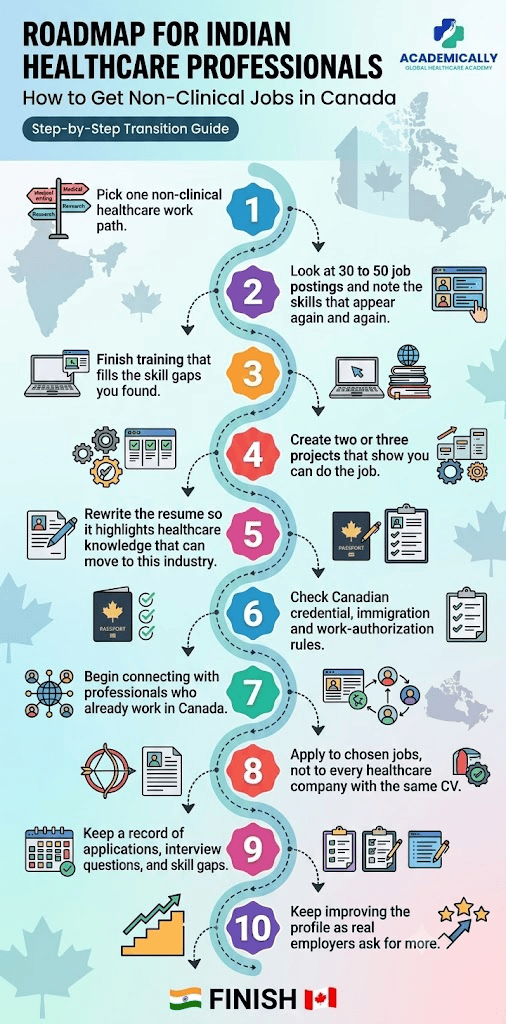
Final thoughts
My biggest takeaway from moving toward non-clinical healthcare work is that a healthcare degree does not have to lock you into one job title.
A BDS, MBBS, PharmD, nursing or life‑science qualification can become the foundation for careers in research, medical communication, drug safety, regulatory affairs, healthcare technology and other fields. Canada can offer opportunities in this field.
A clinical degree does not automatically become an industry job and a non‑clinical course does not replace work authorization real experience or employer demands.
The strongest approach, in my view, is to combine healthcare expertise + industry-specific skills + Canadian-market research + a targeted resume + legitimate work authorization.
That is how I would approach non‑clinical healthcare jobs, in Canada for Indians—not to escape healthcare but to use my healthcare background in a way while building a career that follows the professional direction I want.