Recently, I came across a story on social media about an MBBS graduate who reportedly cleared the Foreign Medical Graduate Examination (FMGE) after the 26th attempt. Twenty-six attempts!
First, congratulations to the candidate. The determination to continue despite repeated setbacks deserves recognition. Not everyone has the patience, financial resources or emotional strength to keep going after so many unsuccessful attempts. But the story also made me think about thousands of foreign medical graduates preparing for FMGE and wondering what their professional future will look like if they cannot clear it.
Over the last few days, I have received several messages from MBBS graduates following the latest FMGE results. Some are celebrating. Others are disappointed. Many are asking questions that go beyond the examination:
- Should I attempt FMGE again after multiple failures?
- Can I get a job in India after MBBS abroad without FMGE?
- Can I work in Australia or the USA without clearing FMGE?
- Are there non-clinical jobs for MBBS graduates who studied abroad?
- Can I earn a good salary without practising clinical medicine?
- Is moving into the pharmaceutical industry a practical career decision?
My message is simple:
FMGE is an important examination, but it should not be the only career plan for every MBBS graduate. Your medical education has value beyond one examination. The challenge is understanding where that value can be applied.
Let's explore the available possibilities.
FMGE After 26 Attempts: Persistence or Delayed Career Growth?
The Foreign Medical Graduate Examination is a screening examination conducted by the National Board of Examinations in Medical Sciences (NBEMS). It applies to eligible Indian citizens and Overseas Citizens of India (OCIs) holding foreign primary medical qualifications who seek the relevant registration to practise medicine in India. Candidates must secure at least 150 marks out of 300 to qualify. There is nothing wrong with attempting FMGE multiple times. Every candidate has different circumstances, preparation requirements and career ambitions.
However, repeated attempts can have consequences:
- Financial pressure: Examination fees, coaching expenses, accommodation and preparation resources add up.
- Delayed career growth: Several years spent preparing may postpone entry into professional employment.
- Family expectations: Graduates may feel pressure to justify the investment made in overseas medical education.
- Emotional stress: Repeated unsuccessful results can affect confidence and motivation.
- Uncertainty: Without an alternative plan, candidates may find it difficult to decide what to do next.
This does not mean that another FMGE attempt is necessarily a bad decision. If you are consistently improving, identifying your knowledge gaps and getting closer to the qualifying score, another structured attempt may be reasonable. But if you have attempted the examination repeatedly without meaningful progress, it may be time to reassess your preparation strategy and career direction. A Plan B is not an admission of failure. It is responsible career planning.
FMGE Pass Percentage Trends: June 2022 to October 2026
How has the FMGE pass percentage changed over the last few years?
The following data presents the reported pass percentages across selected FMGE sessions between June 2022 and October 2026. The figures show considerable variation between examination sessions, highlighting the challenges candidates face when preparing for the screening examination.
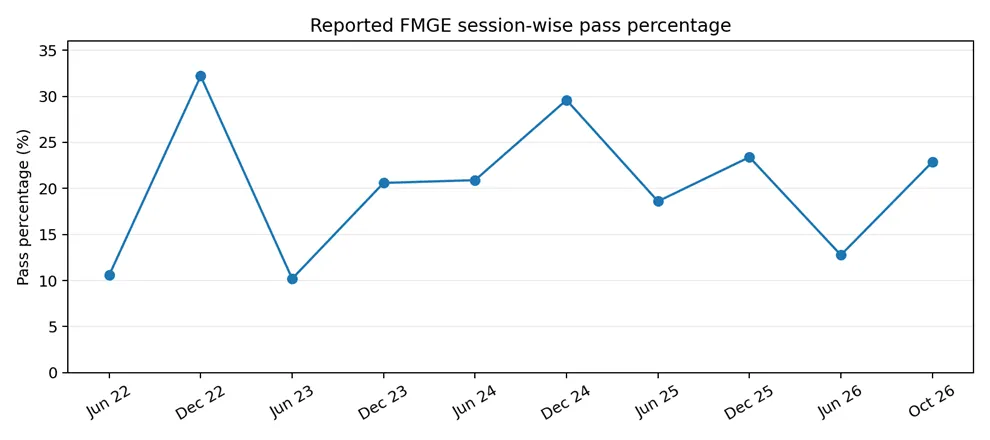
| Examination session | Reported pass percentage |
| June 2022 | 10.6% |
| December 2022 | 32.2% |
| June 2023 | 10.2% |
| December 2023 | 20.6% |
| June 2024 | 20.9% |
| December 2024 | 29.6% |
| June 2025 | 18.6% |
| December 2025 | 23.4% |
| June 2026 | 12.77% |
| October 2026 | 22.87% |
Source note: Historical percentages are a working secondary-source compilation and should be verified against NBEMS result notices or reliable contemporaneous reporting before publication. October 2026 figures are based on the reported pass/fail outcomes, excluding absent and withheld candidates.
What Do the Latest FMGE Results Tell Us?
The October 2026 FMGE results offer an important perspective on the challenges foreign medical graduates face. NBEMS declared the October 2026 results on 10 November 2026. The examination was conducted on 31 October 2026. The reported result figures are:
| Result category | Number of candidates |
| Total candidate entries | 42,113 |
| Passed | 9,354 |
| Failed | 31,539 |
| Absent | 1,190 |
| Results withheld | 30 |
| Pass percentage | 22.87% |
The 22.87% pass percentage is calculated using candidates with declared Pass or Fail outcomes (9,354 + 31,539). Absent and withheld candidates are excluded. In other words, more than three out of every four candidates with declared results did not qualify in this session.
These numbers should not be interpreted as an indication that foreign medical graduates lack the ability to become competent doctors. They demonstrate the difficulty of a particular screening examination.
They also raise an important career-planning question: should every graduate put every other professional possibility on hold until FMGE is cleared? I do not believe so.
Why Do So Many Foreign Medical Graduates Focus Only on FMGE?
There are several reasons. First, most students who pursue MBBS abroad intend to return to India and practise medicine. Their families have often invested substantial time and money in overseas education with this expectation.
Second, clinical practice is the most familiar career destination. Medical students spend years studying anatomy, physiology, pathology, pharmacology and clinical subjects. They naturally associate their degree with becoming a practising doctor.
Third, many graduates have limited exposure to the pharmaceutical and healthcare industries.
They may not know that medical graduates can contribute to:
- Pharmaceutical research and development.
- Medical Affairs and scientific communication.
- Drug safety and pharmacovigilance.
- Clinical trials and clinical operations.
- Medical education and scientific publications.
- Healthcare technology and medical content.
FMGE is important for the relevant Indian registration route. However, it does not determine every possible application of a medical qualification. The important distinction is between practising medicine independently and working in a non-clinical healthcare or pharmaceutical industry role. The latter may be possible without FMGE, depending on the employer, responsibilities and eligibility criteria.
International Clinical Career Options After MBBS Abroad: AMC Australia and USMLE USA
What if you still want to practise clinical medicine but do not want your entire career to depend on FMGE?
You can investigate international medical licensing pathways. Two prominent options for eligible international medical graduates are Australia's AMC pathway and the USMLE route in the United States. However, remember that these are independent licensing systems. Clearing FMGE is not a prerequisite for Australian or US medical registration, but neither pathway automatically grants you the right to practise.
Australian Medical Council (AMC) Pathway
Australia offers opportunities for eligible international medical graduates through different assessment pathways. For graduates considering the Standard Pathway, the general process involves:
- Check medical school eligibility: Confirm that your medical school, primary qualification and graduation year meet the applicable requirements.
- Create an AMC account: Establish an AMC portfolio where applicable.
- Complete primary-source verification: Have the required medical credentials verified through the applicable process.
- Pass the AMC CAT MCQ examination: Demonstrate the required medical knowledge across relevant clinical disciplines.
- Complete the clinical assessment: Pass the AMC Clinical Examination or an eligible AMC-accredited Workplace-Based Assessment (WBA).
- Proceed with registration requirements: Meet the relevant Medical Board of Australia and Ahpra requirements for the registration you are seeking.
The WBA option is not simply an alternative examination that any candidate can select immediately. It requires an eligible clinical position and acceptance into an accredited WBA programme.
The Standard Pathway is not the only pathway available. Some international medical graduates may qualify for other routes depending on their qualifications and experience.
Important: AMC certification and medical registration are separate stages. Candidates must meet the applicable registration requirements before practising as doctors in Australia.
United States: USMLE Pathway
The United States offers another clinical career pathway through the United States Medical Licensing Examination (USMLE). International medical graduates must first check whether their medical school and graduation year meet the applicable ECFMG eligibility requirements. The general route involves:
- Check medical school eligibility: Your medical school must have the appropriate ECFMG Sponsor Note in the World Directory of Medical Schools.
- Apply for ECFMG Certification: Complete the relevant application and medical education credential requirements.
- Pass USMLE Step 1: Demonstrate foundational medical science knowledge.
- Pass USMLE Step 2 CK: Demonstrate clinical knowledge and its application.
- Meet ECFMG clinical and communication requirements: Fulfil the applicable Pathways requirements, including the required OET Medicine performance where applicable.
- Obtain ECFMG Certification: Complete the requirements for certification.
- Apply for residency: Participate in the competitive US residency application and selection process.
The USMLE registration process for international medical graduates changed in January 2026. International candidates now register through the Federation of State Medical Boards (FSMB), while ECFMG continues to determine certification eligibility. Passing Step 1 and Step 2 CK does not guarantee a residency position. Candidates must also consider residency competitiveness, training requirements and subsequent state medical licensing requirements.
For graduates who want to build a clinical career in the United States, USMLE can be worth investigating, provided they meet the eligibility criteria and are prepared for the time and financial commitment.
Non-Clinical Jobs for MBBS Graduates Without FMGE
This is an area that deserves considerably more attention. A medical degree does not restrict you to hospital-based clinical practice. Pharmaceutical companies, biotechnology organisations, clinical research companies and healthcare organisations need professionals who understand medical science. Some of these organisations recruit MBBS graduates for roles that do not require FMGE. Here are six career areas worth exploring.
You can also explore current non-clinical healthcare vacancies on Jobslly, a healthcare-focused job portal that helps candidates discover opportunities across pharmaceutical, research and healthcare organisations.
Medical Affairs
Medical Affairs is one of the most relevant career areas for MBBS graduates interested in the pharmaceutical industry. Medical Affairs teams work at the intersection of medical science, clinical evidence, healthcare professionals and pharmaceutical products. Their responsibilities may include:
- Scientific communication and medical information.
- Reviewing clinical evidence and published research.
- Supporting medical education initiatives.
- Developing scientific presentations and educational materials.
- Communicating product-related scientific information.
- Supporting medical strategy and evidence generation.
Medical Affairs professionals help ensure that scientific information is communicated accurately and responsibly. MBBS graduates with good clinical knowledge, scientific understanding and communication skills may find this field worth exploring.
Possible growth: Medical Affairs Associate → Medical Advisor → Medical Affairs Manager → Medical Affairs Director.
Medical Science Liaison (MSL)
Medical Science Liaison is another career option for medical graduates who enjoy scientific discussions and professional engagement. An MSL typically works with healthcare professionals, researchers and key opinion leaders to facilitate scientific exchange. Responsibilities may include:
- Discussing clinical trial data and published evidence.
- Responding to scientific queries within approved responsibilities.
- Conducting scientific presentations.
- Building professional relationships with healthcare experts.
- Communicating medical insights to internal teams.
- Supporting scientific and medical education initiatives.
Unlike a conventional pharmaceutical sales representative, an MSL role is primarily focused on scientific engagement rather than product selling. Employers may look for therapeutic-area knowledge, strong communication skills, relevant experience and an understanding of clinical evidence.
Possible growth: Medical Information Associate → Medical Science Liaison → Senior MSL → Medical Affairs Leadership.
An MSL position may not always be an entry-level opportunity. Graduates may need to develop relevant experience through Medical Information, Medical Affairs or related scientific roles.
Pharmacovigilance and Drug Safety
Every medicine has a safety profile that needs continuous monitoring. Pharmacovigilance focuses on identifying, assessing, understanding and preventing adverse effects and other medicine-related problems. MBBS graduates can explore roles such as:
- Drug Safety Associate.
- Pharmacovigilance Associate.
- Safety Case Processing Associate.
- Medical Information Associate.
- Drug Safety Specialist.
Typical responsibilities include adverse event case processing, safety documentation, medical terminology review, literature monitoring and regulatory reporting support.
Some physician-level medical reviewer positions have additional qualification, registration or experience requirements.
A graduate entering this field should understand adverse event reporting, seriousness and causality assessment, safety databases and Good Pharmacovigilance Practices.
Clinical Research and Clinical Trials
Clinical research is another career option for graduates who are interested in how medicines, medical devices and treatments are developed and evaluated. Clinical trials involve several stages, from early investigations to larger studies assessing safety and efficacy. Possible job roles include:
- Clinical Trial Assistant.
- Clinical Research Coordinator.
- Clinical Research Associate (CRA), subject to experience and employer requirements.
- Clinical Operations Associate.
- Clinical Data Management Associate.
- Regulatory Affairs Associate.
A medical background can be useful when understanding clinical protocols, patient eligibility, medical terminology and research documentation. Knowledge of Good Clinical Practice (GCP), clinical trial phases, study protocols and research ethics can help candidates prepare for these roles.
Medical Reviewer
Medical reviewers examine medical information, clinical records, scientific documents or healthcare-related content, depending on the position. Their work may involve:
- Reviewing medical records.
- Assessing clinical documentation.
- Checking medical accuracy.
- Reviewing healthcare claims or case information.
- Evaluating scientific content.
- Supporting clinical documentation and quality processes.
However, the term Medical Reviewer covers different responsibilities across employers. Some positions may accept MBBS graduates without FMGE, while others require active medical registration, additional credentials or specific experience.
Always check the job description before applying.
Medical Writing and Medical Communications
If you enjoy explaining medical concepts, interpreting research and communicating scientific information, Medical Writing may be another option.
Medical writers contribute to several types of healthcare and pharmaceutical content, including:
- Clinical study reports and research documentation.
- Scientific manuscripts and publications.
- Medical education materials.
- Medical communication documents.
- Literature reviews.
- Scientific presentations.
- Patient education content.
Medical writing requires more than good English.
A candidate should be able to interpret research, understand clinical evidence, distinguish reliable scientific findings from unsupported claims and communicate information accurately. A portfolio of relevant scientific writing samples can be useful when applying for entry-level opportunities.
What Can Non-Clinical MBBS Jobs Pay in India?
One of the most common questions I receive from foreign medical graduates is whether they can earn a respectable salary without clearing FMGE. The answer is yes, but expectations should be realistic. Non-clinical salaries vary considerably depending on the organisation, job responsibilities, city, experience, technical knowledge and communication skills. The following figures are illustrative career-planning estimates, not verified national averages or guaranteed starting packages.
| Career area | Illustrative annual salary |
| Medical Affairs | ₹5-12 LPA |
| Medical Science Liaison | ₹6-15 LPA |
| Pharmacovigilance / Drug Safety | ₹3.5-8 LPA |
| Clinical Research | ₹3.5-8 LPA |
| Medical Reviewer | ₹4-10 LPA |
| Medical Writing | ₹4-10 LPA |
Important salary disclaimer: These ranges are indicative estimates for career exploration. Actual compensation may be lower or higher depending on the employer, role, experience, location and qualifications. Senior positions and specialised medical reviewer roles may have different requirements and compensation structures. These figures should not be interpreted as guaranteed fresher packages.
A key point worth understanding is that your MBBS degree may help you enter the industry, but it does not automatically qualify you for every specialised position.
For example, a Medical Affairs Associate and an experienced Medical Affairs Manager have very different responsibilities. Similarly, an entry-level Drug Safety Associate and a physician medical reviewer are not interchangeable positions.
Your skills, experience and professional development will influence your career growth.
How Can MBBS Graduates Prepare for Non-Clinical Jobs in Four to Six Months?
Suppose you have decided to explore the pharmaceutical industry while continuing to consider your FMGE options. Where should you start?
The first step is to identify a specific career area. Trying to prepare for Medical Affairs, Clinical Research, Drug Safety and Medical Writing simultaneously may leave you with fragmented knowledge.
A focused four-to-six-month learning period can help some graduates develop foundational knowledge and role-specific competencies. However, training duration alone does not determine job readiness or employment outcomes.
Here is how you can approach the preparation.
Month 1: Understand the Industry and Choose Your Career Direction
Start by understanding how pharmaceutical and healthcare organisations operate. Explore the responsibilities of different departments, the types of positions available and the skills employers expect.
Choose one primary career direction based on your interests and existing strengths.
Month 2: Build Your Technical Knowledge
Focus on the fundamentals of your selected field. For Medical Affairs and MSL preparation, this may include:
- Scientific communication.
- Clinical data interpretation.
- Therapeutic-area knowledge.
- Medical presentations.
- Clinical evidence evaluation.
For Clinical Drug Development, this may include:
- Drug development stages.
- Clinical trial phases and design.
- Good Clinical Practice.
- Clinical trial documentation.
- Pharmacovigilance fundamentals.
- Regulatory and research processes.
Month 3: Develop Practical Skills
Move beyond theoretical learning. Practise interpreting clinical studies, preparing scientific presentations, reviewing medical documents and explaining clinical concepts.
For Medical Writing, develop writing samples. For Clinical Research, become familiar with protocols and trial documentation. For Drug Safety, understand adverse event case processing and safety reporting.
Month 4: Build Your Professional Profile
Your CV should communicate more than your MBBS qualification.
Highlight:
- Medical and scientific knowledge.
- Research exposure.
- Clinical internships and relevant experience.
- Communication skills.
- Technical training.
- Projects and practical assignments.
Develop a professional LinkedIn profile and begin networking with people working in your selected field.
Months 5-6: Prepare for Interviews and Apply
Start applying for relevant entry-level opportunities while continuing to improve your skills. Practise explaining your transition from clinical education to the pharmaceutical industry. Be prepared to answer questions such as:
- Why do you want to move into Medical Affairs?
- How can an MBBS background contribute to Clinical Research?
- What is the difference between Pharmacovigilance and Drug Safety?
- How would you interpret a clinical study?
- What do you understand about the responsibilities of an MSL?
Structured preparation, practical exposure and interview readiness can improve your ability to compete for relevant roles. Employment will still depend on vacancies, eligibility, employer expectations and individual performance.
Where Can You Get Structured Training?
At Academically Global, we offer professional programmes designed to help healthcare graduates explore careers beyond conventional clinical practice. Two relevant options include:
Executive Programme in Medical Affairs
For graduates interested in Medical Affairs, scientific communication, clinical evidence and pharmaceutical industry roles.
Executive Programme in Clinical Drug Development
For graduates interested in clinical research, drug development, clinical trials and related pharmaceutical functions.
These programmes include structured training and 100% job assistance. Job assistance can include career guidance, CV preparation, interview preparation and support with relevant opportunities. It does not guarantee employment, selection or a particular salary.
Should You Continue FMGE or Explore Another Career?
There is no universal answer. The right decision depends on your professional ambitions, financial situation, preparation progress and eligibility. Use the following framework to evaluate your options.
| Your current situation | What you should consider |
| You are close to the FMGE qualifying score | Review your preparation strategy and consider another structured attempt. |
| You have had several unsuccessful attempts | Identify knowledge gaps and reassess the time and resources required. |
| You want to practise clinically in India | Continue towards the relevant Indian registration pathway. |
| You want an international clinical career | Investigate AMC, USMLE or other eligible country-specific pathways. |
| You are interested in the pharmaceutical industry | Explore Medical Affairs, MSL and Drug Safety. |
| You enjoy research and scientific documentation | Explore Clinical Research and Medical Writing. |
| You want to enter the healthcare industry without clinical practice | Investigate suitable non-clinical positions and their employer-specific requirements. |
One important point: you do not necessarily have to abandon FMGE to investigate other options.
You can continue preparing for the examination while researching industry roles, developing additional skills and understanding international pathways.
However, avoid committing substantial money to another examination or training programme without evaluating the likely return, eligibility and career relevance.
Your decision should be informed, not driven entirely by disappointment following an examination result.
My Message to Every Foreign Medical Graduate
I have worked with healthcare professionals across different countries and educational backgrounds. One thing I have learnt is that career success does not always follow a straight line.
Some graduates enter clinical practice in India. Some pursue postgraduate education. Some move to Australia, the USA or other countries. Others build successful careers in pharmaceutical companies, clinical research, medical communication and healthcare organisations. I respect every student who continues to work towards practising medicine in India. Clearing FMGE is a significant achievement, and the effort required to reach that milestone should never be underestimated.
But I also want foreign medical graduates to understand that their education may have value beyond one examination. If you have not cleared FMGE, take time to understand why. Evaluate whether another attempt is realistic. Explore your eligibility for international pathways. Research non-clinical opportunities. Identify the skills you need to develop.
Do not allow one examination result to become the only measure of your professional worth. Your MBBS degree represents years of education, discipline and effort. You deserve to make informed decisions about how to use it.
Think Beyond FMGE. Think Beyond Borders.