Pharmaceutical and biotechnology companies deal with regulatory submissions as the confluence of scientific evidence, product information, quality data, and regulatory strategy. One of the key concepts for regulatory affairs professionals to grasp is the Common Technical Document (CTD) and its electronic implementation - the electronic Common Technical Document (eCTD).
The CTD eCTD dossier submission regulatory affairs process encompasses much more than putting together documents and understanding dossier structure. Regulatory professionals need to understand dossier structure, regional requirements, document lifecycle management, electronic publishing, validation, submission sequences, and agency-specific technical requirements.
The CTD was developed by the International Council for Harmonisation (ICH) to establish a common structure for presenting quality, safety, and efficacy information to regulatory authorities. It comprises five modules, with Module 1 being region-specific and Modules 2-5 designed as common modules.
This guide explains what regulatory affairs professionals should know about CTD and eCTD dossier submission, from the basic structure to practical submission considerations.
What Is a CTD Dossier?
The Common Technical Document (CTD) is a standardized format for organizing information submitted to regulatory authorities for the approval of pharmaceutical products.
Prior to the harmonization of the CTD, companies often needed to reorganize essentially the same scientific information according to the requirements of different regulatory authorities. The CTD created a common framework and reduced the need for duplication and made regulatory review more efficient.
A CTD dossier consists of information regarding:
- Administrative and regional information
- Overall summaries of the product
- Quality and manufacturing information
- Non-clinical study information
- Clinical study information
The CTD is divided into five modules.
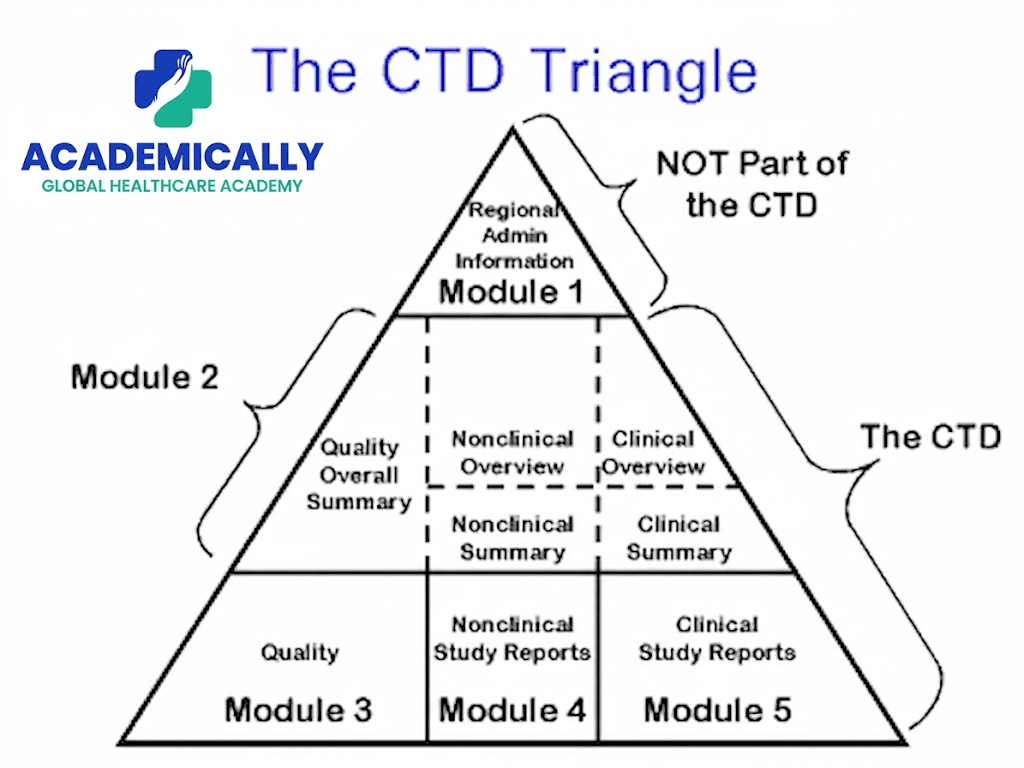
CTD Module 1: Administrative and Regional Information
Module 1 contains information that is specific to the regulatory region or country.
Depending on the market, this may include:
- Application forms
- Regional administrative documents
- Prescribing information
- Product information
- Labelling
- Environmental information
- Regional certifications
- Local regulatory declarations
Unlike Modules 2-5, Module 1 is not completely harmonized and must be prepared according to the requirements of the relevant regulatory authority.
CTD Module 2: CTD Summaries
Module 2 provides high-level summaries of the detailed information presented in the remaining modules.
It generally includes:
- CTD table of contents
- CTD introduction
- Quality Overall Summary
- Non-clinical overview
- Clinical overview
- Non-clinical written and tabulated summaries
- Clinical summary
This module is particularly important because reviewers can use it to understand the product quickly, development program, and major scientific conclusions.
CTD Module 3: Quality
Module 3 focuses on the quality and manufacturing aspects of the pharmaceutical product.
It may include information about:
- Drug substance
- Drug product
- Manufacturing processes
- Specifications
- Analytical procedures
- Process validation
- Stability
- Packaging
- Quality controls
Regulatory affairs professionals often work closely with CMC, quality assurance, analytical development, manufacturing, and formulation teams to collect and organize this information.
CTD Module 4: Non-clinical Study Reports
Module 4 contains non-clinical documentation supporting the safety assessment of the product.
Examples include:
- Pharmacology studies
- Pharmacokinetic studies
- Toxicology studies
- Reproductive toxicity studies
- Genotoxicity studies
- Other relevant non-clinical reports
CTD Module 5: Clinical Study Reports
Module 5 contains clinical information supporting the efficacy and safety of the product.
It may include:
- Clinical study reports
- Clinical study protocols
- Statistical information
- Clinical pharmacology studies
- Efficacy studies
- Safety studies
- Literature references
- Other clinical documentation
Together, Modules 3, 4, and 5 provide much of the detailed scientific evidence that regulators evaluate during product review.
What Is eCTD?
The electronic Common Technical Document (eCTD) is the electronic implementation of the CTD.
Rather than simply submitting a collection of electronic documents, eCTD provides a structured electronic framework that allows regulatory authorities to navigate, review, and manage submissions throughout the product lifecycle.
ICH describes eCTD as a way to electronically submit the CTD from applicants to regulators while maintaining the harmonised CTD structure.
The important distinction is:
CTD = content and organizational framework
eCTD = electronic structure and technical format used to submit and manage that content
Therefore, knowing the CTD modules alone is not enough for professionals working in modern regulatory operations.
CTD vs eCTD: What Is the Difference?
| Feature | CTD | eCTD |
| Meaning | Common Technical Document | Electronic Common Technical Document |
| Purpose | Standardizes dossier content | Enables structured electronic submission |
| Modules | Modules 1–5 | Modules 1–5 electronically structured |
| Navigation | Traditional document organization | Hyperlinks, navigation and electronic structure |
| Lifecycle management | Limited | Strong lifecycle management capabilities |
| Submission sequences | Not applicable in the same way | Uses defined electronic submission sequences |
| Validation | Content-focused | Technical and content-related validation |
| Regulatory use | Foundation for dossier | Widely used electronic submission format |
The eCTD therefore should not be viewed as simply a PDF version of the CTD. It includes technical components that allow regulators to understand relationships between documents and manage changes across successive submissions.
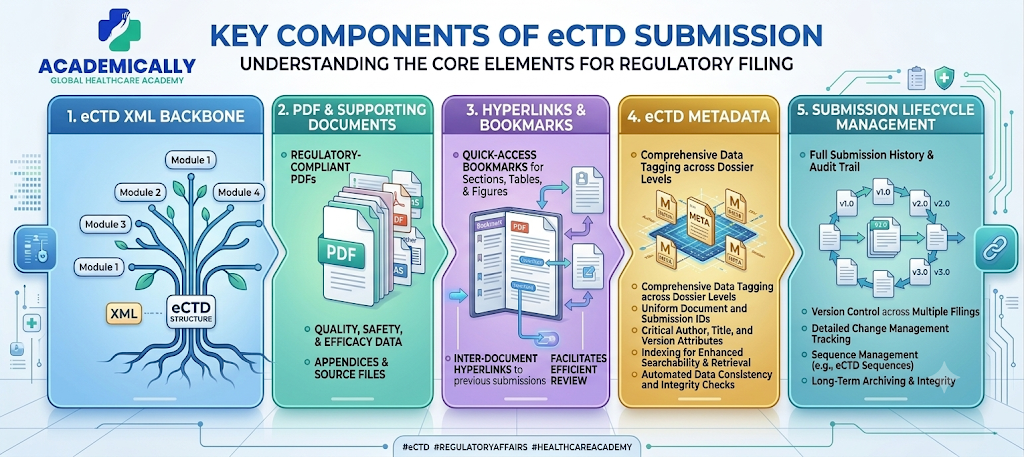
Key Components of an eCTD Submission
A typical eCTD submission comprises several technical elements that regulatory affairs professionals need to understand.
1. XML Backbone
The XML backbone provides the electronic structure and relationships within the submission.
It helps identify where documents are located and how they relate to the dossier structure.
2. PDF and Other Supporting Documents
Regulatory documents are commonly provided in compliant electronic formats, particularly PDF.
ICH specifications address aspects such as file format, navigation, fonts, security, annotations, and file size. For example, ICH's submission-format specification states that PDF files should not contain JavaScript, dynamic content, attachments, or 3D content.
3. Hyperlinks and Bookmarks
Documents should be appropriately bookmarked and linked where required so reviewers can navigate efficiently through the dossier.
Poor navigation can make an otherwise scientifically strong submission difficult to review.
4. Metadata
eCTD submissions rely on metadata to identify documents, their placement, relationships, and lifecycle status.
5. Lifecycle Management
One of the major advantages of eCTD is the ability to manage documents across multiple regulatory submissions.
Documents may be added, replaced, or withdrawn through lifecycle operations rather than creating completely independent dossiers every time.
How Does the CTD/eCTD Dossier Submission Process Work?
Although the exact process differs by regulatory authority and application type, regulatory professionals can broadly think of dossier submission as a series of interconnected stages.
Step 1: Understand Regulatory Requirements
The process begins with determining:
- Target regulatory authority
- Application type
- Product type
- Applicable guidelines
- CTD/eCTD version
- Regional Module 1 requirements
- Submission timelines
- Technical requirements
This step is critical because eCTD requirements are not identical across every jurisdiction.
ICH harmonizes the core framework, but regional implementation remains important. ICH specifically notes that implementation of harmonized guidelines occurs according to applicable national, local, or regional requirements.
Step 2: Build the Dossier Content
The regulatory team coordinates with multiple functions to collect the required documentation.
Typical contributors may include:
- CMC
- Clinical research
- Biostatistics
- Pharmacovigilance
- Medical writing
- Quality assurance
- Non-clinical development
- Manufacturing
- Regulatory affairs
The regulatory professional must ensure that the information is complete, consistent, current, and placed in the correct CTD section.
Step 3: Organize the Five Modules
The collected information is matched into Modules 1-5.
This involves checking whether documents are:
- Complete
- Correctly classified
- Current
- Appropriately named
- Assigned to the correct section
- Consistent with other dossier documents
Step 4: eCTD Publishing
Specialized eCTD publishing software is used to transform the dossier into a compliant electronic submission.
The publishing process may involve:
- Creating the electronic structure
- Assigning metadata
- Building the table of contents
- Creating XML files
- Applying hyperlinks
- Creating bookmarks
- Managing document lifecycle attributes
- Packaging the submission
Step 5: Validation
Validation is one of the most important stages.
An eCTD may be scientifically complete but still encounter technical problems that need correction before submission.
Validation can identify issues involving:
- Missing documents
- Broken hyperlinks
- Incorrect metadata
- Invalid file formats
- Naming problems
- Incorrect lifecycle operations
- XML errors
- Folder structure
- Regional requirements
- Technical conformance
The FDA specifically advises sponsors to review and validate eCTD submissions before submission to avoid errors.
Step 6: Regulatory Submission
Once the submission has passed the required checks, it can be transmitted to the regulatory authority through the applicable electronic submission system.
For example, the FDA uses the Electronic Submissions Gateway (ESG) for eCTD submissions, with specific requirements governing electronic transmission.
Step 7: Agency Review and Subsequent Sequences
The dossier does not stop evolving after the initial submission.
Regulators may issue:
- Information requests
- Deficiency questions
- Clarification requests
- Review comments
- Requests for additional analyses
- Requests for updated documentation
Regulatory teams then prepare subsequent submissions while maintaining the dossier's lifecycle and document history.
What Regulatory Affairs Professionals Must Know About eCTD Versions ?
One important area for professionals entering regulatory operations is understanding that eCTD specifications evolve.
The FDA currently supports eCTD v3.2.2 and eCTD v4.0 according to its applicable standards and data standards requirements. FDA began accepting new regulatory applications in eCTD v4.0 from September 16, 2024.
Meanwhile, ICH continues to update the eCTD v4.0 implementation framework. The latest ICH eCTD v4.0 Implementation Guide, version 1.7, and the associated Controlled Vocabulary Package were endorsed in June 2026.
This means regulatory professionals should avoid treating eCTD as a static skill.
Instead, they need to develop the habit of checking:
- Current ICH specifications
- Regulatory authority guidance
- Regional Module 1 requirements
- Validation criteria
- Technical conformance guides
- Submission standards
- Implementation timelines
For example, FDA's eCTD standards page was updated in August 2026 with changes to validation criteria and regional eCTD v4.0 resources.
Common eCTD Submission Challenges
Several issues can delay or complicate regulatory submissions.
Incorrect Document Placement
A document may contain the right information but still be placed under the wrong CTD heading.
Broken Hyperlinks
Links that do not work correctly can interfere with reviewer navigation.
Inconsistent Information
Differences in product name, formulation, manufacturing information, study identifiers, dates, or other details across modules can raise questions during review.
Incorrect Lifecycle Management
Replacing or adding documents incorrectly can affect the regulatory history of the submission.
Technical Validation Errors
An eCTD package may fail validation because of technical issues unrelated to the scientific quality of the content.
Regional Non-compliance
A dossier prepared according to the general ICH framework can still require regional modifications, particularly in Module 1.
Skills Regulatory Affairs Professionals Need for CTD and eCTD
Professionals working in regulatory submissions can benefit from developing a combination of scientific, regulatory, and technical skills.
Regulatory Knowledge
Understand:
- ICH guidelines
- CTD structure
- Regional requirements
- Submission pathways
- Regulatory timelines
Document Management
Professionals should be comfortable managing large numbers of documents while maintaining version control and submission history.
Technical Understanding
You do not necessarily need to become a software developer, but understanding XML, metadata, hyperlinks, validation, lifecycle management, and eCTD publishing workflows can be highly valuable.
Attention to Detail
Regulatory submissions are highly detail-oriented. A small inconsistency can create additional questions or require corrective action.
Cross-Functional Communication
Regulatory affairs professionals frequently coordinate with clinical, CMC, quality, safety, medical writing, and other teams.
Regulatory Intelligence
Because submission requirements evolve, professionals must know how to identify and interpret updated regulatory guidance.
Professionals from BPharm, PharmD, MBBS, BDS, life sciences, and other healthcare backgrounds may have strong scientific knowledge but limited exposure to regulatory workflows and industry practices. A structured learning program can help bridge this gap.
Academically's non-clinical courses can be considered as upskilling options for healthcare professionals looking to transition into non-clinical healthcare careers. The course can help learners build industry-relevant knowledge across areas such as regulatory affairs, medical writing, clinical research, pharmacovigilance, and other non-clinical career pathways, depending on the learner's chosen track.
For someone specifically interested in regulatory affairs, structured training can help connect theoretical pharmaceutical or medical knowledge with practical concepts such as regulatory documentation, CTD/eCTD dossiers, submission processes, regulatory guidelines, and industry workflows. It can also help candidates understand what employers expect from entry-level regulatory professionals and identify the skills they need to strengthen before applying for relevant roles.
Why CTD and eCTD Knowledge Matters for Regulatory Affairs Careers ?
For professionals pursuing careers in Regulatory Affairs, CTD and eCTD are not merely theoretical concepts.
They are connected to practical responsibilities such as:
- Dossier preparation
- Regulatory submissions
- Submission publishing
- Document management
- Regulatory operations
- Agency correspondence
- Submission tracking
- Lifecycle management
- Regulatory intelligence
Job descriptions for regulatory affairs associates and regulatory operations professionals may include activities related to dossier compilation, submission management, document publishing, regulatory databases, and electronic submissions.
For example, Solenis currently lists a Global Regulatory Strategy Specialist role in Hyderabad that involves keeping track of global regulations that affect products, technologies and markets, creating reports on trends and assessments of their impact on strategy for leaders.

Similarly, Accenture is hiring for role of Lifescience Regulatory Services Associate at Bangalore that specifically involves handling bookmarks and hyperlinks for submission documents, following ICH guidelines, supporting compliance checks to ensure products meet current regulations.

Developing knowledge of CTD and eCTD can therefore help candidates demonstrate that they understand how regulatory information moves from internal development teams to health authorities.
Jobslly can help healthcare and life-science professionals explore non-clinical opportunities across pharmaceutical and healthcare organizations. Its current job listings include roles such as LifeScience Regulatory Services Associate at Accenture, Global Regulatory Strategy Specialist at Solenis.
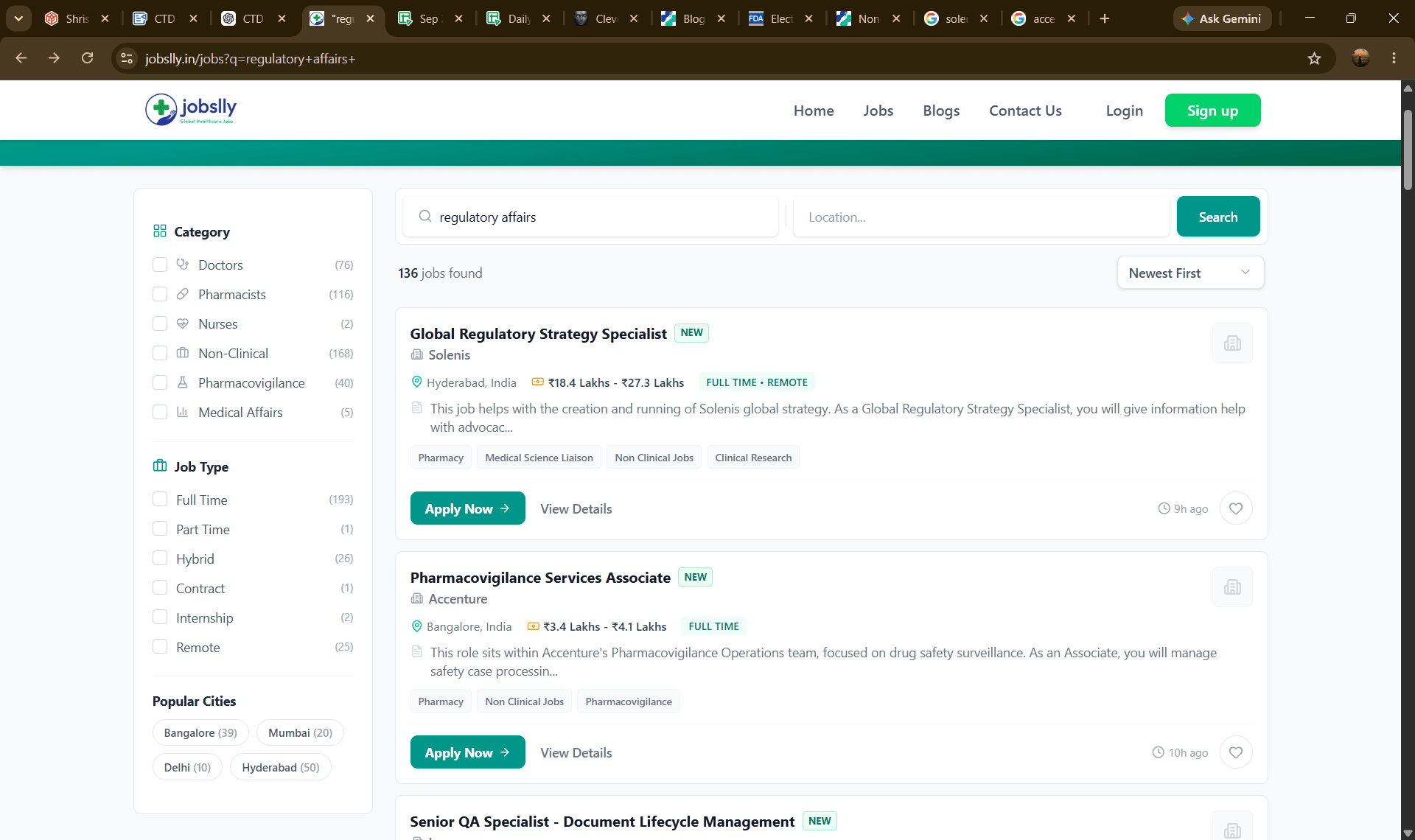
Jobslly also allows users to search healthcare and non-clinical opportunities by role, location and job type, making it useful for professionals who are specifically targeting regulatory affairs or other pharmaceutical corporate careers.
CTD and eCTD: What Should Beginners Learn First?
If you are new to regulatory affairs, a practical learning sequence would be:
Step 1: Learn the five CTD modules.
Step 2: Understand what information belongs in each module.
Step 3: Learn the difference between CTD and eCTD.
Step 4: Understand eCTD backbone, metadata, hyperlinks, bookmarks, and lifecycle management.
Step 5: Study regional requirements for markets such as the US, EU, UK, Canada, Australia, or other target markets.
Step 6: Learn the basics of eCTD validation and technical conformance.
Step 7: Understand how initial submissions and subsequent sequences are managed.
Step 8: Follow current regulatory updates instead of relying only on older training material.
This approach creates a stronger foundation than attempting to memorize technical specifications without understanding the overall submission lifecycle.
The Future of eCTD in Regulatory Affairs
eCTD is continuing to evolve as regulatory authorities modernize their submission and review systems.
The transition toward eCTD v4.0 is particularly important. The new version builds on the electronic submission framework while introducing updated technical architecture and implementation concepts.
However, adoption is not occurring identically across all regions. ICH's current implementation information shows different voluntary and mandatory timelines across jurisdictions, reinforcing the importance of checking regional requirements before preparing a submission.
For regulatory professionals, this means that continuous learning is part of the job.
The ability to understand both regulatory science and submission technology will become increasingly valuable as regulatory operations become more digital.
Conclusion
The CTD eCTD dossier submission regulatory affairs workflow sits at the intersection of pharmaceutical science, regulatory strategy, document management, and technology.
The CTD provides the standardized framework for presenting quality, safety, and efficacy information, while eCTD provides the electronic structure that enables regulatory authorities to receive, navigate, review, and manage that information efficiently.
For regulatory affairs professionals, understanding the five CTD modules is only the starting point. A strong professional should also understand eCTD publishing, metadata, lifecycle management, technical validation, regional Module 1 requirements, submission sequences, and evolving eCTD standards.
As regulatory agencies continue to adopt and update electronic submission systems, professionals who combine regulatory knowledge with strong eCTD and regulatory operations skills can position themselves for opportunities across regulatory affairs, regulatory operations, dossier management, and submission publishing.
The most important takeaway is simple: a successful regulatory submission is not just about having the right scientific information - it is also about organizing, validating, and submitting that information in the format and structure expected by the regulator.