Clinical Trial Phases (Phase I-IV) and the Career Roles Behind Each Stage

Written by

Co-Author

3 Min

Summary:

Clinical trials turn promising treatments into evidence that regulators, clinicians, and patients can trust. Each phase answers scientific and safety questions, and each stage creates opportunities for professionals across clinical operations, data management, biostatistics, pharmacovigilance, medical writing, regulatory affairs, and medical functions. This guide explains where clinical trials fit within drug development, what happens across the major phases, and how responsibilities evolve as evidence becomes stronger and broader. It also shows why phase knowledge matters for healthcare and life-science graduates planning a non-clinical career.The article connects clinical-trial knowledge with practical upskilling through Clinical Drug Development programme and current healthcare opportunities, helping readers move from understanding the lifecycle to preparing for relevant industry roles, building skills, and approaching interviews with confidence. 

Key Takeaways

  • Early trials focus on safety, tolerability, and dosing.
  • Later studies strengthen evidence on efficacy and safety.
  • Post-approval studies extend learning into real-world use.
  • Clinical operations, data, safety, regulatory, and medical roles span the lifecycle.
  • Practical training can connect clinical knowledge with pharma careers and job opportunities.

Ever wondered how a simple molecule in a laboratory transforms into a life-saving medicine on pharmacy shelves? Behind every breakthrough drug lies a multi-billion-dollar clinical research engine that bridges science and human health. 

For medical, pharmacy, and life-science graduates, clinical trials represent one of the most lucrative and high-growth career avenues outside traditional hospital walls. Every phase answers critical safety and efficacy questions, opening doors for professionals in clinical operations, data management, pharmacovigilance, regulatory affairs, and medical monitoring. Understanding these trial phases is your first step toward building a rewarding career in the pharma and healthcare industry.

If you are looking to explore broader international opportunities, understanding the regulatory bodies and the salary offered at a global level in clinical drug development provides valuable context on how cross-border clinical research operates.

This guide explains where clinical trials fit within drug development, what happens across the major phases, and how responsibilities evolve as evidence becomes stronger and broader. 

What Is a Clinical Trial?  

A clinical trial is a planned human study that evaluates an intervention such as a medicine or biological product. Sponsors define objectives, eligibility, design, dosing, assessments, data collection, and analysis before the study begins. Good Clinical Practice protects participants and supports reliable results.

Clinical trials sit inside the wider drug-development lifecycle:

Discovery

↓

Preclinical research

↓

Clinical trials

↓

Regulatory review

  ↓

Approval

↓

Post-market evidence

Clinical Trial Phases: Phase I to Phase IV

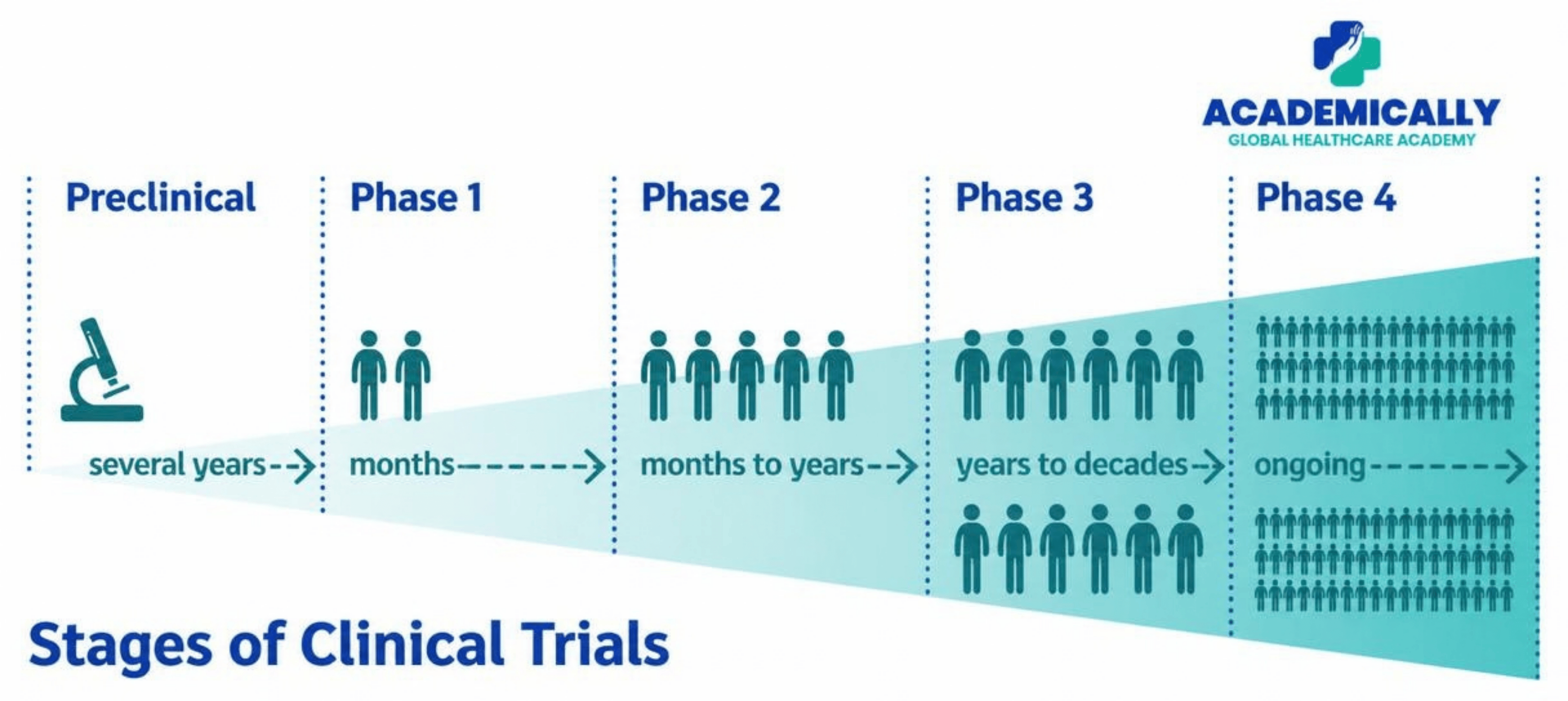
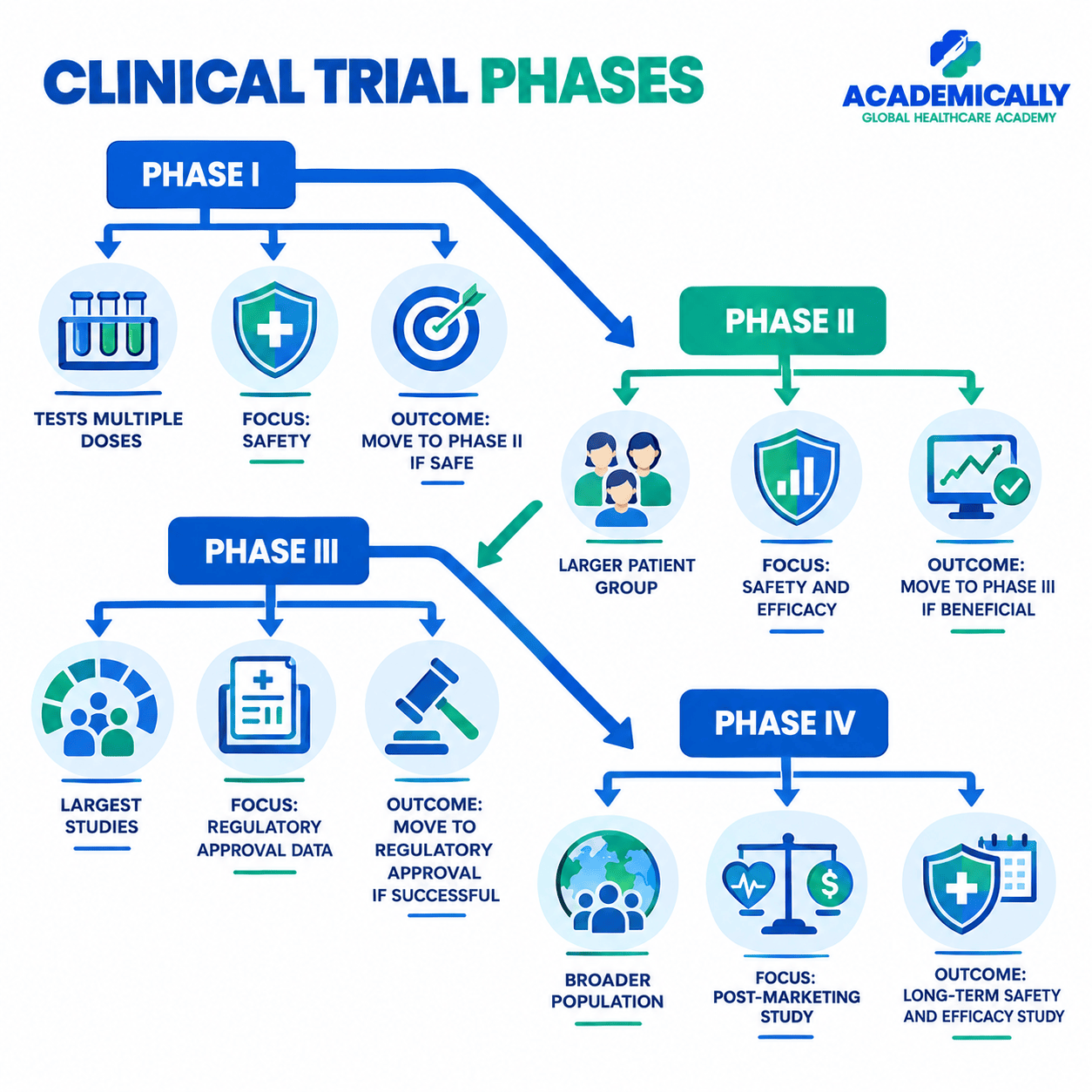
The four phases describe how the evidence question changes, while studies may use adaptive, decentralised, pragmatic, or specialised designs.

Phase I: First Human Evidence

  • Evaluates initial safety, tolerability, dose escalation, and PK/PD parameters.
  • Conducted in small, closely monitored groups, usually involving healthy volunteers.

Phase II: Testing for Early Efficacy

  • Tests preliminary clinical and biological efficacy in target patient populations.
  • Utilizes dose-ranging, randomization, and biomarkers while continuing safety monitoring.

Phase III: Confirming Benefit

  • Confirms efficacy and safety across large, diverse patient populations against standard care or placebo.
  • Generates the pivotal evidence needed to support regulatory submission and marketing approval.

Phase IV: Learning After Approval

  • Assesses long-term safety, real-world effectiveness, and expanded uses after regulatory approval.
  • Driven primarily by pharmacovigilance, real-world evidence (RWE), and medical affairs teams.
PhaseMain questionFocus
Phase IIs it safe in humans?Safety, dose, PK/PD
Phase IIDoes it show promise?Efficacy, dose, safety
Phase IIIDoes benefit hold at scale?Confirmatory efficacy, safety
Phase IVWhat happens after approval?Post-market safety, effectiveness

Which Career Roles Work Across the Phases?  

While clinical trial phases progress sequentially, professional roles within clinical research often overlap across multiple stages. A single specialist, whether in data management, monitoring, or regulatory oversight, may manage tasks spanning Phase I through Phase IV simultaneously depending on project needs.

PhaseAssociated Career Roles
Phase I: First Human EvidenceCRA, Clinical Trial Coordinator, Medical Monitor, Clinical Trial Physician, Clinical Data Manager, Biostatistician, Clinical Pharmacology Specialists
Phase II: Testing for Early EfficacyCRA, Clinical Data Manager, Biostatistician, Medical Monitor, Medical Writer, Clinical Research Project Support
Phase III: Confirming BenefitCRA, Clinical Project Manager, Data Manager, Biostatistician, Medical Writer, Medical Monitor, Regulatory Affairs Professional
Phase IV: Learning After ApprovalPharmacovigilance Associate/Scientist, Safety Physician, Real-World Evidence Professional, Medical Affairs, Medical Writer, Regulatory Affairs

Jobslly’s current non-clinical listings include:

  • Clinical Research,
  • Data Management,
  • Pharmacovigilance,
  • Regulatory Affairs,
  • Medical Science Liaison, and related functions

Estimated Salary Structure for Clinical Trial Roles in India  

Compensation in clinical research varies significantly based on qualifications, trial phase complexity, and whether you work with a global CRO, top-tier pharmaceutical firm, or research institute. Below is an overview of standard annual salary ranges (in INR Lakhs Per Annum) in India across key career profiles:

Clinical Phase FocusRole ProfileEntry-Level Salary (0–2 Years)Mid-to-Senior Level Salary (3–8+ Years)
Phase I & IIClinical Pharmacology Specialist₹4.5 – ₹6.5 LPA₹8.0 – ₹15.0 LPA
Phase I – IIIClinical Research Associate (CRA)₹3.5 – ₹5.5 LPA₹7.0 – ₹14.0 LPA
Phase I – IVClinical Data Manager (CDM)₹3.2 – ₹5.0 LPA₹6.5 – ₹12.0 LPA
Phase I – IVBiostatistician₹4.0 – ₹6.0 LPA₹8.5 – ₹16.0 LPA
Phase II – IVMedical Writer₹3.8 – ₹5.5 LPA₹7.5 – ₹13.5 LPA
Phase III – IVRegulatory Affairs Specialist₹3.5 – ₹5.2 LPA₹7.0 – ₹14.5 LPA
Phase IV FocusPharmacovigilance (PV) Associate₹3.0 – ₹5.0 LPA₹6.0 – ₹11.0 LPA
Across All PhasesMedical Monitor / Safety Physician (MD/MBBS)₹9.0 – ₹14.0 LPA₹18.0 – ₹30.0+ LPA

Regulatory Authorities Governing Clinical Trials in India  

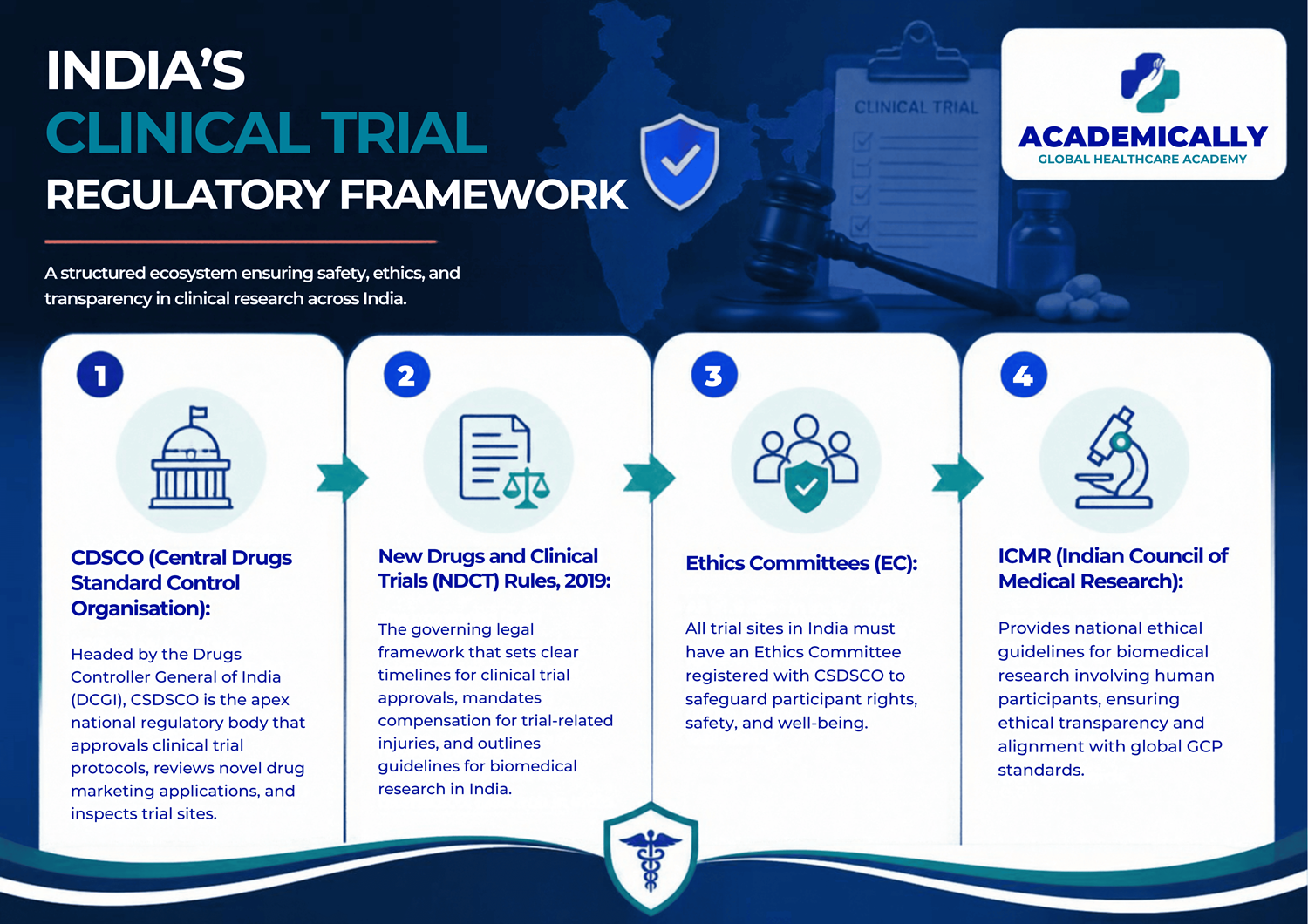
Navigating clinical drug development requires strict compliance with national legal frameworks and regulatory bodies. In India, clinical research activities are overseen primarily by:


Top Companies Hiring for Clinical Trial Roles in India  

Graduates looking to enter the clinical research ecosystem can explore opportunities across three primary employment sectors:

1. Pharmaceutical Multinationals & Indian Pharma Leaders  

  • Sun Pharma, Dr. Reddy’s Laboratories, Cipla, Lupin, Zydus Lifesciences, Biocon
  • Pfizer India, Novartis India, AstraZeneca, GlaxoSmithKline (GSK) 

2. Contract Research Organizations (CROs) & Data Solutions  

  • IQVIA, Parexel, ICON, Syneos Health, Labcorp (Covance), Fortrea, Medpace
  • Cliantha Research, Veeda Clinical Research, Cognizant Healthcare, TCS Life Sciences 

3. Indian Government Bodies & Research Institutes  

  • ICMR (Indian Council of Medical Research) institutes
  • CDSCO regional offices & Pharmacovigilance Programme of India (PvPI)
  • THSTI (Translational Health Science and Technology Institute), BIRAC, CSIR-CDRI, NIPER

What Skills Make You Job-Ready?  

Employers look for practical industry capabilities beyond a standard healthcare or life-science degree. Essential skills include: 

Skill Area / DomainCore Competencies
Good Clinical Practice (GCP)

• ICH E6(R3) guideline implementation

• Ethical trial conduct & participant protection

• Risk-based trial oversight

Clinical Trial Documentation

• eTMF management & documentation

• IB, ICF design, and CSR handling

Site Management & Monitoring

• Site selection & feasibility

• Site Initiation Visits (SIV) & Routine Monitoring (RMV)

• Site close-out procedures

Data Literacy & EDC Systems

• EDC system fluency

• eCRF completion

• Data query resolution workflows

Safety & PV Workflows

• ICSR processing & MedDRA coding

• AE/SAE reporting timelines

• Safety escalation protocols

Regulatory Knowledge

• CDSCO & NDCT 2019 compliance

• Global standards alignment (US FDA, EMA)

Scientific Communication & Cross-Functional Collaboration

• Medical & clinical data articulation

• Cross-team alignment (Clinical, Stats, Regulatory)

How to Build a Career Around Clinical Trial Phases  

Academically’s Executive Programme in Clinical Drug Development bridges academic knowledge and industry workflows. Its curriculum covers clinical trials, regulatory affairs, pharmacovigilance, medical affairs, clinical data management, biostatistics, medical writing, GCP, real-world evidence, and a capstone. It also includes mentorship, assignments, interview preparation, CV/LinkedIn support, and Jobslly job assistance.

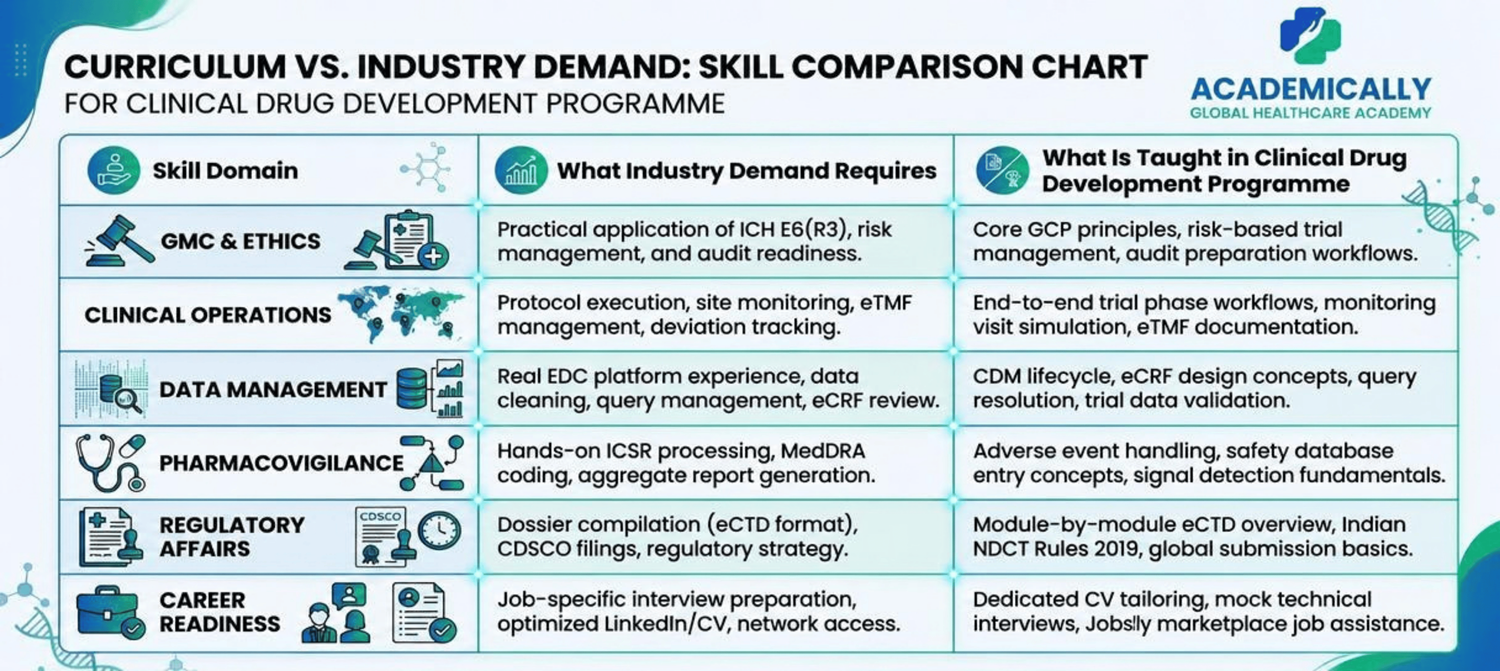
Curriculum vs. Industry Demand Comparison  

To see how structured upskilling aligns with employer expectations, here is how the programme maps directly to real-world job requirements: 
FAQs

What are the clinical trial phases?

Many medication studies employ the clinical trial phases as the major steps for gathering evidence. Phase I establishes initial safety and dose in humans. Phase II analyzes preliminary effectiveness. Phase III confirms efficacy and safety on a broader scale. Phase IV collects further information following approval. Designs and sequencing are program dependent.

What is the difference between a Phase I and Phase II?

Phase I studies determine whether an investigational treatment can be safely given to humans and help determine dosage and pharmacokinetic information. Phase II expands to persons with the target disease and includes preliminary efficacy questions; Both are still being monitored for safety, but the big question in Phase II is whether the treatment is effective enough to be worth further research.

What occurs in Phase III clinical trials?

Phase III trials provide more complete confirmatory data on the benefits and hazards of a medication. They often include larger and more diverse populations and may compare the intervention to standard treatment or placebo. Clinical operations, data and statistics, medical, writing, and regulatory teams become vital since the program must provide evidence sufficient for regulatory submission and review.

What is the importance of Phase IV trials?

Approval doesn't resolve every question concerning a drug. Phase IV studies can discover safety issues that are rare or take a long time to appear, assess effectiveness in the general population, assess utilization, investigate other uses, or meet post-marketing criteria. Pharmacovigilance and real-world evidence teams are important because routine use provides larger datasets than previous research alone.

Can a doctor be involved in clinical studies and not treat patients?

Yes. Doctors can progress into Medical Monitor, Clinical Trial Physician, Safety Physician, Medical Reviewer, Medical Affairs and other evidence-based professions. Clinical training is still useful as these professions require knowledge of disease, treatment effects, patient safety and clinical judgments. Additional training helps put that knowledge into practice with GCP, trial operations, safety, documentation and regulatory workflows.

Do pharmacists work in clinical trials and medication development?

Yes. Knowledge gained through a degree in Pharmacy can be used in pharmacovigilance, clinical research, medical information, medical writing, regulatory affairs and related roles. Often the difference is in industry workflow, not scientific knowledge. Pharmacists get an understanding of the way trials, safety systems, documentation and cross-functional teams work through targeted training.

Is the field of clinical drug development open to BDS graduates?

Having acquired the right skills in the field BDS graduates can seek non-clinical positions. Pathways: Clinical Research Associate, Clinical Trial Coordinator, Drug Safety or Pharmacovigilance, Medical Writing, Medical Review. Dental training provides a biomedical base, focused upskilling adds the vocabulary, documentation, safety, regulatory and operational expertise necessary in pharma and CRO environments.

What skills should I learn for a CRA or clinical research position?

Basic principles of informed consent, site documentation, monitoring ideas, deviation management and clinical-trial terminology. Then improve communication, data literacy, and problem-solving. It’s also helpful to know the broader lifecycle, because CRA work is not done in isolation, but in connection with investigators, data teams, safety teams, project managers and regulatory functions.

Will a good grasp of clinical trials help you in your pharmacovigilance career?

Quite so. Safety assessment starts during clinical development and continues after approval. Pharmacovigilance professionals benefit from knowledge of trial phases in terms of understanding how adverse events are gathered, reviewed, documented, escalated and interpreted. It also makes the post-market safety work easier to understand because Phase IV ties clinical findings to the larger real-world safety surveillance.

Where can I get jobs after learning clinical drug development?

Jobslly is a non-clinical healthcare career marketplace with current positions in Clinical Research, Data Management, Pharmacovigilance, Regulatory Affairs, Medical Affairs and similar tasks. Candidates can learn about role requirements, discover gaps in skills, and apply for relevant openings, all while gaining practical experience and comparing opportunities with their present preparation and career objectives.
Dr Aditi Chandra

Medical Content Writer Intern

BDS

about the author

BDS, PGDip Hospital & Healthcare Management(Symbiosis University), Fellow in Endodontics( Saveetha University), Fellow in Aesthetic Dentistry (Greifswald University).
Dr Aditi is a dentist with over four years of clinical and healthcare experience, combining expertise in dentistry, healthcare management, medical communication, and content development. 
Beyond clinical practice, Dr Aditi has experience creating evidence-based healthcare content, design patient education materials, and digital health communications. Her work is grounded in scientific research, with a strong focus on translating complex medical information into clear, accessible, and engaging content for diverse audiences. She is also skilled in healthcare marketing, workflow optimisation, and strategic communication.
Currently, Dr Aditi serves as a Medical Content Creator Intern at Academically Global, where she develops educational content for healthcare professionals, students, and international licensing aspirants. She is committed to delivering accurate, up-to-date, and research-backed information that empowers readers to make informed educational and career decisions.