While exploring healthcare careers I discovered that a healthcare degree does not automatically lead to patient‑facing jobs. There are careers that combine clinical knowledge with data, technology, research and pharmaceutical development.
One such career is Clinical SAS programming.
A Clinical SAS programmer uses SAS software to work with clinical datasets. The role involves:
- preparing datasets
- performing analyses
- generating tables, listings and figures and
- assisting with regulatory submissions.
It sits at the intersection of clinical research, programming, statistics and data standards.
Being from a dental background, I find this Clinical SAS programmer career particularly interesting because it shows how a healthcare expert can use clinical, scientific and data knowledge in a non‑clinical job.
This Clinical SAS Programmer career guide covers the skills needed, salary expectations in India, certification options, eligibility, career progression and the practical steps I would take to enter the field.
What Is a Clinical SAS Programmer?
A Clinical SAS programmer uses SAS to process, analyse and report data generated during clinical trials.
While processing information from hundreds and thousands of study participants there will be data from laboratory tests, adverse events, medical history, demographics, vital signs, concomitant medications, efficacy assessments and much more. Someone needs to transform this information into standardised datasets and reliable statistical outputs.
That is where the clinical SAS programmer becomes important.
Typical responsibilities include:
- Programming clinical trial datasets using Base SAS
- Writing SAS SQL and macro programs
- Creating SDTM and ADaM datasets
- Producing Tables, Listings and Figures (TLFs)
- Performing programming checks and validation
- Supporting statistical analysis
- Maintaining programming documentation
- Working with biostatisticians, data managers and clinical teams
- Supporting regulatory submission requirements
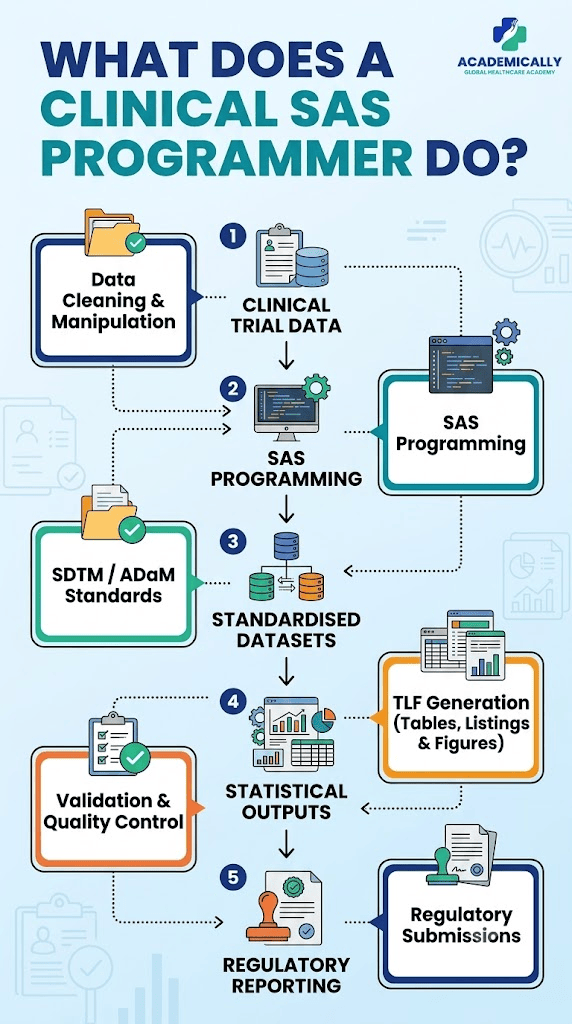
This helped me understand why this is not a "SAS coding job." It is a highly‑specific clinical‑data career.
Why Is Clinical SAS Programming Important?
Clinical research generates volumes of structured data and regulators need that information in standardised reviewable formats.
SDTM, ADaM and Define‑XML are among the standards used in submissions, including FDA‑related submissions. A programmer therefore needs to think beyond writing code.
The bigger responsibility is accuracy, traceability, consistency and reproducibility.
That is the one reason I see a distinction between learning SAS syntax and building a genuine clinical SAS programmer career. Knowing commands is useful, but understanding how those commands are applied to regulated clinical data is what makes the skill professionally relevant.
Skills Needed for a Clinical SAS Programmer Career
I would divide the skills into four areas: programming, clinical research knowledge, data standards and professional skills.
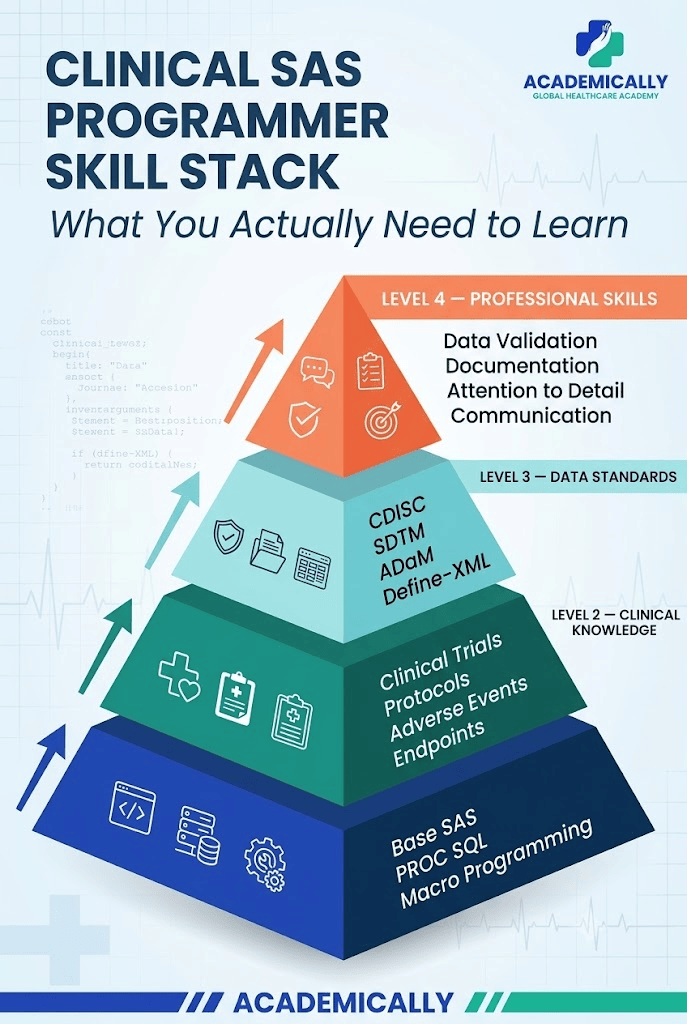
1. Base SAS Programming
Base SAS is the foundation.
I would focus on:
- The DATA step
- Variables
- Conditional logic
- Functions
- Formats
- Informats
- Sorting
- Merging
- Importing and exporting datasets and
- Common PROC procedures
2. PROC SQL
SQL becomes beneficial when working with relational clinical data.
I would learn:
- SELECT statements
- joins
- filtering
- grouping
- calculated variables
- subqueries and
- summary operations.
Strong SQL knowledge can also make it easier to understand how datasets relate to one another.
3. SAS Macro Programming
Macro programming helps automate repetitive tasks.
Clinical projects often involve programming activities across multiple datasets, treatment groups or studies. Understanding macro variables, parameters and reusable macro programs can improve efficiency and consistency.
4. Clinical Trial Knowledge
This is where healthcare graduates have a foundation.
I would learn:
- Clinical trial phases
- Protocols
- Case Report Forms
- Patient populations
- Endpoints
- Randomisation
- Adverse events
- Laboratory data
- Efficacy and safety analysis
- Clinical Study Reports
- Regulatory submissions
A programmer does not necessarily need to become a clinician. The goal is to understand the environment in which the data is generated and analysed.
5. CDISC SDTM and ADaM
CDISC knowledge is essential for clinical programming roles.
SDTM standardises the organisation and structure of trial data. ADaM focuses on analysis datasets. Supports traceability back to SDTM.
I would also learn the procedure of how clinical trial data moves from raw data to regulatory submission.
How Clinical Trial Data Moves From Raw Data to Regulatory Submission?
Patient Data
↓
Raw Clinical Data
↓
SDTM Datasets
↓
ADaM Datasets
↓
Tables, Listings & Figures
↓
Statistical Analysis
↓
Regulatory Submission
For example:
Raw: Patient visits, lab results, adverse events
SDTM: Standardised clinical domains
ADaM: Analysis-ready datasets
TLFs: Results presented for interpretation
6. Statistics
You do not necessarily need to become a professional statistician, but basic statistics matter.
I would study:
- descriptive statistics
- hypothesis testing
- p-values
- confidence intervals
- ANOVA
- regression concepts and
- commonly used clinical trial analyses.
A good programmer should understand what the analysis is trying to communicate before translating requirements into code.
7. Validation and Attention to Detail
Clinical programming operates in a quality‑focused environment.
Small programming errors can impact outputs, interpretation or submission readiness. Strong documentation, validation, version control, checking and traceability therefore matter enormously.
Clinical programming is one area where my clinical background changed how I view data work. Clinical practice taught me to take documentation seriously because every patient record needs accuracy. Clinical programming applies a similar mindset to trial data.
Who Can Become a Clinical SAS Programmer?
A computer science degree is not the only route into this field.
Graduates from pharmacy, life sciences, biostatistics, mathematics, statistics, analytics and computing can build foundations. Healthcare graduates can therefore have an advantage in understanding medical terminology and clinical concepts.
My dental training, for example, gave me exposure to clinical documentation, patient histories, diagnostic terminology, radiology and treatment records. Those experiences do not automatically make someone a programmer, but they can reduce the learning curve around healthcare concepts.
The important point is this: a healthcare degree gives you domain knowledge, while SAS training gives you capability.
You need both if you want to build a clinical SAS programmer career.
Clinical SAS Programmer Salary in India
Salary is one of the things to research before investing time and money into any career transition.
Public salary platforms vary considerably because compensation depends on experience, employer, city, technical skills and job title.
| Qualification | Experience | Predicted CTC |
| MBBS (Indian) | Fresher | Around 10 LPA |
| 2 to 4 years | 10 to 12 LPA | |
| 5 to 8 years | 12 to 16 LPA | |
| >10 years | 16 to 24 LPA | |
| MBBS (FMG) | Fresher | 6 to 8 LPA |
| 2 to 4 years | 8 to 10 LPA | |
| 5 to 8 years | 10 to 12 LPA | |
| >10 years | 12 to 15 LPA | |
| BDS | Fresher | 3 to 6.5 LPA |
| 2 to 4 years | 4 to 7 LPA | |
| >5 years | 5 to 8 LPA | |
| Pharm. D/ M. Pharm | Fresher | 3 to 5 LPA |
| 2 to 4 years | 4 to 6 LPA | |
| > 5 years | 5 to 8 LPA | |
| B. Pharm | Fresher | 2.5 to 5 LPA |
| BAMS | Fresher | 2.5 to 5 LPA |
| > 2 years | 4 to 6 LPA | |
| BHMS | Fresher | 2.5 to 5 LPA |
| > 2 years | 4 to 6 LPA |
These figures should therefore be treated as market benchmarks than guaranteed salaries. A realistic way to think about progression is:
| Career stage | Approximate India salary picture |
| Fresher/ trainee | ₹3–6 LPA |
| Junior programmer | ₹5–9 LPA |
| Experienced programmer | ₹8–15+ LPA |
| Senior/ lead-level roles | Can move beyond ₹15 LPA |
Actual compensation can lie outside of these ranges. Employer, therapeutic area, programming complexity, CDISC expertise, location and prior experience can all influence an offer.
Clinical SAS Certification: What Should I Choose?
Healthcare professionals often want to move into non-clinical careers but are uncertain whether they should choose clinical research, clinical data management, pharmacovigilance, medical affairs or another pathway.
Academically's Non-Clinical Courses can help professionals explore this wider ecosystem through structured programmes covering areas such as Clinical Research, Clinical Drug Development, Medical Affairs, Pharmacovigilance, Clinical Data Management and related healthcare-industry functions. Academically states that its programmes combine industry-focused training, capstone projects, mock interviews, mentorship and job assistance.
My approach would therefore be:
Learn Base SAS
↓
Build SQL and Macro skills
↓
Learn clinical trial concepts
↓
Master SDTM and ADaM
↓
Practise TLF Generation and Validation
↓
Prepare for the SAS certification with Academically
↓
Build a portfolio using clinical‑style datasets
↓
Resume and Interview Preparation
↓
Search Targeted Jobs at Jobslly
↓
Clinical SAS/ Clinical Data Roles
A certificate becomes more valuable when I can explain the work behind it. This is a lesson I have learned during my transition into non‑clinical healthcare.
A certificate can prove that I completed training but an interviewer can still ask:
- “Show me how you would create an SDTM dataset.”
- “Explain the difference between SDTM and ADaM.”
- “How would you validate your output?”
- “What happens between raw clinical data and a final TLF?”
That is why hands‑on practice matters.
I would create two or three portfolio projects showing data transformation, SDTM mapping, ADaM derivations, SQL, macro automation and TLF creation. My resume would then communicate what I can actually do.
The broader value of Academically comes from helping healthcare professionals understand where their clinical background fits within the larger non-clinical healthcare industry.
How To Find Clinical SAS Programmer Job Opportunities?
Learning the skill is only half the journey.
The next question is always: Where do I apply?
That is where Jobslly can be useful.
Jobslly is a healthcare‑focused job platform where professionals can search roles across research, clinical data, pharmacovigilance, medical affairs and other healthcare functions. Its listings include data programming and data‑management opportunities giving candidates a way to explore adjacent roles when a pure Clinical SAS Programmer opening is not available.
I particularly like this approach because searching only for "Clinical SAS Programmer" can make a job hunt unnecessarily narrow.
I would also search for titles such as:
- Clinical Data Programmer
- Statistical Programmer
- SDTM Programmer
- ADaM Programmer
- Clinical Data Analyst
- CDM Programmer
- Biostatistics Programmer
Jobslly can therefore become part of the application strategy alongside company career pages and CRO recruitment portals.
Career Growth After Becoming a Clinical SAS Programmer
The career does not have to stop at an entry‑level programming role.
A possible progression can look like:
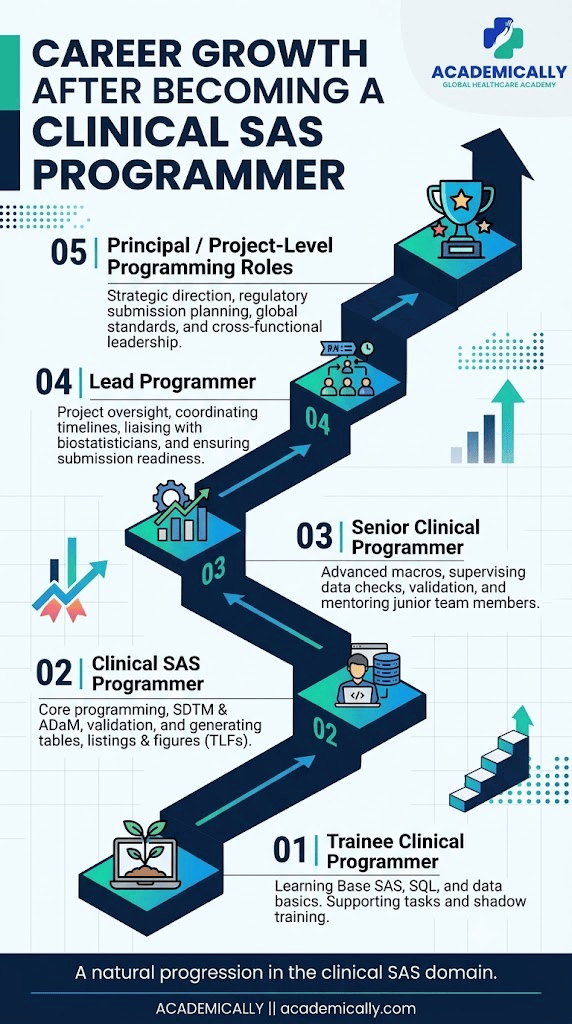
Some professionals can also move toward programming, biometrics, clinical data management, standards programming or broader clinical analytics.
The strongest long‑term profiles usually combine three things:
Technical depth + clinical domain understanding + regulatory data expertise
How To Start a Clinical SAS Programmer Career From a Healthcare Background
If I were starting today, I would follow a focused roadmap:
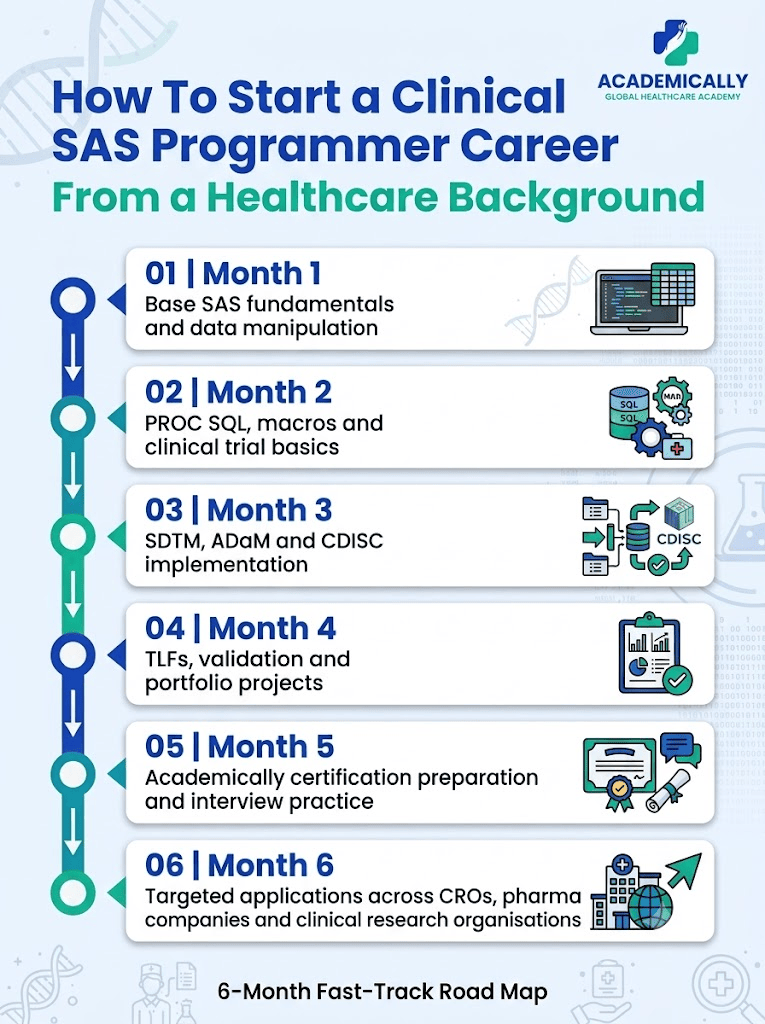
I would also tailor my resume to each role rather than sending the same healthcare resume everywhere.
Most importantly, I would learn to explain my transition clearly.
My story would not be, "I left dentistry because I didn't want clinical work.”
I would position it as:
“My healthcare education gave me a foundation in clinical science and medical data. I then developed programming and clinical research skills to move into a data‑driven role within the life sciences industry.”
That sounds like a career progression rather than a career escape.
Final Thoughts
My biggest takeaway from researching the clinical SAS programmer career is that it is not simply about learning SAS.
The clinical SAS programmer role is about learning:
- how data moves
- how standards make that data usable
- how analysis is performed and
- how programmers help produce reliable clinical research outputs.
Healthcare professionals already bring something to the table: an understanding of science, disease, medical terminology and clinical environments. The missing layer is technical skill.
Once I understood that difference, the clinical SAS programmer career no longer looked like an unrelated IT job and instead looked like another way to use healthcare knowledge.
Anyone thinking about this path should focus on Base SAS, SQL, Macro programming, clinical trials, CDISC SDTM, ADaM, statistics, validation and practical projects.Academically's certification course can strengthen the SAS programmer profile. A real portfolio can show the SAS programmer skill.
Structured non-clinical education can help professionals see the healthcare industry while a healthcare-focused job site, like Jobslly can help find the right job.
That combination gives me a clearer picture of what building a serious clinical SAS programmer career really involves.