While I first looked into non-clinical healthcare jobs, I noticed that Clinical Research and Regulatory Affairs were usually put together but very few guides explained the real differences in their work.
Both Clinical Research and Regulatory Affairs belong closely to the pharmaceutical and healthcare fields. They both use science, documentation, research and teamwork. Still Clinical Research and Regulatory Affairs can differ a lot in duties, required skills, workplace setting and career growth.
That is why when someone asks me about a career in Clinical Research vs Regulatory Affairs I do not simply ask, Which is a better career choice?
Instead I ask, Which type of work would I like to do each day? This second question has helped doctors, dentists, pharmacists, nurses and life‑science graduates who move from traditional clinical jobs into non‑clinical roles in healthcare.
Clinical Research vs Regulatory Affairs: What Is the Real Difference?
I like to simplify the distinction this way:
Clinical Research mainly deals with conducting and managing studies on people while Regulatory Affairs mainly ensures that products, studies and submissions satisfy the regulatory rules.
A Clinical Research professional may coordinate trial activities, monitor study conduct, manage documentation,support investigators and help ensure that research follows the approved protocol and the Good Clinical Practice rules.
The FDA, for example, oversees clinical trials with the aim of protecting participants and supporting the development of safe and effective medical products.
Meanwhile, a Regulatory Affairs professional operates at a different point in the development and commercialisation process. They help with submissions, prepare dossiers, manage product information and approval routes, handle post‑approval changes and communicate with the right regulators.
In the United States the electronic Common Technical Document or eCTD is used for submissions that support INDs and NDAs.
This means the two fields overlap, but they are not interchangeable.
What Does a Clinical Research Professional Actually Do
Before considering this career, I would look beyond the title 'Clinical Research'.
Clinical Research is an ecosystem rather than a single job. Depending on the organization and level, professionals can work as:
- Clinical Research Coordinator
- Clinical Research Associate
- Clinical Trial Assistant
- Clinical Trial Manager and many other roles.
At the study level, a Clinical Research Professional may work on:
- Coordinating trial tasks
- Maintaining study documentation
- Supporting patient recruitment and visits
- Monitoring trial sites
- Reviewing study data
- Making sure the protocol is followed
- Communicating with investigators, sponsors and CROs
- Assisting with inspections and audits
The role can therefore feel quite dynamic.
I would particularly look into Clinical Research if I enjoy seeing how studies move from protocol to execution. A person who enjoys coordinating and working with stakeholders on timelines, trial steps and documentation may find this area engaging.
Another factor I would consider is the work environment. Some Clinical Research jobs are largely office-based, while site‑based roles may require travel and coordination with research centres. A person who dislikes sitting in front of a screen all day with variety may find this a good choice.
The key point is that clinical research is connected to evidence generation.
What Does a Regulatory Affairs Professional Do
Regulatory Affairs has a different focus.
I think of Regulatory Affairs as the function that asks: What does the company need to submit, document, update or demonstrate to meet regulatory requirements in a particular market?
Depending on the role, responsibilities can involve:
- Preparing and reviewing regulatory paperwork
- Supporting submissions
- Managing regulatory databases and records
- Tracking regulatory changes
- Reviewing product information and labels
- Supporting with changes after approval
- Coordinating answers to regulatory questions
- Collaborating with teams from clinical, safety, medical and quality
All of these can change based on the product, the market and other factors.
India has its own rules for drugs and clinical trials under CDSCO, such, as the New Drugs and Clinical Trials Rules, 2019 and similar rules exist for products sold in the United States, Europe and elsewhere.
I see Regulatory Affairs as a career that rewards precision and consistency.
A small mistake in documentation, an overlooked requirement or an incomplete submission can create problems later. That makes attention to detail, regulatory interpretation, scientific writing and organised documentation particularly important.
At the time a person who really likes reading guidelines, checking documents and understanding how regulations affect product development will naturally lean toward regulatory affairs.
Clinical Research vs Regulatory Affairs: Side-by-Side Comparison
| Factor | Clinical Research | Regulatory Affairs |
| Main focus | Conducting and managing clinical studies | Regulatory compliance and submissions |
| Core question | Is the study being conducted correctly and generating reliable evidence? | Does the product/documentation meet regulatory requirements? |
| Typical environment | CROs, pharma companies, research sites, hospitals | Pharma, biotech, medical devices, CROs, consulting |
| Work style | Operational, collaborative, study-focused | Documentation-heavy, analytical, compliance-focused |
| Stakeholder interaction | Investigators, sites, sponsors, trial teams | Regulatory teams, medical, clinical, safety, quality and authorities |
| Travel | Can be relevant in site-monitoring roles | Usually more office-based, depending on role |
| Key skills | GCP, coordination, trial documentation, data review | Regulatory knowledge, documentation, scientific writing, attention to detail |
| Career direction | CRC → CRA → Trial/Project Management and related functions | Regulatory Associate → Specialist → Manager and specialist/global roles |
Which Career Uses Healthcare Background Better
This is where I think healthcare professionals often overthink the choice.
Having a medical or healthcare degree already gives a valuable advantage in understanding the field.
I may already understand disease mechanisms, treatment principles, medical terminology, patient safety and clinical documentation. What I often lack is familiarity with the industry's workflows.
That is the actual transition gap.
A dentist moving into research may better understand patient interaction, documentation and treatment processes. A pharmacist may have a base in medicines and formulation. A doctor may have experience with diagnosis, therapeutics and clinical decision‑making.
These skills can be transferred, but employers still look for in‑role expertise.
BDS/ MBBS/ BPharm/ Nursing/ Life Sciences
↓
Existing Strengths: Medical terminology, Scientific knowledge, Patient communication, Clinical documentation, Evidence interpretation, Healthcare workflows
↓
Industry Skills to Add: GCP, Regulatory frameworks, Clinical trial processes, SOPs, Submission concepts, Industry documentation
↓
Potential Roles: Clinical Research, Regulatory Affairs, Medical Writing, Medical Affairs, Pharmacovigilance, Clinical Data Management
I remember a point during my dental career when I was discussing a clinical case and started wondering about everything that happens beyond the treatment chair. I understood the patient, the diagnosis and the treatment plan, but I became curious about how clinical evidence is generated, documented, reviewed and eventually used to support healthcare decisions. That curiosity led me to explore Clinical Research and Regulatory Affairs.
As I read more about both fields, I realised that my BDS background had already given me a foundation in medical knowledge, documentation and patient safety; I simply needed to learn how those skills could translate into the healthcare industry.
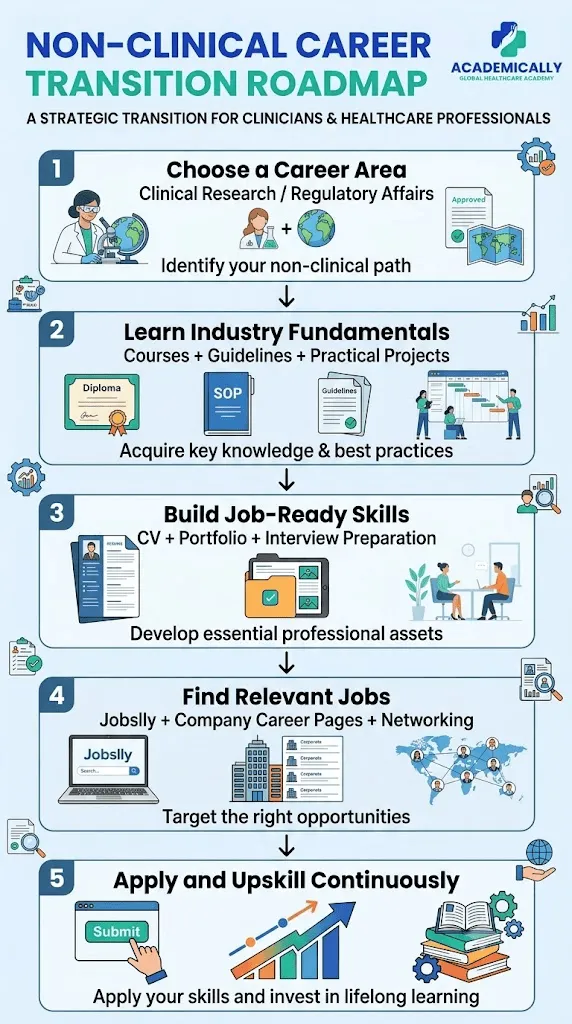
Hence, I considered structured upskilling because healthcare education and industry expectations are not always the same.
Academically's Non-Clinical Courses are designed specifically around this gap. Its current non-clinical portfolio covers areas including Clinical Research, Clinical Drug Development, Pharmacovigilance, Medical Writing, Medical Affairs, HEOR and Clinical Data Management. The platform states that its non-clinical programmes include industry-oriented training, capstone projects, mentorship and job assistance, with successful completion providing 180 CPD points valid for five years.
I would look at these programmes more as a way to understand the vocabulary, workflows and expectations of the industry.
Which One Is Better for Freshers?
A fresher should look at accessibility, skill fit and the kind of entry-level role available, rather than assuming that one field automatically offers an easier entry.
Clinical Research can provide entry points through roles connected to trial coordination and clinical operations. Academically's current clinical research guidance highlights roles such as Clinical Research Coordinator and Clinical Research Associate within the broader clinical development ecosystem.
Meanwhile regulatory affairs may have entry‑level positions but specific requirements depend on the company, therapeutic area and product. Strong knowledge of regulatory documentation and frameworks can therefore make a difference when competing for entry roles.
My approach would be to examine job descriptions first and then work backwards: What skills are repeatedly appearing in the vacancies I want?
That shows me what I need to learn than picking random certificates.
Who Should Choose Clinical Research
You should lean towards clinical research if you enjoy:
Research + coordination + clinical studies + teamwork + changing priorities
You may enjoy the field if you like being close to the process of running studies and seeing how clinical evidence is generated.
Clinical research can also appeal if you want a career that can eventually grow into areas such as clinical operations, project management, clinical development, data management or related functions.
It is important to know that some roles are deadline‑driven and operational. A person who strongly dislikes coordination, follow‑ups or study timelines will eventually find the environment frustrating.
Who Should Choose Regulatory Affairs
You should explore Regulatory Affairs when your interests are more aligned with:
Documentation + compliance + guidelines + analysis + precision
You may be a stronger fit if you naturally notice inconsistencies, enjoy structured processes and do not mind spending significant time reviewing technical documents.
Regulatory Affairs can also grow more specialised. Over time professionals may build knowledge about specific products, regulatory markets, submissions, lifecycle management or particular regulatory tasks.
What If You Are Interested in Both
This is actually more common than people realise.
Clinical Research and Regulatory Affairs do not exist in separate worlds.
A clinical study creates evidence. That evidence is part of the larger development and regulatory story. Regulatory requirements can shape study design and documentation. Clinical, Regulatory Affairs, medical, safety and quality teams often need to work together.
This means you do not have to lock yourself into one identity on day 1.
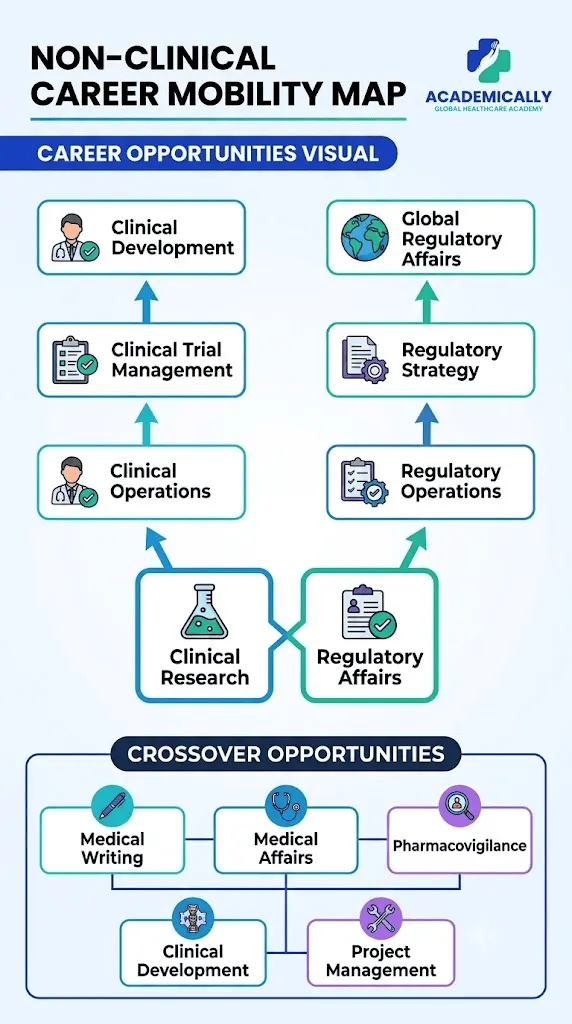
The bigger career asset is not the job title. It is understanding how the healthcare product lifecycle works from evidence generation to approval and beyond.
How to find the Right Opportunity
The next challenge is usually not learning. It is finding relevant vacancies.
This is where Jobslly can help. Instead of searching broad job portals with terms like "healthcare jobs" I can use a healthcare-focused platform to narrow my search to relevant categories and job types.
Jobslly currently lists opportunities in areas such as Clinical Research, Regulatory Affairs, pharmacovigilance, medical affairs and other non-clinical healthcare functions. Its platform also lets candidates filter opportunities by profession, job type and location.
I find this approach much more practical because the job search itself becomes part of my career research.
I can compare actual job descriptions, spot recurring requirements, see which roles fit my background and then adjust my CV to match those requirements.
This creates a much stronger loop:
Learn → Build skills → Search relevant jobs → Identify gaps → Improve → Apply
Practical Decision Framework
When you compare a Clinical Research career with a Regulatory Affairs career you should ask yourself five questions.
- Do you enjoy clinical studies and coordination?
→ Yes → Explore Clinical Research - Do you enjoy regulations, documentation and detail?
→ Yes → Explore Regulatory Affairs - Do you enjoy both?
→ Explore Clinical Development / cross-functional roles - Still unsure?
→ Compare job descriptions → Identify skill gaps → Take introductory training → Apply for relevant roles
Final Take away
I do not see Clinical Research and Regulatory Affairs as competing careers.
I see them as two pathways within the same larger healthcare ecosystem.
Clinical Research may fit better if you want to contribute to how clinical evidence is generated and managed.
Regulatory Affairs may fit better if you want to contribute to how that evidence and product information are translated into compliant regulatory processes.
Neither decision requires abandoning healthcare identity.
That is probably the biggest lesson I have taken from exploring non‑clinical careers: my clinical degree is not the end of my career path. It can become the foundation for a completely different kind of healthcare career.
Healthcare Degree → Industry Skills → Clinical Research / Regulatory Affairs → Cross-Functional Growth
The smartest starting point in view, is to understand the work and identify the skills that are missing, gain exposure and apply to roles that genuinely match that preparation. That is a more useful way to think about clinical research versus regulatory affairs career, than simply asking which one is better.