Have you been thinking about stepping away from clinical work?
You love medicine, the science behind disease, and the progress of new therapies. What is wearing you down is the thought of spending the next few decades juggling endless patient queues, gruelling shifts, and hospital burnout.
So you start exploring other options. That's when you see Clinical Research Associate.
At first, the title can sound slightly confusing and mysterious.
What does a CRA actually do on a day-to-day basis? Do you need a formal research degree to break in, or does a clinical background in MBBS, BDS, BPT, or BPharm give you a solid foot in the door?
Then comes the most practical question of all: is the compensation actually worth walking away from clinical practice?
Let’s break down what this career path really looks like in plain, straightforward terms.
Who Is a Clinical Research Associate?
In simple terms, a Clinical Research Associate helps make sure a clinical study is being carried out properly.
A clinical study is research involving people to understand whether a medicine, treatment or healthcare intervention is safe and effective.
As a CRA, you're not the person treating the patient. Instead, you are part of the study and the research team.
You might have to:
A CRA is responsible, among other things, for acting as a main communication link between the study sponsor and the investigator, checking that the site is suitably qualified and resourced, and verifying that the study follows the approved protocol and informed-consent requirements.
In everyday language:
You're helping make sure the research is being done the way it is supposed to be done.
Who Can Become a Clinical Research Associate?
This is where things become interesting.
Employers commonly ask for a bachelor's degree in life sciences, healthcare, nursing or a related field. A lot of current Clinical Research Associate postings list degrees in life sciences, nursing, healthcare or related disciplines, depending on the level of the role.
Your qualification may be relevant if you have:
| Background | Can it be relevant to CRA roles? |
| MBBS / Medicine | Yes |
| BDS / Dentistry | Yes, depending on role |
| BPharm / Pharmacy | Yes |
| PharmD | Yes |
| BPT / Physiotherapy | Potentially, depending on employer and research area |
| BSc Life Sciences | Yes |
| BSc Biotechnology / Biochemistry / related disciplines | Often relevant |
| Nursing | Yes |
| Other health/life-science degrees | Depends on employer |
The important word is relevant.
Having one of these degrees does not automatically qualify you for every CRA position.
The employer may also look for research exposure, communication skills, relevant training or previous clinical-research experience.Various entry-level postings, emphasise a life-sciences degree, communication, computer skills and the ability to produce accurate work under deadlines.
What Does Your Healthcare Background Already Give You?
Your healthcare and life sciences background is one of the biggest advantages you have.
You already understand:
- Disease and treatment- You know what common diseases are, how they are diagnosed and how treatment decisions are made.
- Medical terminology- A study document filled with medical terminology is much less intimidating when you've already studied medicine.
- Clinical thinking- You know how healthcare professionals think about patients, treatment and outcomes.
- Patient interaction- If you've worked clinically, you've already developed communication and professional interaction skills.
- Medical records- You're familiar with the importance of accurate documentation.
- Healthcare teamwork- You know that good healthcare depends on multiple people working together.
These skills can make the transition easier.
They don't teach you how clinical research works though. That's where the second half of your learning begins.
What Skills Do You Need to Learn?
You know the healthcare and life sciences side.
Now you need to learn the research and industry side.
| You may already have | You may need to learn |
| Medical knowledge | How clinical trials are run |
| Disease understanding | Study documentation |
| Clinical terminology | Research rules and guidelines |
| Patient-care experience | Monitoring |
| Scientific understanding | Trial communication |
| Documentation experience | Industry processes |
| Professional communication | Reporting and follow-up |
| Attention to detail | Clinical research systems and tools |
A good CRA needs to understand both:
The CRA Career Path: Where Can You Start and Where Can You Go?
One of the best things about this career is that the CRA role doesn't have to be the end point. It could be the beginning to a very fulfilling career trajectory.
Your Career Flow can potentially look like the this:
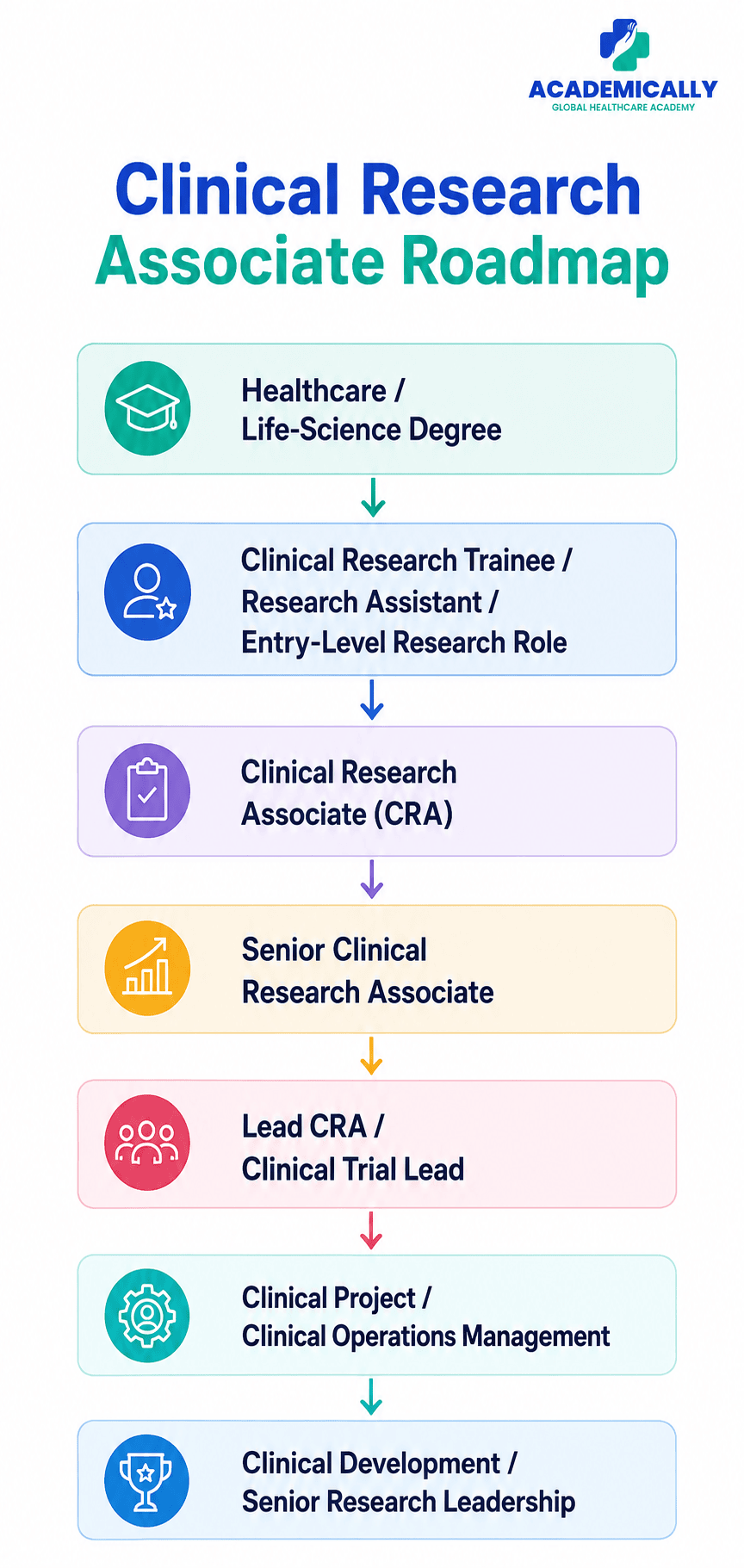
The exact titles vary between companies.
You may also move into related areas such as clinical data, regulatory work, medical affairs or broader drug-development roles.
Various current career postings show CRA positions involving study coordination, site communication, documentation, project planning, monitoring and mentoring junior colleagues as professionals progress.
CRA Salary in 2026: What Can You Expect?
Let's get to the question you probably searched first.
How much does a Clinical Research Associate earn?
Well, the answer depends heavily on country, company, experience and exact role.
For India, current data shows:
- Clinical Research Associate: ₹3–6 LPA
- Average CRA base pay: about ₹4 LPA
- Senior Clinical Research Associate: ₹10–18 LPA
- Lead Clinical Research Associate: around ₹25-40 LPA in the current displayed trajectory
These figures are based on reported salary data and should be treated as market indicators rather than guaranteed packages.
Instead of adding more noise to your job search, the idea is to make the search more relevant.
You can look for opportunities that actually connect with your qualification and career direction rather than spending hours filtering out unrelated vacancies.
Jobslly is India's first healthcare-exclusive job portal. The platform is specifically for doctors, pharmacists, dentists, physiotherapists and other healthcare professionals looking for opportunities.
CRA Salary Growth: India vs USA vs Australia
If you're looking for CRA opportunities, don't put yourself in a box by looking only at India. Your career options can extend to international markets such as the USA and Australia, where clinical research professionals are in demand.
The USA generally requires an appropriate employment-based immigration route for foreign workers, and sponsorship depends on the employer and role. Australia's skilled-migration system has its own occupation, visa and eligibility requirements.
For Indian healthcare professionals, Australia can be an especially interesting option because of its established skilled-migration pathways and healthcare and life-sciences ecosystem. It also performs well on measures such as work-life balance and environmental quality.
So, when you're planning your CRA career, have a broader view.
To make the comparison easier, the table below uses current salary benchmarks for CRA roles in India, USA and Australia:
| Career stage | Salary in Indian Rupee | Salary in USD | Salary in AUD |
| Fresher | ₹3–6 LPA | US$59K–90K | A$67K–85K |
| Senior CRA | ₹10–18 LPA | US$90K–120K | A$90K–120K |
| Lead CRA | ₹25- 40 LPA | US$115K–180K | A$115K–179K |
What should you take from the chart?
The same career can have very different earning potential depending on the market, experience, country and seniority.
Thinking Australia? Let's talk.
What Does a Fresher CRA Actually Do All Day?
This is one of the most useful things to understand before you choose the field.
A job title can sound completely different from the actual work.
So, imagine it's your first day as a CRA. Here's what it would look like:
| Time | Focus | Key Responsibilities |
| 9:00 AM | Inbox & Triage | Screen updates from research sites and study managers; flag urgent deadlines and pending queries. |
| 10:00 AM | Document Review | Audit incoming site files and essential documents for accuracy and protocol compliance. |
| 11:00 AM | Site Communication | Coordinate with site coordinators via call or email to resolve queries and retrieve missing items. |
| 12:30 PM | Action Item Logging | Update trial management systems (CTMS/eTMF) and log all site interactions. |
| 2:00 PM | Study Team Sync | Align with internal teams on enrolment metrics, site timelines, and protocol deviations. |
| 3:00 PM | Query Resolution | Track pending issues to confirm whether site-level corrections have been completed. |
| 4:30 PM | Next-Day Prep | Prioritize tomorrow's action items and prep files for upcoming site visits or reviews. |
| 5:30 PM | Wrap-Up | Finalize daily trackers and log off. |
Clinical research is deadline-driven, and you may have several studies, sites or conversations moving at once.
There's significant emphasis on monitoring, communication, documentation and checking that follow approved plans.
The role isn't about sitting at a desk and “doing research” all day.
It's a mix of: communication + documentation + problem-solving + organisation + research understanding.
Who Will Thrive as a CRA?
You may enjoy this role if you:
- Like organised work
- Notice small mistakes
- Enjoy communicating with different people
- Can manage deadlines
- Like solving practical problems
- Are comfortable following processes
- Enjoy research but don't necessarily want to be a full-time scientist
- Can work independently
- Don't mind occasional travel
- Like the idea of being part of a larger healthcare project
A CRA role can give you variety, but it also demands responsibility.
The Most Important Question: Do You Need a New Degree?
This depends on your current qualification and the roles you're targeting.
Many employers ask for a relevant bachelor's degree in life sciences, healthcare or nursing.
The only thing you should ask yourself is- “What gap is stopping me from being job-ready?”
Practical gaps can often be addressed through targeted training rather than starting your entire education again.
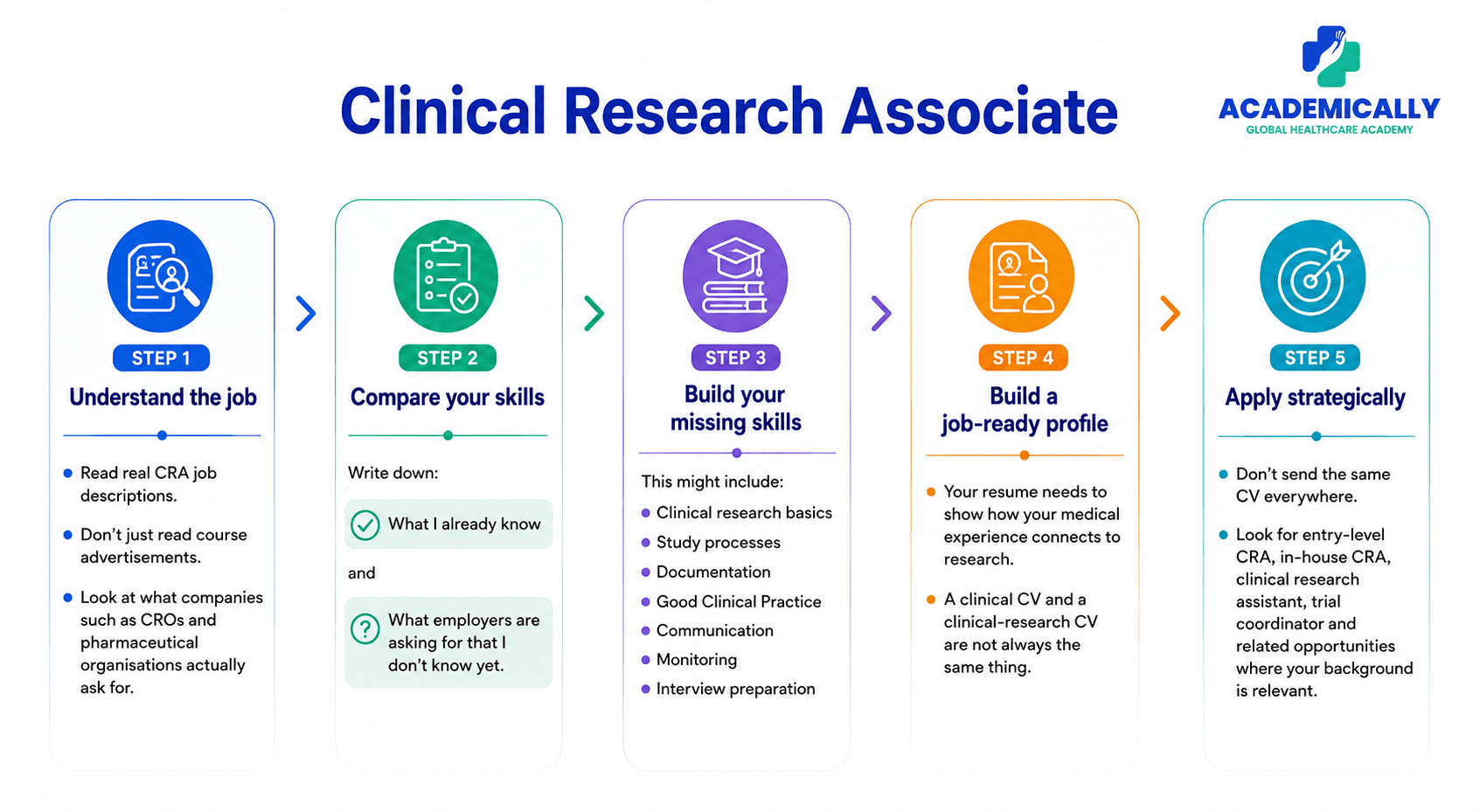
So, How Do You Actually Move Into CRA?
A practical roadmap could look like this:
Still Thinking, “But Where Do I Begin?”
Career transition can feel overwhelming when you're staring at twenty job descriptions thinking: “What exactly should I do first?”
You don't have to make your transition alone.
Academically's non-clinical career ecosystem includes upskilling options in clinical research alongside other healthcare-industry pathways. The programmes include practical projects, mock interviews, personalised mentorship, resume support and a dedicated portal for job openings as well.
What's the point of this?
Think of your transition as three stages:
Learn → Prepare → Apply
Learning tells you how the industry works.
Preparation helps you become job-ready.
The final step is getting yourself in front of employers.
That's where a combination of training, career guidance and healthcare-specific job support can be useful.