When I began looking for opportunities beyond clinical dentistry I learned a key lesson – a healthcare degree can lead to many more opportunities than I thought in college.
As a dentist I had always known the career path – internship, practice, postgraduate studies or international dental practice. While exploring non‑clinical healthcare roles I discovered the chance to build a career in medical writing, clinical research jobs, pharmacovigilance, medical affairs and other healthcare functions.
Germany particularly caught my attention because of its pharmaceutical, biotechnology and clinical research ecosystem that exists in the country.
This led me to a question that many Indian healthcare graduates are now asking:
Is it possible for an Indian doctor, dentist, pharmacist or life‑science graduate to build a career in clinical research jobs Germany for Indians or in pharmacovigilance in Germany?
The answer is that opportunities do exist. It requires far more than simply searching for a job and sending applications.
In this blog I want to share the roadmap that I would follow if I were planning to build a career in clinical research jobs Germany for Indians or to explore pharmacovigilance opportunities.
Why Germany caught my attention
Germany is one of Europe’s healthcare and pharmaceutical markets and is thus an interesting destination for professionals wishing to transition from clinical practice to work in a healthcare‑related industry.
What I find interesting is that clinical research jobs and pharmacovigilance are both governed under the European regulatory environment.
Professionals working in roles in Germany should be aware of the European clinical‑trial framework, including the EU Clinical Trials Regulation and the Clinical Trials Information System, CTIS.
Similarly, pharmacovigilance professionals should understand the European Medicines Agency’s Good Pharmacovigilance Practices, or GVP.
This means that an Indian healthcare graduate cannot simply learn clinical research or drug safety concepts and assume the preparation is complete – I would personally focus on learning how those concepts are applied to the European regulatory environment.
This can have importance when applying to German employers.
Clinical research jobs Germany for Indians
One thing I learned while exploring non-clinical careers was that "clinical research" is not a single job title. An Indian healthcare graduate can potentially explore roles such as:
Clinical Trial Assistant
This role can involve study documentation, coordination, trial administration and support activities.
Clinical Research Associate
CRAs may be involved in monitoring sites, reviewing study conduct and ensuring compliance with protocols and applicable regulations.
Clinical Research Coordinator
This role can involve coordinating activities at sites and communicating with investigators study teams and participants.
Study Start‑Up Associate
Study start‑up professionals may work on activities related to site activation, essential documents, submissions and trial initiation.
TMF Specialist
A Trial Master File professional focuses heavily on clinical‑trial documentation, completeness and quality.
Clinical Data Coordinator
This pathway can be relevant to professionals in clinical data, data review and data quality rather than site operations.
Pharmacovigilance is another pathway I would consider
Pharmacovigilance interests me because it connects healthcare knowledge with medicine safety. If someone enjoys understanding drug reactions, reviewing scientific information, analysing safety data and working within regulated processes this can be a strong area to investigate.
Potential job titles include:
- Drug Safety Associate
- Pharmacovigilance Associate
- Pharmacovigilance Specialist
- Medical Reviewer
- Signal Detection Specialist
- Aggregate Reporting Associate
- Literature Surveillance Specialist
When I researched this field, I noticed that employers may look for knowledge of concepts such, as Individual Case Safety Reports, MedDRA, causality assessment, seriousness, expectedness, safety databases, signal detection and regulatory reporting.
I would also ensure that I understand the European pharmacovigilance environment, particularly EMA GVP and related safety processes.
This is where I believe healthcare graduates can have an advantage. We already understand the medical side of the information. The challenge is learning how that information is processed, documented and reported within the industry.
Do Indian healthcare degrees need recognition
This is an area I would research carefully before I make any plans.
A major point that Indian healthcare graduates often miss is the distinction between clinical professions and non‑regulated industry roles.
If I wanted to practise as a dentist, doctor or pharmacist in Germany I would need to understand the professional recognition and licensing requirements.
However an industry role such as Clinical Trial Assistant, Pharmacovigilance Associate or Clinical Operations Associate can follow a different pathway.
Germanys official guidance states that foreign academic qualifications may need to be demonstrated as comparable using systems such as anabin or a Statement of Comparability from ZAB depending on the situation and immigration route.
So, rather than assuming that my BDS or other healthcare qualification automatically qualifies me—or automatically prevents me from working there—I would check the requirements of the particular job and visa pathway.
What skills would I build before applying
This is probably the important part of my preparation.
When I moved from thinking about clinical careers to exploring healthcare industry roles I learned that recruiters want to see more than a degree – they want to see evidence that I understand how the industry works.
This is where structured upskilling can help.
Academically's Executive Programme in Clinical Drug Development offers programmes across areas such as clinical research, drug safety and pharmacovigilance, clinical data management and clinical drug development.
I would use this type of training to understand the terminology, workflows and expectations of the healthcare industry.
This pathway also includes industry‑oriented training and states that its non‑clinical courses provide 180 CPD points for five years along, with job assistance through Jobslly.
I would also supplement my training with EU‑specific knowledge, CTIS and the EU Clinical Trials Regulation for clinical research and EMA GVP for pharmacovigilance.
This combination would be more useful to transition into the German market.
For clinical research I would prioritise:
- ICH‑GCP
- Clinical‑trial lifecycle
- Protocol interpretation
- Clinical documentation
- Site management concepts
- Trial Master File
- Clinical data basics
- CTIS awareness
- European clinical‑trial regulations
- Scientific communication
For pharmacovigilance I would focus on:
- ICSR processing
- MedDRA
- Causality assessment
- Seriousness and expectedness
- GVP
- Signal detection
- Risk‑management concepts
- Aggregate reporting
- Literature surveillance
- EudraVigilance concepts
I would make sure that my CV shows transferable skills such as scientific writing, literature review, medical terminology, attention to detail and evidence‑based decision making.
Do I need language skills
This is a question I would ask before I plan a career move to Germany. The practical answer is: it depends on the employer and on the role.
Some multinational pharmaceutical companies, CROs and research organisations operate in English in internationally oriented teams.
At the same time, German language proficiency can increase the number of opportunities available and make workplace communication easier.
Germany's official immigration guidance also recognises language proficiency as part of job‑search pathways, including the Opportunity Card route.
Personally I would not wait until I had become fluent in German before I begin my career preparation. I would build my research or pharmacovigilance profile first and learn German simultaneously. Even basic German can help me understand job descriptions, communicate comfortably and demonstrate that I am preparing for the job market.
Also, after learning basic German and building my research or pharmacovigilance profile, I would excel myself in German language at level B2 and pass a specialist language exam at level C1.
Should I gain experience in India first?
Personally, I think this is one of the practical strategies for a fresher.
Rather than thinking: "I need to get a job in Germany. "
I would think: "How can I become employable for Germany?"
These are two very different approaches.
An Indian healthcare graduate can first gain experience in a research, pharmacovigilance, medical writing, clinical data or related entry‑level role in India.
This can make the profile more meaningful when international employers review the CV.
It also gives candidates something to discuss during interviews.
A healthcare graduate who says, "I have completed a course in research" has a different profile from one who says, "I have training in GCP and six months of experience supporting clinical‑trial documentation.”
How to find relevant clinical research and pharmacovigilance job opportunities
Another challenge I have seen while exploring non‑clinical careers is simply knowing where to find suitable jobs.
Searching randomly across websites can become overwhelming particularly when a healthcare graduate is trying to identify entry‑level roles.
Jobslly can help professionals explore healthcare opportunities across areas such as research, pharmacovigilance, medical writing and other non‑clinical functions.
I would be using a platform like Jobslly not to search for jobs but also to understand what employers are asking for.
For example if I repeatedly see job descriptions mentioning GCP, case processing, MedDRA, clinical documentation or safety reporting that tells me what skills I should be strengthening.
This creates a cycle:
Search jobs → identify skill gaps → upskill → gain experience → improve CV → apply again.
For someone ultimately targeting Germany, building experience in India can make this process even more valuable.
Moreover, I would not be limiting my search to one keyword. Instead I would be searching for role titles such as:
- Clinical Trial Assistant Germany
- Clinical Research Associate Germany
- Clinical Operations Germany
- Study Start‑Up Associate Germany
- TMF Specialist Germany
- Pharmacovigilance Associate Germany
- Drug Safety Germany
- Medical Safety Germany
I would also be using German terms such as:
- Klinische Forschung
- Klinische Studien
- Pharmakovigilanz
- Arzneimittelsicherheit
This is important because some German‑language vacancies may not appear when I search exclusively in English. I would also be exploring opportunities across companies, CROs, biotechnology companies, research institutions and healthcare service organisations.
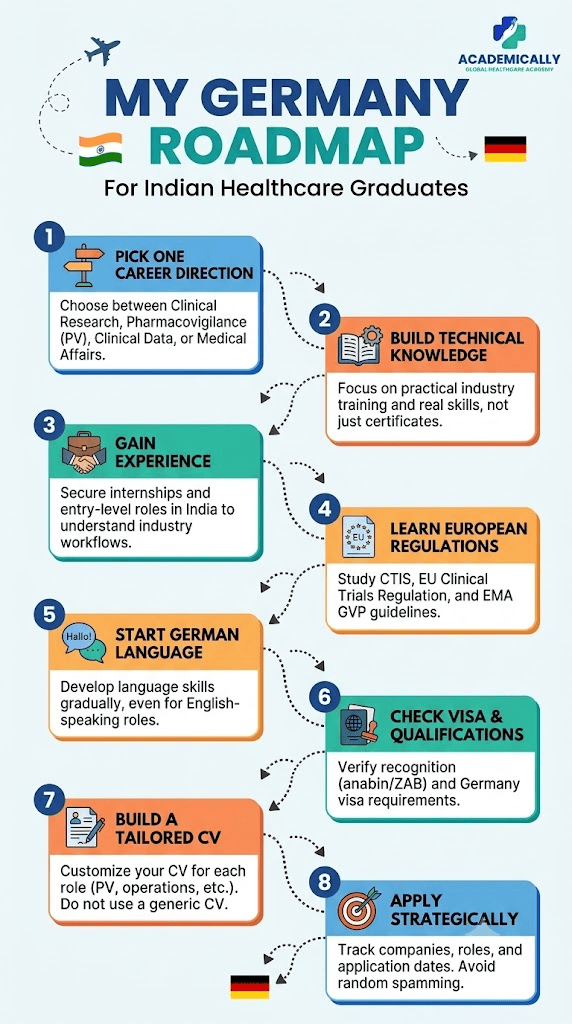
My takeaway
As someone from a healthcare background I have learned that an international non‑clinical career is not built simply by saying, "I have a BDS/MBBS/BPharm/PharmD degree and I want to move abroad." The degree is the starting point.
The differentiators are industry knowledge, practical exposure, regulatory understanding, communication skills, experience and a career strategy.
If I were planning my move toward Germany, I would not be waiting until I physically reached Germany to start building my profile. I would be starting in India. I would be learning skills, gaining experience, understanding European regulations, improving my CV, networking and researching immigration requirements while I am still here.
This is how I would approach the search for clinical research jobs in Germany for Indians – not as an attempt to relocate but, as a career transition.