Introduction
Clinical research is becoming increasingly data-driven, creating strong career opportunities for professionals who can manage, validate, and interpret clinical trial data. Clinical Data Management is an essential function within clinical research that ensures clinical trial data are accurate, complete, consistent, and ready for statistical analysis and regulatory submission.
For healthcare and life-science graduates looking to move beyond traditional clinical roles, clinical data management jobs can offer an attractive combination of scientific work, technology, career growth, and opportunities with pharmaceutical companies, biotechnology organizations, CROs, and healthcare technology companies.
This guide explains what clinical data management involves, the qualifications required, common job roles, skills to develop, career progression, and expected clinical data management salary in 2026.
What Is Clinical Data Management?
Clinical Data Management is the process of collecting, organizing, reviewing, cleaning, validating, and maintaining data generated during clinical trials.
Clinical data managers work with information collected from sources such as:
- Electronic Case Report Forms (eCRFs)
- Laboratory results
- Patient medical records
- Electronic health records
- Imaging and diagnostic assessments
- Patient-reported outcomes
- Adverse event reports
The primary objective is to ensure that clinical trial data are high-quality, reliable, traceable, and suitable for statistical analysis.
Clinical Data Management typically involves collaboration among clinical research associates (CRAs), investigators, biostatisticians, statisticians, medical monitors, clinical programmers, pharmacovigilance professionals, and regulatory teams.
Why Consider Clinical Data Management as a Career in 2026?
The growth of clinical trials, decentralised research, electronic data capture, real-world evidence, and digital health technologies is increasing the volume and complexity of clinical data.
This has created demand for professionals who understand both clinical research and data processes.
Clinical data management can be particularly suitable for healthcare professionals who:
- Want to transition from direct patient care into a non-clinical career
- Enjoy working with structured information and technology
- Have an interest in clinical research
- Prefer analytical and process-oriented work
- Want opportunities in pharmaceutical, biotechnology, or CRO organizations
- Want to develop a career that can progress into clinical operations, data sciences, or related functions.
What Does a Clinical Data Manager Do?
A clinical data manager`s responsibilities vary according to experience and organization, but commonly include:
1. Database Design
Clinical data managers help design clinical trial databases and electronic case report forms according to the study protocol.
2. Data Validation
They develop and review validation checks to identify inconsistent, missing, or potentially incorrect data.
3. Data Cleaning
Data discrepancies are reviewed and resolved by coordinating with study teams, clinical sites, and other stakeholders.
4. Query Management
Clinical data managers generate and track data queries when information requires clarification or correction.
5. Medical Coding
Depending on the role, professionals may work with coding systems such as MedDRA for adverse events and WHO Drug for medications.
6. Database Lock
One of the important milestones in clinical data management is database lock. Before the database is locked, outstanding discrepancies and data issues must be appropriately addressed.
7. Regulatory and Quality Compliance
Clinical data management processes must follow applicable protocols, quality standards, and regulatory requirements.
Clinical Data Management Career Path
A typical career pathway may look like:
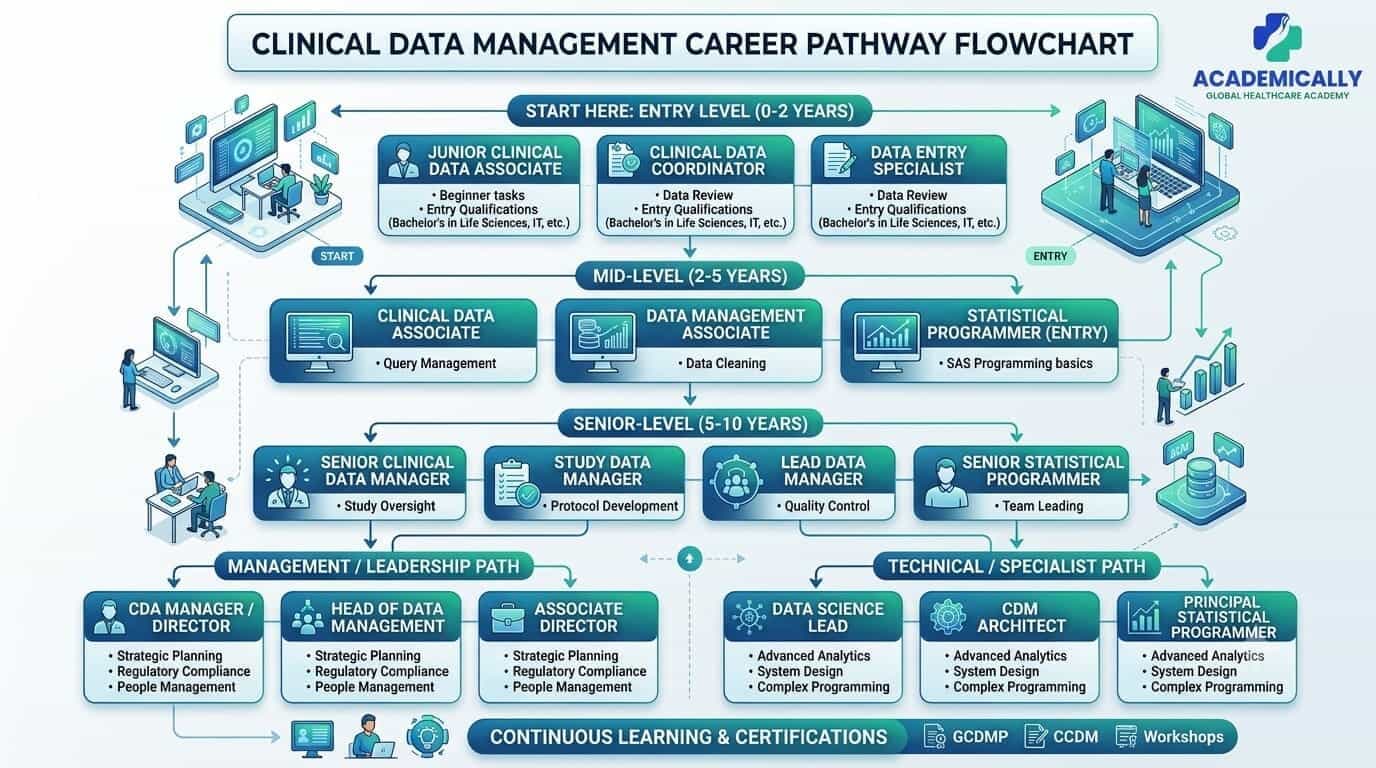
The exact titles vary among organizations.
Professionals can also move into related areas such as:
- Clinical programming
- Clinical research
- Clinical operations
- Statistical programming
- Real-world evidence
- Data analytics
- Medical writing
- Pharmacovigilance
- Clinical data science
How to Get a Clinical Data Management Job as a Fresher
Breaking into CDM as a fresher can be challenging, but a structured approach can improve your chances.
Step 1: Build a Foundation in Clinical Research
Start by understanding:
- Clinical trial phases
- Clinical trial protocols
- Good Clinical Practice (GCP)
- Informed consent
- Clinical trial documentation
- Safety and efficacy data
- Clinical trial terminology
Step 2: Learn Clinical Data Management Concepts
Understand the clinical data lifecycle, including:
Data collection → Data entry → Data validation → Query management → Data cleaning → Reconciliation → Database lock
Step 3: Develop Technical Skills
Familiarity with clinical data management systems can strengthen your profile.
Important areas to explore include:
- Electronic Data Capture (EDC) systems
- Clinical database concepts
- Data validation
- Query management
- Excel
- Basic SQL
- Clinical coding
- CDISC standards
Knowledge of platforms such as Medidata Rave, Oracle Clinical, or other EDC systems can be advantageous, although requirements vary by employer.
Step 4: Understand CDISC Standards
CDISC standards help create consistency in clinical research data.
Beginners should become familiar with terms such as:
- SDTM
- CDASH
- ADaM
- Controlled terminology
You do not necessarily need advanced programming knowledge to begin learning these concepts.
Step 5: Gain Practical Exposure
Courses and certifications can provide theoretical knowledge, but practical exposure can make your resume stronger.
You can create practice projects involving:
- Designing a sample CRF
- Creating data validation checks
- Identifying data discrepancies
- Managing sample queries
- Creating a simple data-cleaning workflow
Skills Required for Clinical Data Management Jobs
A successful clinical data management professional generally needs a combination of scientific, technical, and interpersonal skills.
Technical Skills
- Clinical database management
- EDC systems
- Microsoft Excel
- Data validation
- Query management
- Medical terminology
- Clinical coding
- CDISC standards
- Basic SQL
- Data reconciliation
Soft Skills
- Attention to detail
- Analytical thinking
- Communication
- Problem-solving
- Time management
- Documentation skills
- Team collaboration
- Quality orientation
Attention to detail is particularly important because even small inconsistencies in clinical trial data can affect downstream analysis and decision-making.
Clinical Data Management Salary in India in 2026
Salary varies significantly depending on experience, employer, location, technical skills, educational background, and job responsibilities.
For candidates in India, an approximate 2026 salary range may look like this:
| Experience | Typical Role | Approximate Annual Salary |
| 0–1 year | Trainee / Junior CDM / Coordinator | ₹3–5.5 lakh |
| 1–3 years | Clinical Data Coordinator / Associate | ₹4.5–8 lakh |
| 3–5 years | Clinical Data Manager | ₹7–12 lakh |
| 5–8 years | Senior Clinical Data Manager / Lead | ₹10–18 lakh |
| 8+ years | Manager / Senior Manager / Associate Director | ₹15–25+ lakh |
These are indicative ranges rather than guaranteed salaries. Actual compensation can be higher or lower depending on the organization, city, specialisation, and candidate profile.
Professionals with experience in EDC platforms, CDISC standards, automation, SQL, clinical programming, or data analytics may have stronger opportunities for higher-paying positions.
What Is the Salary of a Clinical Data Management Fresher in 2026?
A fresher entering clinical data management in India may typically start around ₹3–5.5 lakh per year, although the range varies considerably between companies and roles.
Entry-level positions may include:
- Clinical Data Management Trainee
- Clinical Data Coordinator
- Clinical Data Associate
- Junior Clinical Data Manager
- Clinical Research Data Coordinator
Rather than focusing only on the initial salary, beginners should evaluate opportunities at Jobslly based on training, technology exposure, project experience, career progression, and the quality of the organization.
A role that provides hands-on experience with recognized EDC platforms and clinical data standards can potentially create better long-term opportunities.
Clinical Data Management vs Clinical Research
Clinical research is a broad field, while clinical data management represents one specialized function within clinical research.
| Clinical Research | Clinical Data Management |
| Broad field covering clinical trials | Specialized data-focused function |
| May involve site and patient-facing activities. | Generally more data and process oriented |
| Includes clinical operations, safety, regulatory, etc. | Focuses on clinical trial data quality |
| Can involve site visits depending on role. | Many roles are office-based or remote/hybrid |
| Requires understanding of clinical trial operations | Requires clinical + data management knowledge |
For healthcare professionals who want to reduce direct patient interaction while remaining connected to clinical research, CDM can be an option worth exploring.
Is Clinical Data Management a Good Career in 2026?
Yes, CDM can be a promising career option for candidates who enjoy clinical research, data, technology, and quality-focused work.
However, it is important to understand that clinical data management is not simply an "easy non-clinical job." It requires continuous learning and attention to detail. As clinical research becomes increasingly technology-driven, professionals may need to develop additional capabilities in automation, analytics, data standards, and emerging technologies.
Future of Clinical Data Management
The future of CDM is likely to involve increasing automation and integration with advanced data technologies.
Artificial intelligence and automation may help with tasks such as:
- Data discrepancy detection
- Data review
- Query generation
- Risk identification
- Data quality monitoring
- Workflow automation
However, human expertise remains important for interpreting clinical context, evaluating discrepancies, maintaining data quality, and ensuring appropriate decision-making.
This means future CDM professionals may benefit from combining clinical knowledge + data management + technology skills.
How to Make Your Resume Stand Out for CDM Jobs
A strong entry-level resume should clearly demonstrate relevant knowledge rather than simply listing a healthcare degree.
Highlight:
- Clinical research knowledge
- GCP knowledge or training
- EDC exposure
- Excel and data-handling skills
- CDISC fundamentals
- Medical terminology
- Clinical coding knowledge
- Research projects
- Relevant certifications
- Attention to detail and analytical abilities
Healthcare graduates can also emphasise transferable skills gained through clinical practice, such as documentation, patient data interpretation, accuracy, teamwork, and understanding of medical terminology.
Conclusion
Clinical Data Management offers a structured pathway for professionals interested in moving into the growing clinical research and life-sciences industry. From entry-level coordinator roles to senior data management leadership positions, the field provides multiple opportunities for professional development.
For beginners, the best approach is to build a strong foundation in clinical research, learn the fundamentals of clinical data management, gain exposure to EDC systems and data standards, and develop practical data-handling skills.
If you are a healthcare professional considering a transition from clinical practice, clinical data management can be one of several non-clinical career paths worth exploring in 2026.