Clinical practice is a rewarding career path, but it is not necessarily the only way healthcare professionals can use their expertise. As professional interests, priorities, and career goals evolve, many doctors, dentists, nurses, pharmacists, and other healthcare professionals consider career changes from clinical practice.
Moving into a non-clinical career does not mean leaving healthcare behind. Instead, it can be an opportunity to apply clinical knowledge in areas such as medical writing, medical affairs, clinical research, pharmacovigilance, healthcare consulting,medical education, and digital health.
Why Are Healthcare Professionals Considering Career Changes from Clinical Practice?
Indeed clinical practice involves direct patient care but sometimes it can be highly demanding. However, changing professional priorities may encourage clinicians to explore alternative career paths.
Seeking better work-life balance
Long working hours, demanding schedules, administrative responsibilities, and the emotional demands of patient care can influence a clinician's decision to explore other opportunities.
Non-clinical roles may provide different working structures, including corporate, remote, hybrid, research, or project-based environments.
After gaining clinical experience, some healthcare professionals may want to develop skills beyond diagnosis and treatment.
They may become interested in:
- Scientific Communication
- Research
- Healthcare technology
- Data analysis
- Medical strategy
- Business and consulting
- Education and training
Discovering new career interests
Career changes do not always happen because someone dislikes clinical practice. Sometimes, clinicians simply discover another area of healthcare that interests them more.
What Career Options Are Available After Clinical Practice?
Healthcare professionals have several opportunities to build careers outside traditional patient-facing roles.
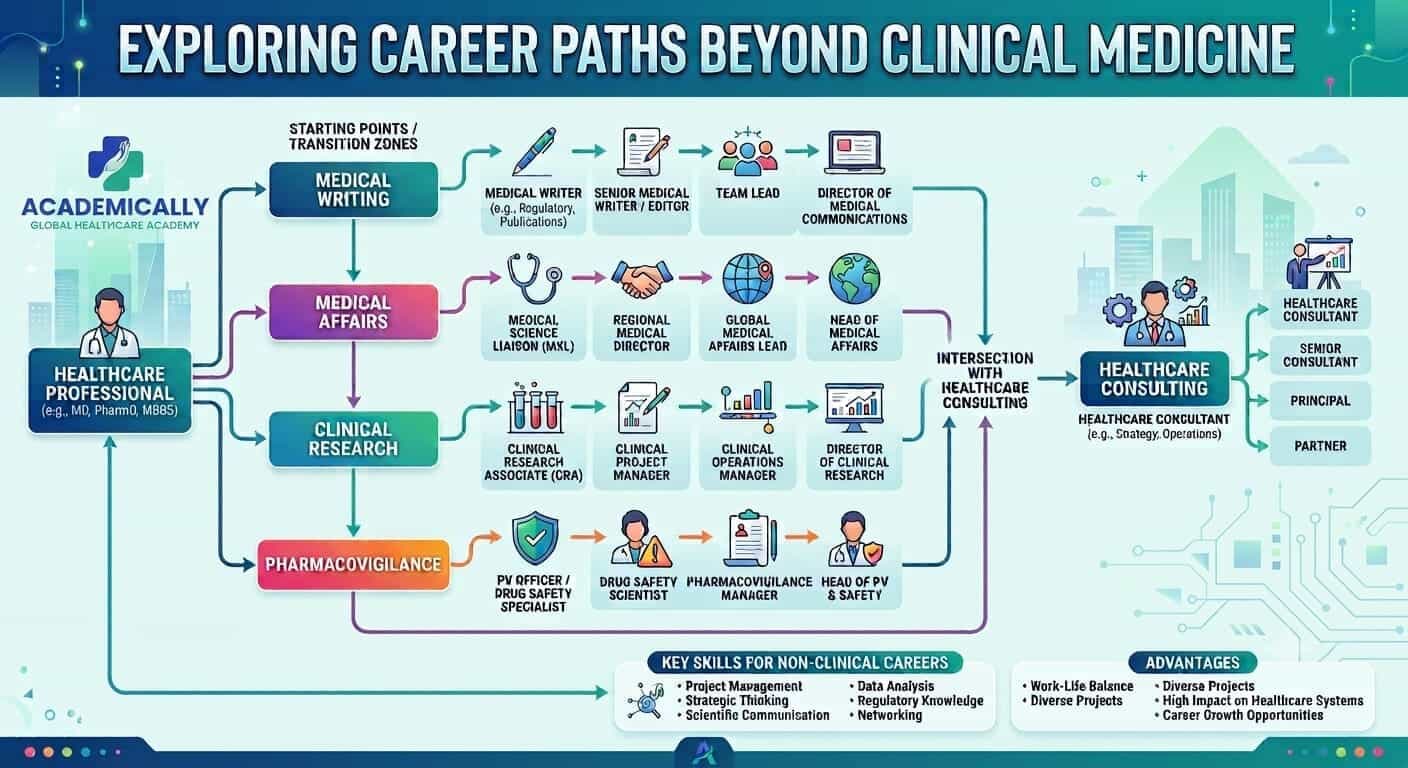
Medical Writing
Medical writing involves creating accurate, evidence-based content for different audiences.
What does a Medical Writer do ?
Depending on the organisation, medical writers may work on:
- Scientific articles
- Medical education content
- Patient education materials
- Clinical trial documents
- Regulatory documents
- Medical communications
- Literature summaries
- Website and healthcare content
Why is clinical experience valuable ?
Clinical professionals already understand medical terminology, disease processes, treatment approaches, and patient perspectives. These skills can provide a strong foundation for medical writing.
Medical Affairs
Medical affairs is another career option for clinicians who enjoy scientific communication and interaction with healthcare professionals.
Potential Medical Affairs Roles
These may include:
- Medical Science Liaison
- Medical Advisor
- Medical Information Specialist
- Medical Communications roles
Clinicians can use their knowledge while developing skills in stakeholder engagement, evidence communication, and medical strategy.
Clinical Research
Clinical research can be suitable for professionals who enjoy scientific investigation and evidence generation.
Career opportunities in Clinical Research
Possible roles include:
- Clinical research coordinator
- Clinical research associate
- Clinical trial associate
- Medical monitor
- Research-related project roles
Clinical experience can help professionals understand clinical workflows, patient populations, treatment protocols, and medical terminology.
Pharmacovigilance
Pharmacovigilance focuses on monitoring and evaluating the safety of medicines.
How can clinicians contribute?
Healthcare professionals can apply their clinical knowledge to activities such as adverse-event assessment, safety documentation, medical review, and drug-safety processes.
Healthcare Consulting
Healthcare consulting combines healthcare knowledge with business, analytical, and strategic thinking.
What can healthcare consultants work on?
Depending on the organization, projects may involve:
- Healthcare strategy
- Market research
- Healthcare operations
- Pharmaceutical strategy
- Patient-care models
- Healthcare technology
What skills can Clinicians transfer to Non-Clinical Careers?
A major advantage of transitioning from clinical practice is that clinicians already possess many transferable skills.
Clinical Knowledge
Understanding diseases, treatments, patient journeys, and clinical workflows can be valuable across multiple healthcare industries.
Communication Skills
Clinicians communicate complex medical information to patients, families, colleagues, and multidisciplinary teams. This experience can translate into scientific communication and stakeholder management.
Critical Thinking
Clinical practice requires professionals to assess information, identify problems, evaluate evidence, and make decisions. These skills are valuable in research, consulting, medical affairs, and writing.
Documentation and Attention to Detail
Clinical documentation requires accuracy and consistency. These qualities are particularly useful in medical writing, research, regulatory, and pharmacovigilance roles.
Teamwork and Collaboration
Healthcare professionals regularly work with multidisciplinary teams. This experience can help them transition into cross-functional corporate environments.
How to Successfully Make a Career Change from Clinical Practice?
Changing careers requires more than simply applying for non-clinical jobs. A structured approach can make the transition more effective.
Identify your career direction
Start by understanding what type of work interests you.
Ask yourself:
- Do I enjoy writing and communication?
- Do I enjoy research and scientific literature?
- Do I prefer data and analysis?
- Do I enjoy interacting with healthcare professionals?
- Do I want a patient-facing or non-patient-facing role?
Assess your existing skills
Create two lists:
- Skills I already have and
- Skills required for my target role
Then identify the gaps between them.
Develop new skills
Once you identify your target career, focus on developing relevant competencies.
Useful skills may include:
- Scientific writing
- Research methodology
- Medical communication
- Data interpretation
- Presentation skills
- Regulatory knowledge
- Project management
- Business communication
- Digital tools
Build a Portfolio
Certificates can demonstrate that you have completed training, but practical work can demonstrate what you can actually do.
For example, someone transitioning into medical writing could create:
- A scientific article
- A clinical trial summary
- A literature review
- A patient education article
- A medical presentation
- A scientific communication sample
Update your Resume and LinkedIn Profile
Your resume should not present you only as someone trying to "leave clinical practice."Instead, highlight how your clinical experience relates to the new role.
For example:
- Clinical documentation > Scientific documentation
- Literature review > Evidence synthesis
- Patient Communication > Stakeholder communication
- Clinical decision-making > Analytical thinking
- Multidisciplinary teamwork > Cross-functional collaboration
Network with Professionals
Networking can help you understand what different non-clinical roles actually involve. Connect with professionals working in your target field, attend webinars, participate in professional communities, and seek informational conversations. Rather than immediately asking for a job or referral, focus on understanding the career path and skills required.
Should you leave Clinical Practice immediately?
Not necessarily.
Consider a gradual transition
If your circumstances allow, you can explore your new career while continuing some clinical work.
You could:
- Learn the required skills.
- Complete relevant certifications.
- Build a portfolio.
- Network with professionals.
- Apply for internships or entry-level positions.
- Gain practical experience.
- Gradually transition into new role.
When a Complete Career Shift May Be Better
For some professionals, balancing clinical work with career development can become exhausting.
If maintaining both careers affects productivity, professional growth, or personal well-being, choosing one direction may be more sustainable.
There is no single correct approach. The right decision depends on individual circumstances and career goals.
What Challenges Can You Expect During a Career Change?
Career transitions can be exciting, but they can also be uncomfortable.
Fear of starting again
One of the biggest concerns is feeling like you are starting from zero. However, you are not starting from zero. Your clinical education and experience have already given you valuable knowledge and professional skills.
Lack of direct experience
Some employers may prefer candidates with industry experience. This is where internships, projects, freelance work, certifications, and portfolios can help demonstrate your ability.
Adjusting to a new work environment
Moving from a clinic or hospital to a corporate or remote environment can require adjustment. You may need to become familiar with:
- Corporate communication
- Meetings and presentation
- Project management
- Deadlines
- Cross-functional teams
- Performance metrics
Managing self-doubt
It is normal to question whether you are making the right decision. Instead of comparing your beginning in a new field with someone else's years of experience, focus on building one skill at a time.
Is a career change from clinical practice worth it ?
A career change can be worthwhile when the new direction aligns with your skills, interests, values, and long-term goals.
Questions to Ask Yourself Before Making the Move
Consider:
- What do I enjoy about my current career?
- What do I want to change?
- Which parts of clinical practice do I want to retain?
- Which non-clinical areas genuinely interest me?
- What skills do I need to develop?
- Can I financially manage the transition?
- What type of work environment do I want?
These questions can help you make a career decision based on clarity rather than temporary frustration.
Final thoughts on career changes from clinical practice
Career changes from clinical practice can feel like a major leap, but they do not have to mean abandoning your healthcare identity.
Your clinical background can become the foundation for a new career in medical writing, medical affairs, clinical research, pharmacovigilance, healthcare consulting, digital health, medical education, and other growing areas.
The key is to identify the right direction, understand the skills required, build practical experience, and learn how to communicate the value of your clinical background.
A career change is not necessarily a step away from healthcare. Sometimes, it is the new way of building ourselves.