Path 1: The ADC Route - The Fastest Way to PR and a High-Paying Dental Career
This is the route most overseas-trained dentists should aim for, and for good reason. Dentistry sits on Australia's Medium and Long-term Strategic Skills List (MLTSSL), which means once you clear the ADC exam and secure provisional AHPRA registration, you become eligible for skilled migration visas, Subclass 189 (Skilled Independent), 190 (State Nominated), or 491 (Regional). The points test requires a minimum of 65, but competitive invitations for the 189 visa typically need 85 or more. A dentist with a recognised degree, IELTS 8.0, and even a year of supervised practice in an area of need can realistically score around 90 points, a strong position for an invitation.
And the payoff is real. As of 2026, the average dentist salary in Australia sits between AUD 215,000 and 245,000 per year, according to SEEK and ERI compensation data, among the highest-earning healthcare professions in the country. Specialists and private practice owners can earn considerably more.
But here's the part most guides skip: passing ADC is genuinely difficult, and a lot of otherwise well-prepared dentists lose time and money to avoidable mistakes.
Where Dentists Actually Go Wrong
| Mistake | Why It Costs You | How to Avoid It |
|---|---|---|
| Losing track of exam validity windows | Initial assessment expires after 7 years; only 3 years to clear the practical after passing ADC written exam | Plan backward from these deadlines from day one |
| Assuming they can work clinically while preparing | No temporary registration pathway exists — not even under supervision | Treat full ADC clearance as the only route to legal practice |
| Treating English proficiency as an afterthought | Minimum Grade B in each OET component (or IELTS equivalent) is required | Prepare English requirements early, in parallel with clinical study |
| Self-studying without structure | Scenario-based questions reward applied clinical reasoning, not memorisation | Get structured feedback on how you reason through cases, not just what you know |
| Not budgeting the true total cost | Practical exam alone costs AUD 4,000–5,000; total pathway often AUD 7,000–9,000+ | Budget the full pathway cost upfront, including Melbourne travel |
| Applying for skilled migration too early | Cannot be assessed under the Dentist occupation category before ADC/AHPRA registration | Secure ADC/AHPRA registration before lodging an EOI |
How to Actually Pass ADC With Confidence
This is exactly why structured preparation matters more than raw study hours. Academically's ADC Exam Preparation Course is built around avoiding precisely these mistakes, live interactive classes with AHPRA-registered faculty, a structured curriculum mapped to the real ADC blueprint, scenario-based practice questions, and AI-based mock tests that mirror the actual exam format. Instead of guessing what “clinical reasoning the ADC way” looks like, you learn it directly from people who've taken candidates through it before. If deadlines and validity windows are your biggest risk, a structured course with a clear timeline is the single best insurance against losing years to a missed window.
Path 2: Getting PR Without the ADC Exam
If your goal is Australian PR, not specifically practising clinically as a dentist, there's an alternative route: study a relevant postgraduate qualification in Australia, work in a related non-clinical field, and pursue permanent residency through that route instead. But be careful, this is where most students get seriously misled.
The biggest misconception: a Masters degree does NOT lead directly to PR.
A lot of students assume that once they finish a course like a Master of Public Health, permanent residency more or less follows. It doesn't. Most of these non-clinical health fields aren't occupations that sit cleanly on Australia's skilled occupation list at all, MPH graduates, for example, don't get to claim “Public Health” as a PR-eligible occupation just by holding the degree. The degree only opens the door to a job. Everything that actually leads to PR happens after that, and it's a longer, harder, and far less certain road than the ADC pathway.
How the Masters Route Actually Works, Step by Step
- Enrol in a relevant Masters degree in Australia (Student visa, Subclass 500)
- Graduate and move to a Temporary Graduate visa (Subclass 485), giving 2-3 years of full-time work rights depending on qualification level
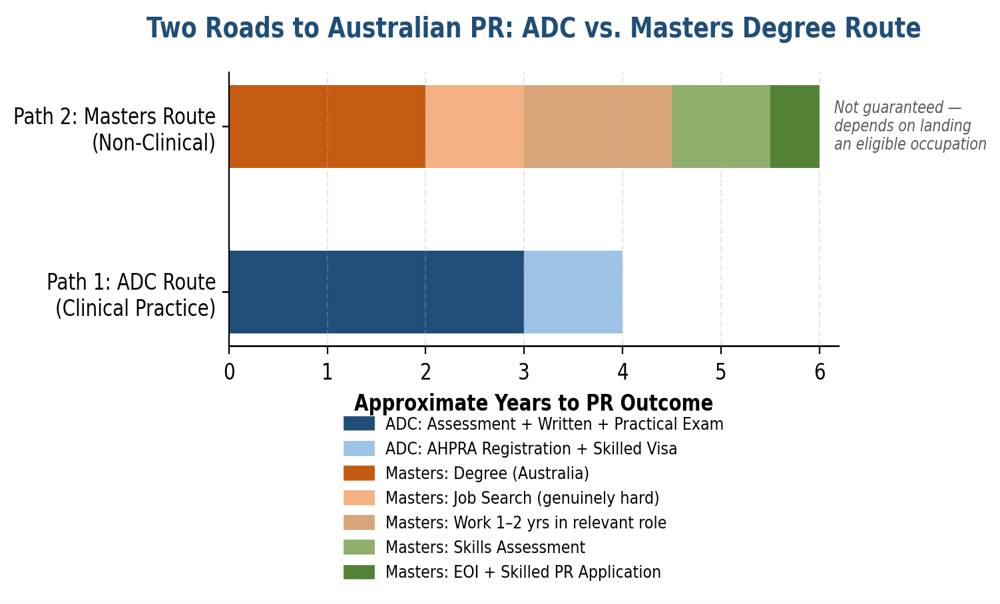
- Find a job in a genuinely relevant field, and this is the hard part. Competition is real, visa-sponsorship-friendly employers are limited, and this stage alone can take many graduates a year or more
- Work in that role for 1–2 years to build the experience needed
- Get a formal skills assessment for an occupation that's actually on the relevant skilled occupation list, this only works if your job role maps to an eligible ANZSCO occupation, which isn't guaranteed for every health-adjacent role
- Submit an Expression of Interest (EOI) and apply for a skilled visa, only after all of the above is in place
This is a genuinely long journey, realistically 5–7 years from starting the Masters to a PR outcome, if it works out at all and every stage depends on the one before it. Unlike the ADC route, where “pass ADC → eligible occupation → clear points pathway” is well-defined, this route only works if you land a job that maps to an eligible occupation, and that's the part most students underestimate.
Healthcare-Related Masters Degrees Dentists Commonly Pursue
Important: holding one of these degrees does not, by itself, qualify you for PR. Whether this route works for you depends entirely on finding a job afterward whose occupation is genuinely on the skilled list, verify this before enrolling, not after.
| Degree | Leads To |
|---|---|
| Master of Public Health | Health promotion, disease prevention, community health programs |
| Master of Health Administration / Management | Hospital and healthcare system management roles |
| Master of Biomedical Science / Biomaterials Research | Research roles, academic pathways, PhD progression |
| Master of Health Policy | Roles shaping healthcare systems rather than delivering clinical care |
| Postgraduate education/teaching qualifications | Teaching in dental hygiene, dental assisting, or foundational science subjects |
One important caution: this route only works for non-clinical pathways. Don't confuse this with Dental Hygienist or Dental Therapist roles, those still require their own separate AHPRA registration and assessment process, and you cannot practise in them without it either.
This path takes considerably longer than going straight through ADC, doesn't lead to clinical practice as a dentist in Australia, and unlike ADC doesn't guarantee PR even if you do everything right, since it depends on landing a job in an occupation that's actually on the skilled list. If your priority is genuinely PR and you're prepared for a long, uncertain journey with the option to explore ADC later, it's a real, legal route. But go in with realistic expectations, not the assumption that the degree alone gets you there.
Ready to start your ADC journey the right way? Book a free 1:1 counselling session with Academically's ADC exam experts and get a personalised roadmap — not a guessing game.