Over 60% of pharmacy and life science graduates actively look for non-clinical pharmaceutical employment for higher earning potential and rapid career growth.
If you are looking to move into high impact healthcare areas, two niche areas dominate the industry landscape – Biostatistics and Health Economics and Outcomes Research (HEOR).
To understand what these career paths look like in practice, let’s take a look at the journey of Aastha and Neha.
They were both pharmacy graduates who wanted the same thing: to get into corporate medical affairs. While Neha joined the executive program in medical affairs, Aastha joined the same program just one month later.
As they moved through the curriculum, they came onto the full module on Biostatistics and HEOR.
That was their light bulb moment.
Biostatistics & HEOR: What Is the Core Mission?
Both positions are identical. However, their main objectives are somewhat different.
Biostatistics is the science of designing clinical trials, analysing data from the protocols and drawing mathematically correct conclusions. Biostatisticians guarantee that clinical trials fulfil the high regulatory standards of bodies like the US FDA and EMA.
HEOR links therapeutic effectiveness to economic value. HEOR professionals examine if a new drug provides enough therapeutic benefit for its costs and convince health authorities and insurance payers to reimburse the treatment.
| Biostatistics | HEOR | |
| Core purpose | Generate and interpret reliable statistical evidence | Understand the value and real-world impact of healthcare interventions |
| Main focus | Clinical trials, study design, analysis, efficacy and safety | Outcomes, costs, cost-effectiveness, quality of life and healthcare value |
| Typical evidence | Clinical trial data | Trial data, observational data, RWE, claims and outcomes data |
| Decision supported | Is the treatment effect credible and well characterised? | Is the intervention valuable relative to available alternatives? |
| Major stakeholders | Clinical teams, statisticians, regulators and research leaders | Payers, HTA bodies, market-access teams and healthcare decision-makers |
Biostatistics asks you to understand the evidence.
HEOR asks you to understand what the evidence means for value and decisions.
Aastha and Neha: Same Qualification, Different Questions
As their Medical Affairs training progressed, their interests became clearer.
| Their preference | Aastha | Neha |
| Enjoyed most | Data and statistical reasoning | Outcomes and healthcare value |
| Preferred question | “Is the result statistically reliable?” | “Is the intervention cost-effective and valuable?” |
| Strongest interest | Clinical trials and analysis | Economic evaluation and RWE |
| Work style | Structured and quantitative | Interdisciplinary and strategic |
| Career direction | Biostatistics | HEOR |
This is one of the biggest advantages of understanding adjacent healthcare functions before you commit to one.
You may enter a programme thinking Medical Affairs is your destination and realise that your strongest fit actually lies in a specialised function within the wider ecosystem.
What Does a Biostatistician Actually Do?
Aastha initially thought a biostatistician simply “worked with numbers.”
She quickly discovered that the role starts much earlier.
A biostatistician can contribute to clinical-trial design, endpoints, sample-size considerations, analysis plans, treatment-effect estimation, subgroup analyses, safety analyses and interpretation of results. Statistical reasoning also supports the evidence submitted for regulatory decision-making.
Biostatistics Skill Toolkit
| Skill | Why it matters |
| Clinical-trial design | Helps structure scientifically sound studies |
| Statistical inference | Supports reliable conclusions |
| Survival analysis | Common in time-to-event research |
| Regression methods | Helps examine relationships and treatment effects |
| Statistical Analysis Plans | Defines how trial data will be analysed |
| R / SAS | Common programming tools in clinical research |
| Data interpretation | Converts analysis into meaningful evidence |
So when Aastha started exploring jobs, she understood something important:
Knowing software is not the same as knowing biostatistics.
The technical toolkit matters, but understanding why and when to use a method matters even more.
Biostatistics Career Flow
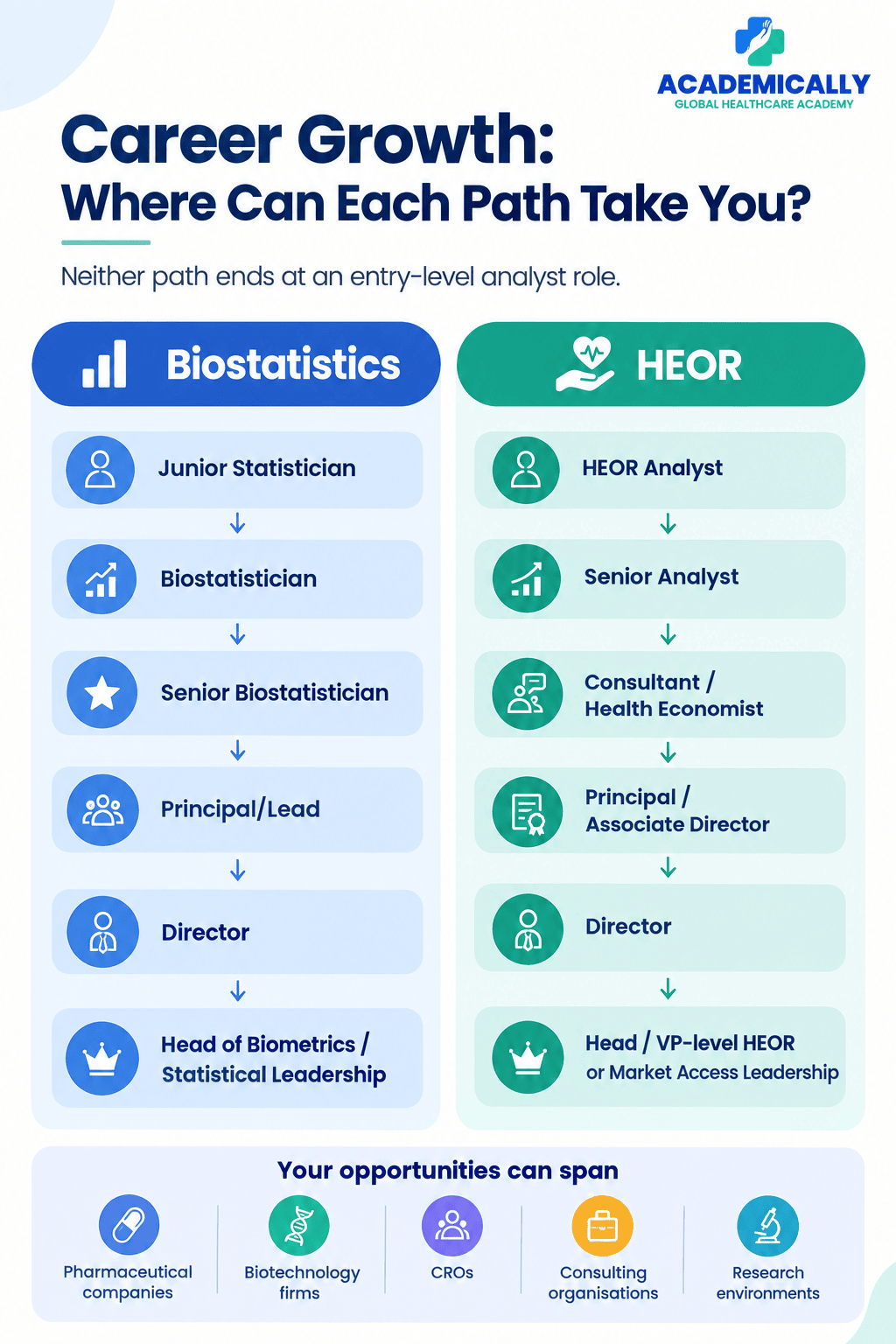
Pharmacy background ↓ Statistics & research foundation ↓ R/SAS + clinical-trial skills ↓ Entry-level role ↓ Biostatistician ↓ Senior/Lead ↓ Leadership |
What Does an HEOR Professional Actually Do?
Neha’s learning experience went in another direction.
She became interested in the question that comes after clinical evidence:
What does that evidence mean when healthcare systems have limited resources?
HEOR can involve economic evaluation, outcomes research, health technology assessment, real-world evidence, evidence synthesis and value communication.
HEOR Skill Toolkit
| Skill | Why it matters |
| Economic evaluation | Compares costs and outcomes |
| Cost-effectiveness analysis | Supports value comparisons |
| Cost-utility analysis | Can incorporate QALYs |
| Decision-tree modelling | Useful for short-term decisions |
| Markov modelling | Useful for longer-term disease pathways |
| Evidence synthesis | Brings multiple evidence sources together |
| R / STATA | Used in quantitative analysis depending on role |
| RWE / claims analysis | Helps understand real-world outcomes and utilisation |
HEOR Career Flow
Pharmacy background ↓ HEOR fundamentals ↓ Economic evaluation + RWE + modelling ↓ Analyst/Associate ↓ HEOR Specialist / Health Economist ↓ Senior/Principal ↓ Leadership |
Biostatistics vs HEOR: Which Skills Will You Use?
This is where the difference becomes much clearer.
| Skill area | Biostatistics | HEOR |
| Statistics | ★★★★★ | ★★★★ |
| Clinical-trial design | ★★★★★ | ★★ |
| Programming | ★★★★ | ★★★ |
| Economic modelling | ★ | ★★★★★ |
| RWE | ★★★ | ★★★★★ |
| Evidence synthesis | ★★★ | ★★★★ |
| Healthcare economics | ★ | ★★★★★ |
| Regulatory evidence | ★★★★★ | ★★★ |
| Market access | ★ | ★★★★★ |
The stars are a practical comparison of typical emphasis.
What Could Your Day Look Like?
Those questions shape their working days.
| Daily responsibility | Biostatistics | HEOR |
| Analyse clinical data | ✓ | Sometimes |
| Develop statistical methods | ✓ | Sometimes |
| Draft SAPs | ✓ | — |
| Support trial design | ✓ | — |
| Build economic models | — | ✓ |
| Conduct cost-effectiveness work | — | ✓ |
| Analyse RWE | ✓ | ✓ |
| Support HTA / market access | Sometimes | ✓ |
| Communicate evidence | ✓ | ✓ |
Career Growth: Where Can Each Path Take You?
What About Salary?
For a Biostatician:
| Career Level | Typical Experience | Common Job Titles | Indicative Salary |
| Entry Level | 0–2 years | Junior Biostatistician, Biostatistician, Statistical Analyst | ₹5–9 LPA |
| Mid Level | 3–6 years | Biostatistician II, Senior Biostatistician | ₹9–18 LPA |
| Senior Level | 7–12 years | Senior/Lead Biostatistician, Principal Biostatistician | ₹18–30 LPA |
| Executive / Leadership | 12+ years | Associate Director, Director, Head of Biostatistics | ₹30–50+ LPA |
For HEOR:
| Career Level | Typical Experience | Common Job Titles | Indicative Salary |
| Entry Level | 0–2 years | HEOR Analyst, Research Analyst, HEOR Associate | ₹5–9 LPA |
| Mid Level | 3–6 years | HEOR Specialist, Senior Analyst, HEOR Consultant | ₹9–18 LPA |
| Senior Level | 7–12 years | Senior HEOR Consultant, HEOR Manager, Senior Manager | ₹18–30+ LPA |
| Executive / Leadership | 12+ years | Associate Director, Director, Head of HEOR/Market Access | ₹30–50+ LPA |
Actual compensation varies according to employer, experience, technical skills, job title, location and function.
As you can see, the salary ranges for Biostatistics and HEOR are broadly similar across different career levels. What truly sets these two career paths apart is what the job entails, the problems you solve, and the core skills required to succeed in each role.
How Aastha and Neha Turned Learning Into Job Applications
Once they knew which direction they preferred, they stopped applying to everything.
They changed their CVs around the roles they wanted.
Aastha highlighted her statistical, research and analytical strengths.
Neha highlighted her understanding of outcomes, economics, evidence and healthcare value.
Then they searched for relevant openings and applied strategically.
Career Application Flowchart
Learn ↓ Identify your strongest interests ↓ Build specialised skills ↓ Create a targeted CV ↓ Find relevant healthcare roles ↓ Apply ↓ Prepare for interviews ↓ Get placed |
A platform such as Jobslly can help make that final transition easier by bringing healthcare-focused jobs into one place.
Biostatistics vs HEOR: Which Career Is Right for You?
| Choose Biostatistics when you… | Choose HEOR when you… |
| Enjoy mathematics and statistics | Enjoy interdisciplinary problem-solving |
| Like structured datasets | Like combining multiple evidence sources |
| Enjoy clinical-trial methodology | Enjoy economics and outcomes |
| Want deeper statistical programming | Want modelling and value assessment |
| Prefer methodological analysis | Prefer science plus strategy |
| Enjoy answering “How strong is the evidence?” | Enjoy answering “What is the value?” |
The right career is the one whose problems you genuinely enjoy solving.
Both Aastha and Neha started with the same degree.
They entered the same type of programme.
They wanted the same end result.
But once they were exposed to the wider healthcare ecosystem, they discovered that they were built for different kinds of work.
That is why learning the fundamentals of both biostatistics and HEOR before choosing your direction can be so useful.
Still feeling confused?