What if the most important person behind a clinical trial decision is not the doctor treating the patient, the researcher running the study, or even the person monitoring the trial?
It might be the person asking a much less visible question: “Can we actually trust what these numbers are telling us?”
That is where biostatistics enters clinical research.
Every clinical study produces data, but data alone cannot tell you whether a treatment works, whether an observed difference is meaningful, or whether the results are robust enough to support a scientific or regulatory decision. A biostatistician helps answer those questions.
This is what makes biostatistician jobs in clinical research particularly interesting for healthcare professionals who enjoy science, analytical thinking and evidence-based decision-making but do not want their entire career to remain patient-facing.
What Is Biostatistics?
Biostatistics is the application of statistical methods to biological and medical problems. A biostatistician applies those methods to questions involving health, disease, treatments, populations and clinical research.
In clinical research, your job is not simply to “run statistics.” You help determine how a study should be designed, how many participants are needed, which outcomes should be analysed, which statistical methods are appropriate, how missing data should be handled and how the results should ultimately be interpreted.
Your work can therefore begin before the first participant enters a trial and continue through analysis, reporting and regulatory review.
What Role Does a Biostatistician Play in Clinical Research?
Clinical research is broader than clinical trials. It includes areas such as epidemiology, outcomes research, health-services research and studies involving interventions. Clinical trials are one important part of that larger research ecosystem.
A biostatistician becomes particularly important when research generates quantitative evidence that needs to be designed, analysed and interpreted rigorously.
For example, during a clinical trial, you may contribute to:
- Study design and statistical planning
- Sample-size and power considerations
- Randomisation approaches
- Definition and analysis of endpoints
- Statistical Analysis Plans
- Analysis of efficacy and safety data
- Subgroup and sensitivity analyses
- Interpretation of treatment effects
- Tables, listings and figures
- Clinical Study Reports and regulatory documentation
| Clinical research → Clinical trial design → Data generation → Statistical analysis → Interpretation → Evidence for decisions |
That entire chain explains why biostatistics is so closely linked with clinical research.
Biostatistics vs Clinical Research: How Do They Overlap?
| Clinical Research | Biostatistics |
| Asks clinically relevant research questions | Helps translate those questions into measurable statistical objectives |
| Defines study objectives and outcomes | Helps determine appropriate analysis methods |
| Conducts or coordinates research activities | Designs and evaluates statistical approaches |
| Generates and manages study data | Analyses and interprets the data |
| Follows ethical and regulatory requirements | Applies statistical principles within the research and regulatory framework. |
| Produces clinical evidence | Helps determine how strong, precise and reliable that evidence is. |
The two are not competing careers. Biostatistics is one of the specialist functions that supports clinical research.
What Skills Do You Need for Biostatistician Jobs in Clinical Research?
The most important mistake you can make is learning software before learning statistics.
Your technical toolkit matters, but employers ultimately need you to understand why a particular method should be used and what its results mean.
Core skills include:
1. Statistical foundations: probability, descriptive statistics, hypothesis testing, confidence intervals, regression and experimental design.
2. Clinical-trial statistics: randomisation, endpoints, sample-size principles, missing data, survival analysis and interpretation of treatment effects. ICH E9 and E9(R1) provide the regulatory framework around many of these principles.
3. Programming and data skills: SAS and R are the two main statistical programming environments, but statistical positions more broadly may also use SPSS, Python, SQL and other analytical tools.
4. Communication: You should be able to communicate statistical results to clinicians, researchers, programmers, project teams, and regulatory stakeholders.
Where Do The Skills of Biostatistics, Medical Affairs and Clinical Drug Development Intersect?
There is a meaningful overlap, particularly around clinical evidence, research methodology, data interpretation, scientific communication and cross-functional collaboration.
Medical Affairs places greater emphasis on scientific exchange, evidence strategy and external stakeholder engagement, and clinical drug development spans study planning, execution and development decision-making.
| Skill / Capability | Biostatistics | Medical Affairs | Clinical Drug Development |
| Clinical research knowledge | High | High | High |
| Study design | High | Moderate–High | High |
| Statistical analysis | High | Moderate | High |
| Data interpretation | High | High | High |
| Evidence generation | High | High | High |
| Literature evaluation | High | High | High |
| Clinical endpoints & outcomes | High | High | High |
| Regulatory knowledge | High | High | High |
| Scientific communication | High | High | High |
| Cross-functional collaboration | High | High | High |
| Therapeutic-area knowledge | Moderate–High | High | High |
| Statistical programming | High | Low–Moderate | Moderate |
| Evidence strategy | Moderate | High | High |
| Scientific stakeholder engagement | Low–Moderate | High | Moderate–High |
This means that a healthcare professional moving into one of these areas may already have part of the foundation.
Structured transition support can make your path easier. Academically has already helped a number of healthcare professionals build transitions beyond traditional clinical careers, helping professionals identify transferable strengths and develop the additional industry skills they need.
What Does Career Growth Look Like?
Your career growth depends on whether you move deeper into statistical programming, biostatistical analysis, study leadership, methodology or management.
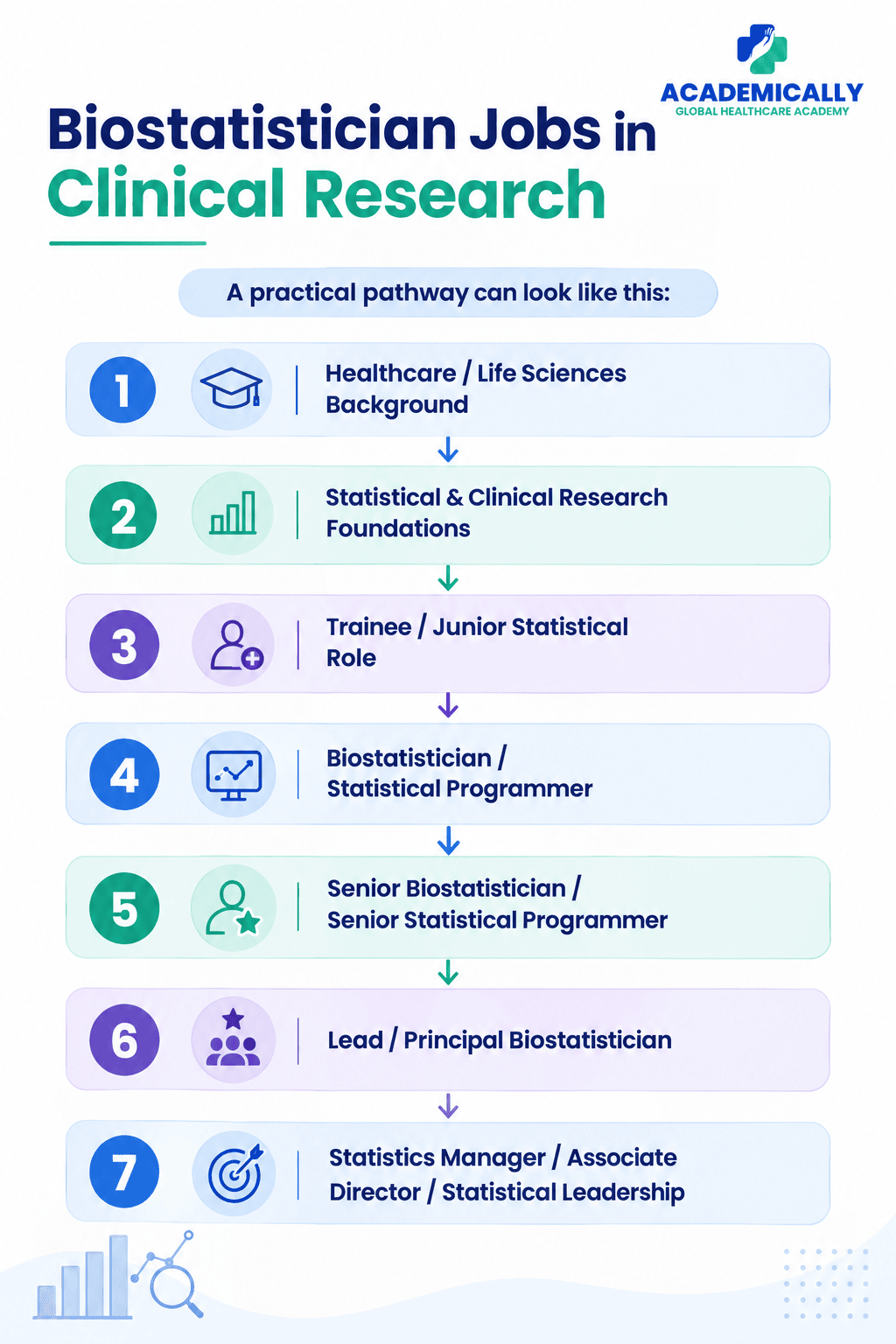
Early in your career, you may spend significant time preparing datasets, programming analyses, validating outputs and supporting study deliverables.
As you become more experienced, your responsibilities can shift toward statistical strategy, SAP development, study design, interpretation, review and communication with senior scientific or regulatory stakeholders.
You do not necessarily have to follow a single straight-line career path either. A healthcare professional who develops strong evidence-generation, data interpretation and research skills can potentially move between adjacent functions over time.
| Career Stage | Typical Focus |
| Healthcare / Life Sciences Background | Clinical knowledge and domain expertise |
| Statistical & Clinical Research Foundations | Statistics, research methodology and clinical-trial concepts |
| Trainee / Junior Statistical Role | Data preparation, programming and analysis support |
| Biostatistician / Statistical Programmer | Statistical analyses, programming and study deliverables |
| Senior Biostatistician / Senior Statistical Programmer | Advanced analyses, SAPs, study support and interpretation |
| Lead / Principal Biostatistician | Statistical strategy, study design and scientific leadership |
| Statistics Manager / Associate Director | Team leadership, strategic oversight and cross-functional decision-making |
What Skills Do You Already Have as a Healthcare Professional?
This is where your healthcare background becomes an advantage.
You already understand:
- Disease mechanisms and clinical terminology
- Medicines and treatment mechanisms
- Clinical endpoints and patient outcomes
- Pharmacology and therapeutic areas
- How healthcare data is generated
- Medical literature and evidence
- The practical context behind clinical decisions
A doctor, pharmacist, nurse, dentist or other healthcare professional may therefore need to strengthen the quantitative side of their profile rather than start from zero.
What you need to add is statistical theory, research methodology, statistical programming and the ability to interpret clinical datasets confidently.
That distinction is important: domain knowledge helps you understand the question; biostatistical knowledge helps you answer it rigorously.
This distinction matters when you are considering more than one non-clinical career path. The same foundation in clinical knowledge, evidence appraisal, research methodology and scientific communication can potentially support transitions into biostatistics, Medical Affairs or clinical drug development, provided you build the specific technical competencies expected in your target role.
What Salary Can a Biostatistician Earn?
Biostatistician salaries vary by experience, role, employer and location. The following figures provide a salary reference for India and the U.S.
| Career Level | Salary in India | Salary in the U.S. |
| Early Career | ₹3.84 lakh/year | $64,000–$82,220/year |
| Mid-Career | ₹5.8–₹8.0 lakh/year | $82,220–$105,650/year |
| Experienced | ₹9 lakh+/year | $105,650–$141,490/year |
Where to Find Relevant Job Opportunities ?
Look beyond generic clinical research jobs or biostatistician roles alone.
Biostatistics skills can be relevant across different areas of clinical research and life sciences, so you can explore opportunities across:
-Pharmaceutical and biotech companies
-Contract Research Organisations (CROs)
-Research institutes and academic organisations
But finding the right healthcare-focused opportunities can itself be a challenge. Search platforms such as LinkedIn, Naukri and Internshala contain thousands of listings, but finding roles that are genuinely relevant to healthcare professionals can mean filtering through a large number of unrelated positions.
That is exactly why Academically launched Jobslly. It is a dedicated healthcare-only job portal designed to bring healthcare opportunities together in one place.
From clinical-research positions to non-clinical, pharmaceutical and life-science careers, Jobslly is built specifically around healthcare professionals, so you can spend less time searching through irrelevant listings and more time finding opportunities that actually match your background and career goals.