Best Country for Indian Dentists ADC vs ORE vs NDEB vs DHA 2027 Comparison

Written by

Co-Author

Created On : Aug 13, 2026 Updated On : Aug 13, 2026 3 Min

Quick Summary: 

Choosing the best country for Indian dentists depends on your budget, English proficiency, career goals, and timeline. Australia (ADC) offers strong earning potential and one of the clearest PR pathways, making it ideal for dentists with good finances and confident English. The UK (ORE) provides solid salaries and job security but has significant practical exam capacity constraints. Canada (NDEB) offers excellent long-term opportunities but is the most expensive and can take the longest. DHA in Dubai/Gulf is the fastest and most affordable option, making it suitable for dentists who need to start earning sooner or build clinical experience and savings.

In short, choose ADC for PR and long-term settlement, ORE for the UK, NDEB for Canada, or DHA as a lower-cost stepping stone toward a future international dental career.

If you're a BDS, MDS, or DDS graduate weighing where to take your dental career next, you've probably landed on these four names: ADC (Australia), ORE (UK), NDEB (Canada), and DHA (Gulf/Dubai). Each one leads somewhere genuinely good but they are not interchangeable, and the right answer depends less on which country “sounds best” and more on your budget, your English confidence, and how much time you can commit before earning again. Here's the honest, side-by-side breakdown.

Quick Comparison: Cost & Timeline
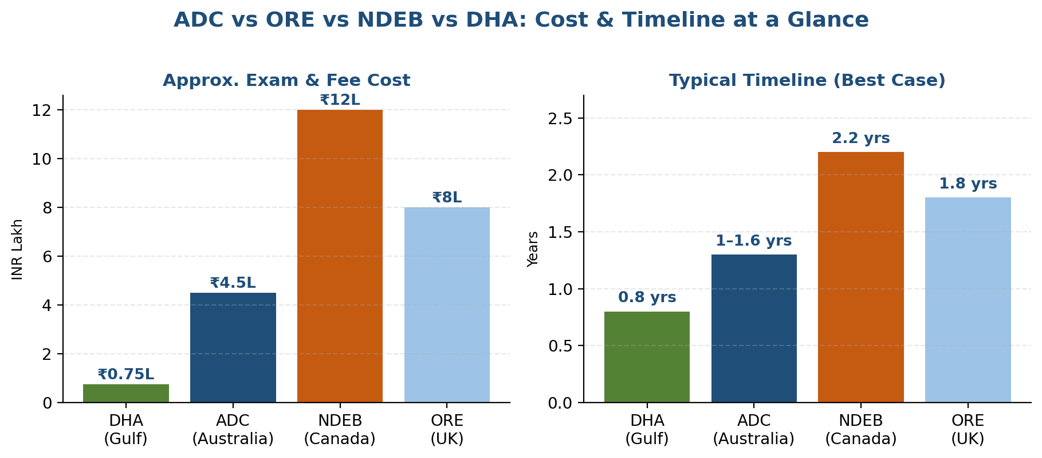
Full Comparison Table

FactorADC (Australia)ORE (UK)NDEB (Canada)DHA (Gulf/Dubai)
Exam structureInitial Assessment → Written → PracticalPart 1 (written) → Part 2 (practical)AFK → ACJ → NDECCSingle computer-based exam
Where you can sit examsWritten stages via Pearson VUE in India; Practical in Melbourne onlyPart 1 at international centres; Part 2 in the UK onlyAFK/ACJ at international centres; NDECC in Ottawa onlyPrometric centres in India; license activation in Dubai
Approx. total exam cost~AUD 7,500 (~₹4.1L)~£5,700+ (~₹6L+)~CAD 8,850 base; often CAD 15–30K+ with prep (~₹9–18L+)~AED 3,000 (~₹75,000)
Typical timeline1–1.6 years1.5–2+ years (Part 2 heavily bottlenecked)1.5–3 years (NDECC heavily bottlenecked)Often under 1 year
Biggest bottleneckPractical exam only in MelbourneOnly ~144 Part 2 seats per sitting worldwideOttawa-only test centre; tiered backlog systemMax 3 attempts, then a 2-year block
Prior work experience neededNot mandatory, fresh graduates eligible1,600 clinical hours requiredNot mandatory upfront2 years post-internship required
Average dentist salaryAUD 215K–245K (~₹1.18–1.35Cr)£45K–95K (~₹50L–1.05Cr)CAD 130K–220K+ (~₹85L–1.4Cr+, wide range by source)AED 10K–45K/month, tax-free (~₹27L–1.2Cr+/yr)
PR / long-term settlementStrong, well-defined path (MLTSSL + points test)Possible, less direct than AustraliaPossible via provincial licensing + Express Entry/PNPNo PR/citizenship path — residency tied to employment

ADC (Australia) - Best for Strong Finances + Good English

This is the pathway we recommend most often, and for good reason. You can complete the Initial Assessment and Written Examination stages from India through Pearson VUE, only the Practical Examination requires travel to Melbourne. Once you clear ADC exam and secure AHPRA registration, Australia offers genuinely high earning potential (AUD 215,000–245,000 average), a real work-life balance most Indian dentists find hard to believe until they experience it, and one of the clearest, most defined PR pathways of any Western country, dentistry sits on the Medium and Long-term Strategic Skills List (MLTSSL), with well-understood points-test requirements.

Who this suits: dentists with solid financial backing (realistically ₹6–8 lakh or more to cover the full pathway comfortably, including travel and prep) and confident English - IELTS 7+ or equivalent OET scores. If that's you, ADC exam is very likely your fastest, most defined route to a genuinely excellent outcome.

Academically provides structured coaching for the ADC exam pathway, live interactive classes, scenario-based practice questions, and AI-based mock tests built around the real ADC exam blueprint, so you're not guessing your way through a high-stakes, deadline-driven process alone.

ORE (UK) - Strong Salary, But a Real Capacity Bottleneck

The ORE route leads to solid earning potential and high job security, given the UK's ongoing dentist shortage. But there's a structural problem worth knowing before you commit: ORE Part 2 only offers around 144 practical exam seats per sitting worldwide. That bottleneck, more than the exam's difficulty, is what stretches many candidates' timelines well past a year for the practical stage alone. Budget for genuine patience here, not just genuine study effort.

Who this suits: dentists prepared for a longer, more competitive queue in exchange for the UK's strong NHS job security and salary progression. 

NDEB (Canada) - Highest Cost, Longest Realistic Timeline

Canada's three-stage AFK → ACJ → NDECC process is thorough, and the destination salary is genuinely excellent but this is the most expensive of the four pathways by a wide margin, especially once structured prep courses are factored in. It also carries its own significant bottleneck: the NDECC clinical exam is held only in Ottawa, and a tiered backlog system introduced in 2025 was created specifically to manage a serious seat shortage.

Who this suits: dentists with the highest budget tolerance of the four options and no urgency to start earning within the first two years.

DHA (Gulf/Dubai): Best for Lower Budget or Weaker English, as a Stepping Stone

This is the pathway we recommend specifically for dentists who don't yet have the ~₹6–8 lakh budget or the strong English confidence that Australia, the UK, or Canada realistically call for. DHA is dramatically cheaper (~₹75,000 total), faster (often under a year), and the English bar is more forgiving in day-to-day clinical practice than an OSCE-style Western exam. The trade-off: you need 2 years of post-internship clinical experience to even qualify, and there's no path to permanent residency or citizenship, your status stays tied to your employment.

The smart strategy we recommend for many candidates in this position: use the Gulf as a genuine stepping stone, not a final destination. Go, build 2–3 years of paid clinical experience, save meaningfully (salaries are tax-free), and use that time to seriously strengthen your English. Many dentists who start this way move on to ADC, NDEB, or ORE a few years later; arriving with more money in the bank, more clinical confidence, and a stronger English foundation than they had straight out of BDS.

So, Which Country Is Actually Best?

  • Strong finances (₹6–8L+) and confident English, want the clearest PR pathway → ADC (Australia)
  • Want UK-level salary and NHS job security, and can handle a competitive exam queue → ORE (UK)
  • Highest budget tolerance, no urgency to start earning quickly, want Canada specifically → NDEB (Canada)
  • Lower budget or weaker English right now, want fast, affordable experience-building first → DHA (Gulf), then reassess Australia/Canada/UK in 2–3 years

Not sure which pathway actually fits your budget, English level, and timeline? Book a free 1:1 counselling session with Academically's experts and get a personalised recommendation — not a generic comparison.

FAQs

Which country is best for Indian dentists - Australia, UK, Canada, or Gulf?

It depends on your budget, English confidence, and timeline. Australia (ADC) offers the clearest PR pathway for those with strong finances and English. The Gulf (DHA) is the fastest, most affordable option and works well as a stepping stone for those building funds and confidence first.

Can I write the ADC exam from India?

Yes. The Initial Assessment and Written Examination stages can be completed via Pearson VUE centres in India. Only the Practical Examination requires travel to Melbourne, Australia.

How much does it cost to become a dentist in Australia vs UK vs Canada vs Dubai?

Approximate total exam costs: ADC (Australia) ~₹4.1 lakh, ORE (UK) ~₹6 lakh+, NDEB (Canada) ~₹9–18 lakh+ with prep, DHA (Dubai) ~₹75,000. Real totals vary with travel, English test fees, and retakes.

Which pathway is fastest for Indian dentists?

DHA (Gulf) is typically fastest, often under a year given its single-exam structure. ADC (Australia) is a close second at 1-1.6 years for many candidates. ORE (UK) and NDEB (Canada) usually take longer - 1.5–3+ years, largely due to their practical exam bottlenecks.

Is DHA a good option for dentists with weak English?

Yes, DHA's English requirements are more forgiving than the OSCE-style assessments used by ADC, ORE, or NDEB, making it a realistic entry point while you build English confidence for a Western-country pathway later.

Can Gulf work experience help me qualify for ADC or NDEB later?

Yes. Clinical experience gained in the Gulf strengthens your overall profile and skills, though you'll still need to independently meet each country's specific exam and eligibility requirements, experience alone doesn't substitute for ADC, ORE, or NDEB assessments.

Which country offers the easiest PR for dentists?

Australia currently offers the clearest, most defined PR pathway for dentists, since dentistry sits on the Medium and Long-term Strategic Skills List (MLTSSL) with well-understood points-test requirements. The UK and Canada have PR routes too, but they're less direct. The Gulf offers no PR or citizenship pathway.

Do I need work experience before applying for ADC, ORE, NDEB, or DHA?

ADC and NDEB don't require prior work experience upfront, fresh graduates are eligible. ORE requires 1,600 clinical hours. DHA requires 2 years of post-internship clinical experience.

Which country has the highest dentist salary?

Australia and Canada both show strong average salaries (roughly ₹1.2–1.4 crore range depending on source and experience), with the UK close behind. Gulf salaries are also strong and fully tax-free, though the ceiling for general dentists is typically lower than in Australia or Canada.

Is the UK ORE exam harder to pass than ADC?

Difficulty is comparable, but ORE's real challenge is capacity, not content, only around 144 Part 2 seats are available per sitting worldwide, which creates long queues regardless of how well-prepared you are.

Why is the NDEB pathway so expensive?

Base NDEB exam fees run about CAD 8,850, but most candidates also invest in structured prep courses given the exam's difficulty and the high cost of a failed attempt, pushing realistic total costs to CAD 15,000–30,000 or more.

Should I choose the Gulf first and then move to Australia or Canada?

For candidates without the budget or English confidence to start with ADC, ORE, or NDEB directly, this is often the smartest sequence: build 2–3 years of paid clinical experience and savings in the Gulf, strengthen your English, and then pursue Australia, Canada, or the UK from a stronger financial and clinical position.

What English test do I need for each pathway?

ADC and NDEB typically accept IELTS, OET, or PTE at healthcare-specific score thresholds. ORE has similar English requirements under GDC standards. DHA's English bar is comparatively more forgiving, though strong communication skills still matter for the Oral Assessment stage if required.

Can MDS specialists get extra advantages in any of these countries?

Yes, specialists generally command premium salaries across all four destinations, particularly in the Gulf's private sector and in Australia and Canada's specialist practice settings. Specific recognition pathways for specialty qualifications vary by country and should be checked individually.

How does Academically help with ADC exam preparation?

Academically's ADC Exam Preparation Course offers live interactive classes with AHPRA-registered faculty, a curriculum mapped to the real ADC blueprint, scenario-based practice questions, and AI-based mock tests built specifically to help you navigate the process and its deadlines with confidence, not guesswork.
Dr. Akram Ahmad

BPharm, PharmD, PhD (University of Sydney, Australia)

about the author

Dr. Akram Ahmad, PhD, is a clinical pharmacist, researcher and healthcare educator with more than 14 years of teaching and research experience across India, Malaysia and Australia. He completed his PhD at the Faculty of Medicine and Health, University of Sydney, where his research focused on medication safety and health outcomes, and has authored over 110 peer-reviewed publications in international journals.

He is the founder and CEO of Academically Global, a healthcare education company that has supported more than 10,000 doctors, dentists, pharmacists, nurses and physiotherapists across 88 countries, and of Jobslly, a healthcare careers platform. He is a TEDx speaker and has been featured on JioHotstar and Wikipedia, and has mentored healthcare professionals in both university and industry settings.

Dr. Ahmad writes and speaks on two areas in particular: international licensing pathways for healthcare professionals, including the AMC (Australia), USMLE (USA), OPRA (Australia and New Zealand), PEBC (Canada), PSI (Ireland) and DHA/MOH (Gulf) examinations, and non-clinical career transitions into pharmacovigilance, Medical Affairs/MSL, clinical research, medical writing and regulatory affairs.

His goal with every article is simple: to give healthcare professionals accurate, practical information about global career options that no one taught them in college.

Find him on:    Google Scholar · Wikipedia · ORCID · YouTube