Australia stands to be one of the most attractive destinations for physiotherapists worldwide. It is due to their high salary, work-life balance and one of the easiest registration pathways. There are more than 40,000 physiotherapists employed nationally. They enjoy a great work-life balance with continued annual growth.
In this blog, you will get to know how to become a physiotherapist in Australia. You will also receive updated information about the new entry pathway registration details. Stay tuned for career prospects and visa options in 2026.
Are Physiotherapists in Demand in Australia?
You can earn a huge salary as a physiotherapist in Australia. Recent data show an average annual income of approximately AUD 95,000. Experienced clinicians earn above AUD 100,000 to AUD 120,000 per year. The figures depend on location, experience, and specialisation. Regional areas pay more to their physios due to the shortage and high demand.
Demand is mainly strong in rehabilitation, geriatric care, sports medicine, and disability support services. Employers are actively seeking both domestic and internationally trained physiotherapists to fill critical skills gaps. This demand is reflected in ongoing recruitment and visa sponsorship opportunities, especially in regional and underserved areas of the country.
It means there are strong employment prospects nationally and regionally. Especially in musculoskeletal care, sports rehabilitation, community health, and aged-care settings.
Do BPT, MPT, and DPT Graduates Follow Different Registration Pathways?
One of the most common misconceptions among internationally trained physiotherapists is that the degree title alone determines the Australian registration pathway. In reality, the Australian Physiotherapy Council (APC) assesses candidates based on their qualification, registration status, country of training, and eligibility for specific pathways such as APEP, FLYR, or Express FLYR.
Whether you hold a Bachelor of Physiotherapy (BPT), Master of Physiotherapy (MPT), or Doctor of Physiotherapy (DPT), your route depends on the APC eligibility criteria rather than the degree title itself.
- A BPT is usually an entry-level qualification.
- An MPT is a postgraduate qualification.
- A DPT is an entry-level doctorate in some countries.
But APC does not place you based on the title alone. It looks at your overseas physiotherapy qualification, your registration status, and whether you fit APEP, FLYR, or Express FLYR criteria.
A BPT graduate from India will usually move through APEP unless they also meet a fast-track country route. An MPT does not automatically create a faster route. A DPT can fit a faster pathway only when the country and registration rules match the relevant FLYR criteria. For example, the US FLYR page explicitly includes both bachelor’s and DPT entry-level qualifications for approved states.
Australian Physiotherapy Entry Pathway (APEP) for Overseas Trained Physiotherapists
APEP is designed to make the assessment process more accessible, efficient, and reflective of clinical practice in the Australian context. You can complete almost the whole of the registration process from the comfort of your home.
Key Stages of APEP
- Eligibility Assessment
You must provide documented proof of your overseas physiotherapy qualification and clinical experience. - Cultural Safety Training
It is a mandatory step in which you will demonstrate understanding of culturally safe practice in Australia. - Remote Written Assessment
A theory-based examination that evaluates your core physiotherapy knowledge according to Australian standards. - Capability Assessment
A remote, live, open-book oral exam that tests clinical reasoning, communication, and applied knowledge. This is a new feature of APEP.
Did you just see… You can complete most of the process online, from the comfort of your home, and there’s no clinical assessment like earlier.
5. Face-to-Face Clinical Workshop
A full-day practical workshop conducted in small groups in Melbourne. It mainly focuses on real-world clinical skills pertaining to Australian standards.
Once you successfully complete all stages, you receive a Final Certificate from the APC, confirming you meet the Australian physiotherapy practise standards.
Which Pathway Suits You?
Australia now has three distinct council routes for overseas-qualified physiotherapists:
- Australian Physiotherapy Entry Pathway (APEP)
- Facilitated Limited Year Registration (FLYR), and
- Express FLYR.
APEP is the refined and a more streamlined entry pathway for international physiotherapists. It is conducted by the Australian Physiotherapy Council (APC). It requires an overseas physiotherapy qualification plus unrestricted registration in the country of training. More than 90% of the registration process is online so you don't need to travel to Australia to giving the exams.
APEP suits you best if:
- You are trained outside an approved FLYR/Express FLYR jurisdiction
- You are comfortable with a pathway that includes remote assessments plus a Melbourne clinical workshop.
- You are planning for a process that takes about 9 months for the fastest candidates.
- Current 2026 APC fees for APEP total $7,814 and you have an opportunity of an ROI of average AUD 95,000 per year when you work as a physiotherapist.
FLYR suits you best if:
- You are trained and registered in an approved FLYR country, including the Netherlands, Singapore, Sweden, or the US states of Texas, Massachusetts, or California.
- You are comfortable with a fully remote process that includes Eligibility Assessment, Cultural Safety Training, and a Written Assessment
- The current 2026 fee total is $3,422 and you have an opportunity of an ROI of average AUD 95,000 per year when you work as a physiotherapist.
Express FLYR suits you best if:
- You are trained and registered in an approved Express FLYR jurisdiction, including Canada, the UK, Ireland, Hong Kong, or South Africa.
- It only requires Eligibility Assessment and Cultural Safety Training, which is fully remote.
- The current 2026 fee total is $1,650.
Note: Express FLYR route is the fastest route of all. It takes just 3 weeks to process your applications and get, set, go to Australia.
What if I am already working as a physio in the Gulf, UK or Singapore?
Many internationally trained physiotherapists considering Australia are not fresh graduates. They may already be practising in countries such as the UK, Singapore, the UAE, Saudi Arabia, Qatar, Oman, Bahrain, or Kuwait. Your current registration and country of qualification can significantly influence which Australian Physiotherapy Council pathway is available to you.
- Express FLYR is built for UK-trained physios with HCPC registration within the past 5 years.
- If you are in Singapore, the Council’s FLYR page specifically lists Singapore as an approved country, with eligibility being a Singapore physiotherapy bachelor’s degree and AHPC registration within the past 5 years.
- If you are working in the Gulf, the current official FLYR and Express FLYR country lists do not include Gulf jurisdictions. So you must go for APEP pathway.
Registration and Licensing With AHPRA
Registration requires:
- A recognised qualification or APC Final Certificate
- Meeting AHPRA’s standards for English language proficiency and professional practice
- Demonstrating fitness to practise (health and professional indemnity requirements)
Once registered, you can work as an independent clinician in hospitals, private practices, community health, sports clinics, or aged-care facilities.
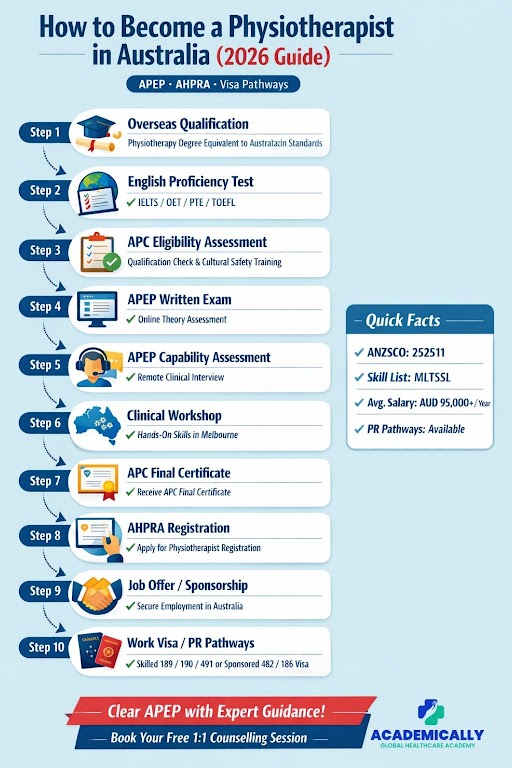
Skills Assessment and Classification- ANZSCO 252511
A physiotherapist (ANZSCO 252511) is classified as Skill Level 1. It means you must have a bachelor's degree or higher in physiotherapy and a positive Skills Assessment to qualify for skilled visas.
The Australian Physiotherapy Council (APC) is the official assessing authority for this occupation. It evaluates whether your education and experience meet the Australian standard.
A positive skills assessment is a prerequisite for Expressions of Interest (EOI) and visa lodgement under points-tested and sponsored immigration streams.
English Language Requirements
You must demonstrate competent English proficiency skills through one of the standard tests (IELTS, OET, PTE, TOEFL iBT). Standard minimum requirements are typically:
- IELTS: 7.0 overall with no band less than 7.0
- OET: B in all subtests and all skills except writing (C+ accepted)
- PTE Academic: 65 overall with minimum communicative scores (56 accepted in writing)
- TOEFL iBT: Total and section requirements as specified (Minimum total score of 94 and section requirements as specified)
Meeting high levels of English proficiency is important for both registration with AHPRA and scoring points for skilled migration.
Visa Options for Physiotherapists
Physiotherapists can pursue several visa pathways depending on their circumstances:
Employer-Sponsored Visas
Subclass 482: Skills in Demand (SID) Visa
Allows qualified physiotherapists to work in Australia with an approved employer sponsor. Depending on the stream and eligibility criteria, the visa can provide a pathway to permanent residency through employer-sponsored programs such as the Subclass 186 visa.
Subclass 186: Employer Nomination Scheme
A permanent residency visa for skilled workers nominated by an Australian employer. Physiotherapists may qualify through Direct Entry or Temporary Residence Transition pathways, depending on their circumstances and work history.
Temporary Graduate Visa
- Subclass 485 – Graduate Work
For recent graduates from Australian institutions on an Australian student visa. Physiotherapy graduates can use this to gain work experience.
Skilled Migration Visas
- Subclass 189 – Skilled Independent (no sponsor required)
- Subclass 190 – Skilled Nominated (state/territory nomination)
- Subclass 491 – Skilled Work Regional (Provisional) (regional nomination)
Physiotherapist (ANZSCO 252511) is a high-priority healthcare occupation that remains eligible for Australia's skilled migration and employer-sponsored visa programs. Applicants generally require a positive skills assessment, English language proficiency, and must satisfy the eligibility requirements of the relevant visa pathway.
Career Roles and Specialisations
Completed your registration? Congratulations! You can now apply to jobs as physiotherapists in Australia. These are some of the range of specialisations and career pathways you can explore.
Clinical Physiotherapist
Work in hospitals, outpatient clinics, private practices, rehabilitation centres, or community health services. Your daily focus will be patient assessment, therapy planning, and functional rehabilitation.
Sports Physiotherapist
Manage sports injuries and help athletes improve performance. These roles are especially prominent in Australia’s active sports culture.
Geriatric Physiotherapist
Support older adults to maintain strength, mobility, independence, and quality of life, particularly in aged-care facilities.
Pediatric Physiotherapist
Specialise in treating infants, children, and adolescents. Help alleviate developmental, neuromuscular, or orthopedic issues.
Occupational Physiotherapist
Focus on workplace health, ergonomics, injury prevention, and rehabilitation after workplace injuries.
Research and Academic Roles
Participate in research or teaching positions in universities or research institutions to help advance physiotherapy practice.
Progress from BPT Graduation in India to Your First Physiotherapy Paycheque in Australia
We've compiled a step-by-step timeline for an Indian physiotherapist using the APEP pathway. Actual timelines vary depending on assessment dates, visa processing, and job search outcomes. Let's have a look.
Month 0: Collect Credentials of Your Physiotherapy Degree
Graduate with your BPT, MPT, or DPT qualification. Start collecting:
- Degree certificate
- Academic transcripts
- Internship completion certificate
- State physiotherapy registration documents
- Employment records (if applicable)
- Passport and identity documents
Goal: Ensure all documents are ready for APC assessment.
Month 1: English Proficiency Test and APC Eligibility Assessment
Submit your eligibility application to the Australian Physiotherapy Council (APC). At the same time:
- Book IELTS, OET, PTE, or TOEFL iBT
- Begin Cultural Safety Training
- Gather any additional documents requested by APC
Goal: Receive eligibility approval and satisfy English language proficiency requirements.
Months 2–4: Prepare for and Complete the Written Assessment
Sit for the APEP Written Assessment
This stage evaluates:
- Musculoskeletal physiotherapy
- Neurological physiotherapy
- Cardiopulmonary physiotherapy
- Paediatric and geriatric care
- Professional and ethical practice
Most candidates spend several weeks preparing through self-study, mentorship, or structured coaching.
Goal: Pass the Written Assessment and move to the next stage.
Months 4–6: Capability Assessment
Attend the remote Capability Assessment.
This live online assessment focuses on:
- Clinical reasoning
- Patient management decisions
- Communication skills
- Evidence-based practice
- Professional judgment
Unlike the previous assessment system, this stage is conducted remotely and is open-book.
Goal: Demonstrate safe and competent clinical decision-making.
Month 7–8: Clinical Workshop in Melbourne
Travel to Australia for the face-to-face Clinical Workshop. The workshop focuses on:
- Hands-on physiotherapy skills
- Patient interaction
- Clinical communication
- Australian practice standards
- Professional conduct expectations
This is generally a one-day practical workshop conducted in small groups.
Goal: Successfully complete the final APEP requirement.
Month 8–9: Receive APC Final Certificate
Obtain your APC Final Certificate. At this stage, you are eligible to proceed with registration. Begin preparing:
- AHPRA application
- Professional indemnity requirements
- Identity verification documents
Goal: Become eligible for physiotherapy registration in Australia.
Month 9–10: AHPRA Registration
Apply for General Registration with AHPRA. After approval, you can legally practise as a physiotherapist anywhere in Australia. Many candidates begin interviewing even before registration is formally finalised.
Goal: Obtain unrestricted registration as a physiotherapist.
Month 10–11: Job Search and Visa Processing
Apply for roles in:
- Private practices
- Hospitals
- Rehabilitation centres
- Community health services
- Aged-care facilities
- Sports clinics
At the same time:
- Apply for a skilled migration visa or employer-sponsored visa
- Finalise relocation plans
- Secure accommodation
Goal: Receive a job offer and complete visa arrangements.
Month 11–12: Relocate to Australia
Move to Australia and begin employment.
Common first destinations include:
- Sydney
- Melbourne
- Brisbane
- Perth
- Adelaide
- Regional centres offering relocation support
During your first few weeks, you'll complete workplace orientation and adapt to Australian clinical documentation systems.
Goal: Start practising as a registered physiotherapist.
Month 12+: First Australian Paycheque
Receive your first salary as a physiotherapist in Australia. At this stage, you can begin:
- Building Australian clinical experience
- Pursuing specialisations
- Exploring employer sponsorship opportunities
- Working towards permanent residency pathways
Estimated total journey: 9–12 months for well-prepared candidates, although timelines may vary depending on assessment availability, registration processing, visa approvals, and employment outcomes.
How Much Does It Cost to Become a Physiotherapist in Australia?
One of the most common questions among internationally trained physiotherapists is how much they should budget for registration, migration, and relocation. While exact costs vary depending on your pathway, visa category, city of destination, and lifestyle, it is important to plan for both registration expenses and settlement costs.
Australian Physiotherapy Council (APC) Fees
The APC pathway fee depends on the route you qualify for. Let's take a look below.
Pathway | Approximate Cost (AUD) |
APEP | AUD 7,814 |
FLYR | AUD 3,422 |
Express FLYR | AUD 1,650 |
These fees cover the assessment stages required to demonstrate that your qualifications and competencies meet Australian standards.
AHPRA Registration Costs
After successfully completing the APC pathway, you must obtain registration through AHPRA.
Expense | Approximate Cost (AUD) |
Application Fee | AUD 434 |
Annual Registration Fee | AUD 211 |
These fees may change annually based on regulatory updates.
English Language Proficiency Test
If you do not already meet an accepted English-language standard, you will need to take an approved test.
Examination | Approximate Cost |
IELTS Academic | AUD 445–470 equivalent |
OET | AUD 587 |
PTE Academic | AUD 475 equivalent |
The exact amount depends on the testing location and exchange rates.
Visa Application Costs
Visa expenses vary according to the pathway selected.
Visa Type | Government Fee (from) |
Subclass 189 | AUD 4,910 |
Subclass 190 | AUD 4,910 |
Subclass 491 | AUD 4,910 |
Subclass 482 | AUD 3,210 |
Subclass 186 | AUD 4,910 |
Additional charges may apply for partners, dependent children, health assessments, police clearances, and migration agent services.
Travel and Relocation Costs
Candidates should also budget for:
- One-way flight to Australia
- Temporary accommodation
- Rental bond and advance rent
- Local transportation
- Basic household setup
- Health insurance (where applicable)
Estimated relocation budget: AUD 3,000–8,000
The figure depends heavily on your destination city and whether you relocate alone or with family.
First Three Months of Living Expenses
Your initial settlement period often requires the largest financial buffer.
Typical costs include:
- Accommodation
- Utilities
- Groceries
- Public transport
- Mobile and internet services
- Daily living expenses
For most physiotherapists relocating independently, a budget of AUD 5,000–10,000 for the first three months is considered prudent, though costs are higher in Sydney and Melbourne.
Estimated Total Investment
APEP Candidate
Expense Category | Estimated Cost (AUD) |
APC Fees | 7,814 |
AHPRA Fees | 645 |
English Test | 450–600 |
Visa Application | 3,210–4,910+ |
Relocation | 3,000–8,000 |
First 3 Months Living | 5,000–10,000 |
Estimated Total | AUD 20,000–32,000+ |
FLYR Candidate
Expense Category | Estimated Cost (AUD) |
APC Fees | 3,422 |
Remaining Costs | Similar |
Estimated Total | AUD 15,000–27,000+ |
Express FLYR Candidate
Expense Category | Estimated Cost (AUD) |
APC Fees | 1,650 |
Remaining Costs | Similar |
Estimated Total | AUD 13,000–25,000+ |
Expert Tips
Many physiotherapists focus only on registration fees and underestimate relocation costs. A more realistic approach is to prepare a budget that covers registration, migration, travel, and at least three months of living expenses before your first Australian paycheque. This provides greater flexibility during your job search and transition period.
Registration and relocation process requires a significant investment of time and money. Many internationally trained physiotherapists have successfully navigated the pathway and built rewarding careers in Australia. Here are some real-world examples of candidates who took different routes to achieve the same goal.
Real Candidate Journeys: How Overseas Physiotherapists Successfully Moved Towards Australia
Every physiotherapist's journey to Australia is different. Some are experienced clinicians, some are recent graduates, and others are balancing work and family commitments while preparing for registration assessments. These real-world examples demonstrate how different candidates successfully navigated the Australian Physiotherapy Entry Pathway (APEP).
Case Study 1: Shravani: From India to the Maldives to Australia Through APEP
Shravani's journey demonstrates that moving to Australia does not always happen in a single step. After completing her BPT and MPT and working in India, she found herself facing a challenge familiar to many physiotherapists: high clinical workload but limited financial growth. Despite having strong qualifications and hospital experience, she realised that funding the Australian registration process directly would be difficult.
Instead of giving up on her goal, she adopted a strategic approach. She secured a physiotherapy position in the Maldives, where she gained international clinical exposure and significantly improved her earning potential. The move allowed her to save for registration costs while strengthening her professional profile.
Using this experience as a stepping stone, she prepared for the Australian Physiotherapy Entry Pathway (APEP), successfully cleared the assessment process, and progressed towards registration in Australia. Her story highlights an alternative route that many physiotherapists overlook: building international experience in countries such as the Maldives, UAE, Qatar, or Saudi Arabia before pursuing Australia.
Starting Point: BPT and MPT-qualified physiotherapist from India
Biggest Challenge: Limited salary growth in India and insufficient savings to immediately pursue Australian registration
Key Strategy: Worked in the Maldives to gain international experience and build financial readiness for APEP
Outcome: Successfully cleared APEP and moved closer to practising as a physiotherapist in Australia.
Case Study 2: Dr. Jayasri: Turning a Setback into Success
Dr. Jayasri's experience highlights that not every successful candidate clears every stage on the first attempt. After narrowly missing the required score in her initial Written Assessment, she reassessed her preparation strategy and focused on strengthening key areas of physiotherapy practice.
While balancing professional responsibilities and family commitments, she invested time in case-based learning, mock assessments, and targeted revision. Her persistence paid off when she successfully passed the assessment on a subsequent attempt and continued her APEP journey.
Starting Point: Experienced physiotherapist preparing for Australian registration
Biggest Challenge: Missing the passing score during the first Written Assessment attempt
Outcome: Successfully cleared the assessment after refining her preparation strategy
Case Study 3: Amritpal Singh: Clearing APEP on the First Attempt
Amritpal Singh, a Bachelor of Physiotherapy graduate from India, accumulated more than seven years of clinical experience before deciding to pursue Australia. He became one of the early overseas physiotherapists to successfully clear the new APEP Capability Assessment on his first attempt after the pathway's introduction.
His preparation focused heavily on structured clinical reasoning, case-based practice, and communication skills. Rather than relying solely on textbook knowledge, he concentrated on understanding how Australian physiotherapy assessments evaluate decision-making, patient safety, and evidence-based practice.
His journey demonstrates how experienced clinicians can leverage their existing knowledge while adapting to Australian standards and assessment formats.
Starting Point: Experienced physiotherapist from India with 7+ years of practice
Biggest Challenge: Adapting to Australian clinical reasoning expectations
Outcome: Cleared the APEP pathway and moved closer to Australian registration
Average Salary and Job Openings
Physiotherapists in Australia earn competitive salaries that reflect qualification level, experience, and location:
- Average annual salary: Around AUD 90,000 to AUD 100,000+ (varies by state and role)
- Salaries can exceed this in senior clinical, specialised or managerial roles
According to recent workforce projections, there is a growing demand for physiotherapists across multiple settings, translating into thousands of job openings annually. The Australian Physiotherapy Council is inviting applications for overseas physiotherapists. It is the best time for you to make a decision.
Day-to-Day Roles and Responsibilities of a Physiotherapist
Physiotherapists play a multifaceted role in healthcare, including:
- Assessment: Evaluating movement, strength, flexibility, and functional limitations.
- Treatment Planning: Designing tailored treatment plans.
- Therapeutic Interventions: Manual therapy, exercises, modalities, and mobility training.
- Pain Management: Addressing chronic and acute pain conditions through evidence-based approaches.
- Rehabilitation: Supporting recovery post-injury or surgery.
- Education: Teaching patients and families about self-management and injury prevention.
- Collaboration: Working within multidisciplinary healthcare teams.
Tips for Success
- Prepare Early for APEP: Take a good APEP coaching that has experienced mentors, use official resources, expert-recommended books and connect with peers.
- Build Clinical Experience: Relevant experience strengthens both migration and employment prospects.
- Research Visa Streams: Points-tested visas like 189/190 require strong English scores and strategic points claims.
- Engage with Migration Professionals: Registered migration agents can provide personalised advice.
Conclusion
Becoming a physiotherapist in Australia in 2026 is an achievable and rewarding professional journey. With structured pathways like APEP, clear licensing standards and robust visa options, international physiotherapists have strong opportunities to build a long-term healthcare career.
Your success depends on careful planning, preparation for the competency assessments, meeting registration standards, and selecting the right visa pathway that aligns with your professional and personal goals. With the right strategy, you can establish a fulfilling physiotherapy career in Australia’s dynamic health system.