The Australian Medical Board has released their proposed changes to the Australian Standard Pathway for 2027. This may offer Indian international medical graduates an alternative pathway to gain their supervised practice year. The changes do not change the current requirements for the AMC exams. However, they propose adding an alternative pathway for supervised practice. They also propose making orientation to the Australian healthcare system mandatory and adding Aboriginal and Torres Strait Islander Cultural Safety Education.
So what does this mean for Indian doctors? Do you still need to sit the AMC MCQ and Clinical exams? Can you use your Indian internship towards your supervised practice? What should you adjust your studies for?
Below I will explain what the current process is for getting registered as a doctor in Australia, what the changes are for 2027, what this means in practical and what you should do to prepare and how you can start your international journey.
What are the changes to the Australian Standard Pathway in 2027?
The Medical Board proposed to improve transparency of the Standard Pathway and provide more flexibility with supervised training. Below are the key changes:
| Area | Current Standard Pathway | Proposed 2027 change |
| AMC exams | AMC MCQ + Clinical exam or WBA | No change |
| Supervised practice | 47 weeks FTE in Australia, with set weeks in medicine, surgery and emergency | Same requirement, or 47 weeks FTE of accredited PGY1 training if available |
| Training framework | AMC National Framework for pre-vocational training | Updated to include the PGY1 outcomes introduced from 2024 |
| Orientation | Required for provisional or limited registration | Explicit requirement before general registration |
| Cultural safety | Not an explicit registration requirement | Aboriginal and Torres Strait Islander cultural safety education required before general registration |
| Name of the standard | Standard for holders of an AMC certificate | Renamed to separate it clearly from the Competent Authority pathway |
What is the Standard Pathway for Indian Doctors?
The Standard Pathway is an Australian medical registration pathway for international medical graduates wishing to gain general registration as they are not eligible for Competent Authority or Specialist registration.
Most Indian MBBS graduates will take this pathway as India is not currently a recognised competent authority country. The AMC exam pathway ensures that an overseas trained doctor has the medical knowledge and clinical skills of an Australian newly qualified medical graduate. There are 4 key components to this pathway.
1. Complete Primary Source Verification
You will need to complete Primary Source Verification before appearing for AMC exams. This confirms that your medical degree is genuine. Be sure to have your MBBS degree, academic transcripts and internship certificate ready. It is recommended that you complete this as early as possible to avoid delays with verification.
2. Clear the AMC MCQ Examination
The first major hurdle is passing the Australian Medical Council Computer Adaptive Test (CAT) Multiple Choice Question Exam. This contains 150 multiple choice questions delivered in a single 3.5 hour session. It assesses your medical knowledge in:
- General Practice
- Internal Medicine
- Paediatrics
- Psychiatry
- Surgery
- Obstetrics and Gynaecology.
The exam is based on computer adaptive testing. You will be given a score out of 500, with the pass mark described as 250.
Dr. Dibyadristi, a Medical Officer from Nepal, has built an impressive career. She has ICU and teaching experience, completed an observership in Italy. She is also a certified yoga teacher. Drawn by Australia's lifestyle and its emphasis on work-life balance, she decided to pursue the Australian Medical Council (AMC) pathway. When she narrowly missed the pass mark in the AMC MCQ exam in first attempt, her motivation took a serious hit. Her family, her mentors at Academically, and her study partner, Dr. Prapti, kept encouraging her to try again. She chose to prepare with Academically, the oldest platform to bring AMC exam knowledge to India. Their teachers are AMC-qualified and AHPRA-registered, so students learn from doctors who have been through the process themselves. Following a structured study plan, she sat grand mock tests, acted on detailed faculty feedback, and committed to six hours of focused study every day. Her effort paid off in September 2026, when she passed the AMC exam. Read Dr. Dibyadrishti's AMC success story in detail to learn more about her preparation strategy.
3. Pass the AMC Clinical Examination or Complete WBA
Once you have passed the MCQ exam you will need to complete either the AMC Clinical Exam or WBA to gain your AMC certificate.
| AMC Clinical Examination | Workplace-Based Assessment |
| Practical examination stations | Assessment in an Australian clinical workplace |
| Tests clinical skills and communication | Evaluates clinical competence in practice |
| Examination-based assessment | Ongoing workplace assessment |
| Requires successful examination performance | Requires an eligible position with an accredited WBA provider |
Successfully preparing for AMC Clinical examination and completing either the Clinical Examination or WBA, alongside the AMC MCQ, enables you to obtain the AMC certificate.
4. Complete Supervised Practice in Australia
Once you have gained your AMC certificate you do not automatically gain general registration. Currently under the consultation proposal you will need to complete 47 weeks of full time equivalent supervised practice. The clinical experience includes:
At least 10 weeks of Medicine
At least 10 weeks of Surgery
At least 8 weeks of Emergency Medicine
Further supervised clinical experience
Once you have completed the relevant requirements you will be able to apply for general registration with the Medical Board of Australia. The AMC assess you through their exams and certification process. However, it is the Medical Board of Australia who decide your registration.
What did the Medical Board propose in June 2026?
The Medical Board proposed to change the current registration standard for doctors with an AMC certificate. They introduced a new standard called General Registration for International Medical Graduates on the Standard Pathway. Although not a complete overhaul of the pathway there are some changes to supervised practice, orientation, cultural safety and training framework.
1. A New 47 Week Accredited PGY1 Training
This is one of the most important changes for Indian doctors. Currently, IMGs must complete the supervised practice requirements, including the specified clinical rotations. However, under the new standard you can complete 47 weeks of full time equivalent accredited PGY1 training.
PGY1 means postgraduate year 1. Accredited PGY1 training follows a structured national training framework. This gives you supervised clinical experience, rotations and assessments. This would provide a more structured training experience. However, there are limited PGY1 roles in Australia and they are often filled by Australian medical graduates. This does not create any extra roles or guarantee IMGs will have a place. This should be seen as an extra option. RMO and similar roles will likely remain important for many IMGs.
2. Updated PGY1 Training Framework
They have updated the reference to the AMC National Framework for Prevocational (PGY1 & PGY2) Medical Training. This includes PGY1 outcomes from 2024.
This means the supervised practice will be more in line with current postgraduate medical training standards in Australia.
3. Australian Healthcare System Orientation Becomes Explicit
International medical graduates with provisional/limited registration already have orientation requirements. However, they proposed standards to make it mandatory to gain an approved orientation with the Board before general registration.
This will help internationally trained doctors understand how the healthcare system works in Australia. Including how they expect you to practice clinically, patient safety, professional responsibilities and healthcare delivery. It is important to understand these differences when moving from clinical practice in India to working in an Australian hospital.
4. Aboriginal and Torres Strait Islander Cultural Safety Education
Another significant change is the requirement to complete Aboriginal and Torres Strait Islander Cultural Safety Education before general registration. Healthcare should be culturally safe. This means understanding the historical, social and cultural influences on health and providing respectful patient centred care.
Indian doctors should start getting familiar with Indigenous health, communication and inequalities in healthcare. Cultural awareness will help with communicating with patients clinically.
5. Greater Flexibility Around Clinical Rotations
The proposal still provides flexibility for IMGs who are unable to complete all core rotations, this may occur if you are working in a smaller or regional hospital.
If your employment opportunities do not allow you to have all the required departments then this framework will help provide flexibility while ensuring you are receiving the expected training outcomes.
What Does This Mean for Indian MBBS Doctors in 2027?
Now you know what the proposal is, it is important to know how it impacts your registration plans. There are 5 key points to note.
The AMC examinations remain essential:
Do not delay starting your AMC preparation. The AMC MCQ and Clinical/WBA remain part of the Standard Pathway.
Starting AMC preparation early can make the journey towards Australian medical registration more manageable, as demonstrated by Dr. Shobhika Ravichandran. After completing her MBBS in Georgia and clearing FMGE on her first attempt, she began exploring the Australian pathway during her internship in Chennai. Recommended by a friend who had successfully cleared the AMC with Academically, India's oldest platform bringing AMC exam knowledge to doctors, she initially studied around two hours daily before increasing her preparation to five to six hours during the final two months. Her journey highlights how starting early gives candidates time to build clinical knowledge, practise regularly and approach the AMC examination with greater confidence.
Your Indian internship does not replace Australian supervised practice:
While completing your compulsory internship as part of your MBBS in India is an important part of your medical qualification it does not replace the supervised practice in Australia. Ensure you keep a copy of your internship and completion certificate for verification.
The new PGY1 option does not guarantee employment:
Even if this new option is introduced you will still need to have a suitable accredited role. Job availability and eligibility will remain important considerations.
Orientation and cultural safety deserve early attention:
Understanding how healthcare is practised in Australia and how to communicate with patients in a culturally safe way can help you transition into clinical roles.
Your job search requires preparation alongside exam preparation:
Getting registered involves more than just passing your exams. You need to understand what is required for employment, create an Australian style CV and find suitable supervised roles.
What Should Indian Doctors Do Now?
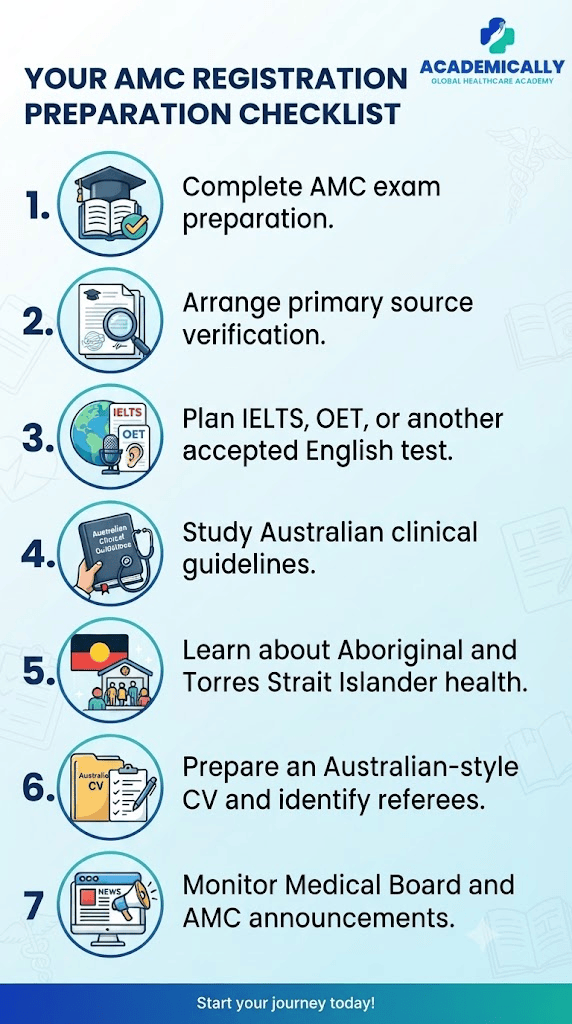
The proposed changes do not require you to pause your AMC preparation. A practical plan can help you move forward while monitoring regulatory updates.
To conclude with...
The proposed changes to the Standard Pathway in Australia provide extra flexibility. However, the main requirements remain the same for Indian MBBS graduates. The AMC exams remain a key part of the pathway. The 47 week accredited PGY1 option could provide an alternative to complete your supervised practice. Orientation to the Australian healthcare system and Aboriginal and Torres Strait Islander Cultural Safety Education will become more important.
The best thing to do is continue preparing for your AMC exams, complete your primary source verification, prepare for English test and start understanding the clinical and healthcare system in Australia.
Waiting for every regulatory detail to become final before taking the first step could unnecessarily delay your plans. Focus on the requirements that already exist while tracking the proposed changes.