Introduction
Every year, thousands of Indian medical graduates dream of practising medicine in Australia. They envision a healthcare system that values clinical excellence, offers better work-life balance, and provides structured career progression. Yet for many, one hurdle appears larger than all the others, the Australian Medical Council (AMC) Clinical Examination (AMC Part II).
Ask any aspiring candidate, and you'll often hear the same concern, "AMC Clinical is incredibly difficult." The examination demands proficient clinical reasoning, excellent communication, and confident decision-making under pressure. However, success stories continue to prove that it is far from impossible. The right preparation strategy, consistent practice, and expert mentorship can make all the difference.
One such inspiring story is that of Dr. Kaushik Gupta. He is an MBBS doctor from Karnataka, India who successfully cleared both the AMC CAT MCQ (AMC Part I) and the AMC Clinical Examination (AMC Part II).
In an exclusive conversation with Dr. Akram Ahmad, Founder & CEO of Academically Global and a PhD from the Faculty of Medicine, University of Sydney, Dr. Gupta shared the decisions, challenges, and preparation techniques that transformed his Australian dream into reality. Let's get inspired.
From MBBS in India to Clearing the Australian Medical Council Exam
Dr. Kaushik Gupta completed his MBBS from Mandya Institute of Medical Sciences, Karnataka, graduating in 2024 before working for several months as a junior doctor. Like many Indian medical graduates, he initially knew very little about the Australian licensing pathway.
"When I first decided to pursue AMC, I honestly didn't know anything about the process. Everything, the basic foundation, was given by Academically."
That statement may sound simple, but it captures one of the biggest hurdles facing international medical graduates.
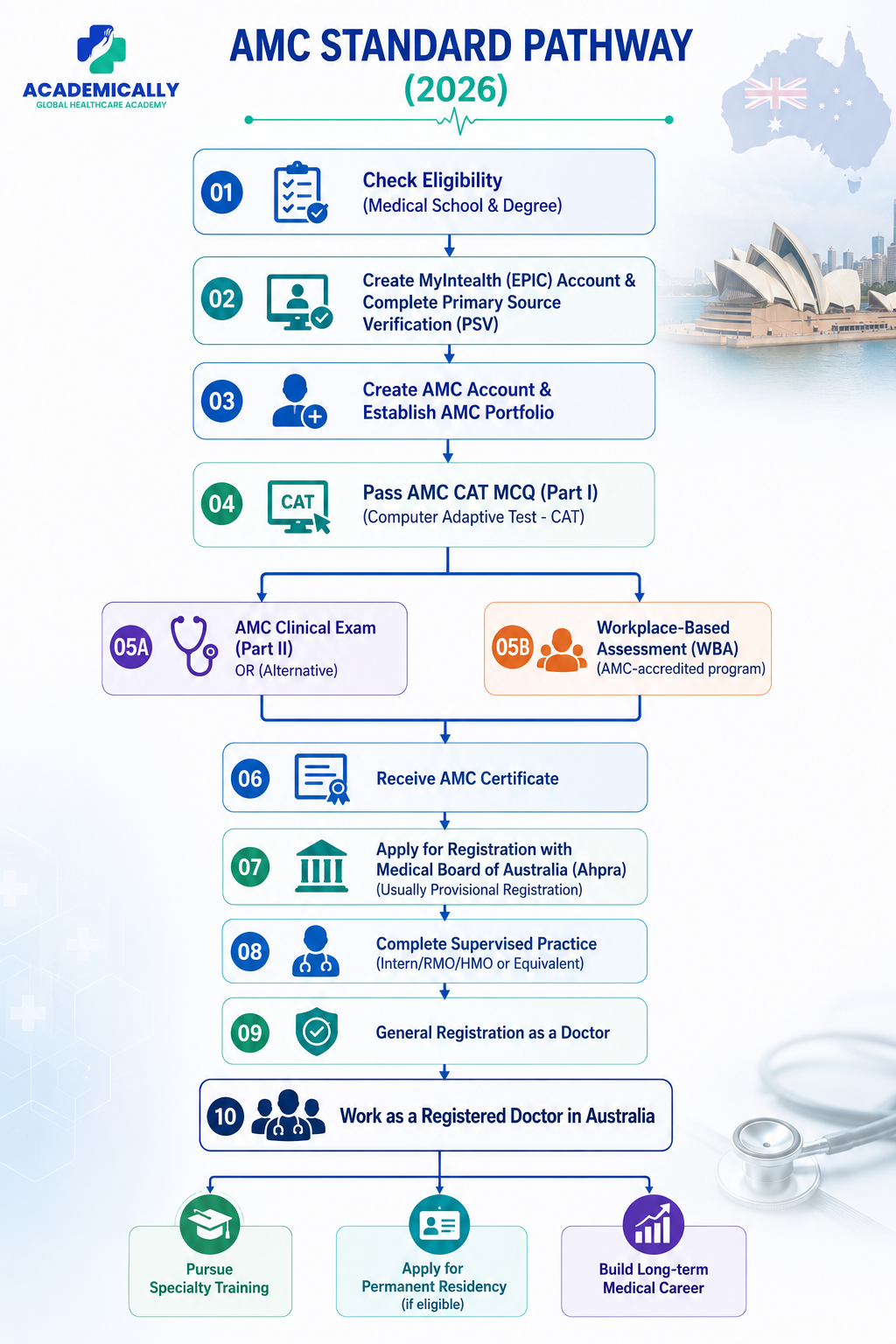
The AMC Standard pathway isn't just another licensing examination. It involves understanding eligibility, documentation, EPIC verification, examination patterns, Australian clinical expectations, and eventually preparing for two completely different assessments:
- AMC CAT MCQ Part I
- AMC Clinical Examination (AMC Part II)
Without a structured roadmap, candidates often waste months navigating scattered information before beginning meaningful preparation. For Dr. Gupta, receiving a systematic introduction to the entire process allowed him to focus his energy where it mattered most, developing clinical competence.
Why International Medical Graduates Choose Australia?
During the interview, Dr. Akram Ahmad asked a simple yet important question: "Why did you choose Australia out of all the other well?" Dr. Gupta's answer reflects the aspirations of thousands of Indian doctors today. He explained that during his internship, he realised he wanted a healthcare career offering:
- better work-life balance
- lower workplace stress
- a highly organised healthcare system
- opportunities for professional growth
Having interacted with seniors already working in Australian hospitals, he had witnessed first-hand how different the clinical environment was.
"When I visited Australia and saw the hospitals, I realised how amazing the healthcare system is."
While competitive salaries certainly attract doctors, many international medical graduates increasingly prioritise professional satisfaction and sustainable careers. Australia continues to face workforce shortages across several medical specialties, creating opportunities for qualified overseas-trained doctors who successfully complete the AMC pathway.
Building the Right Foundation Before Thinking About AMC Clinical
One of the biggest misconceptions among candidates is viewing AMC Part I and AMC Part II as completely separate examinations. Dr. Gupta strongly disagrees. According to him, his success in the Clinical Examination began long before he started practising role plays. It started while preparing for AMC Part I.
"The foundation that Academically built for me during AMC Part I helped me throughout AMC Part II."
He recalled revisiting his handwritten notes repeatedly, even while preparing for the clinical examination.
Whenever he encountered uncertainty regarding Australian guidelines or clinical reasoning, he returned to those notes instead of searching randomly across multiple resources. That consistency created confidence. Instead of depending only on recall files or memorising likely questions, he understood the clinical concepts behind every disease presentation. This distinction became crucial later during the clinical examination.
Why AMC Clinical Exam Part II is Different from Other Medical Licensure Exams?
Perhaps the most valuable insight from Dr. Gupta's interview was his perspective on the nature of the AMC examinations. Many candidates approach licensing exams expecting a factual recall. AMC expects something very different.
"The examination is very clinically oriented. Instead of by-hearting, you really have to become a good doctor."
This philosophy aligns closely with the objectives of the Australian Medical Council.
Rather than testing isolated facts, AMC Clinical stations evaluate whether candidates can safely assess patients, communicate effectively, formulate differential diagnoses, and develop appropriate management plans under realistic clinical conditions. Candidates rotate through structured stations covering history taking, physical examination, diagnostic formulation, and patient management across medicine, surgery, paediatrics, women's health, mental health, and community practice.
That explains why candidates with excellent theoretical knowledge may still struggle if they cannot communicate clearly or think systematically under time pressure.
Why an Excellent AMC Part I Preparation Gives You an Advantage
Dr. Gupta believes many candidates underestimate the long-term value of comprehensive preparation for the AMC CAT MCQ. He observed that some students now rely heavily on recalled questions to clear Part I.
While that approach may occasionally help candidates pass the examination, it often leaves significant knowledge gaps. In contrast, building concepts thoroughly creates confidence that extends far beyond a single exam.
This is precisely why structured preparation matters. A comprehensive AMC Exam Preparation Course should focus not only on helping candidates answer multiple-choice questions but also on developing the clinical reasoning expected throughout the Australian registration pathway. For aspiring doctors, this means learning:
- evidence-based clinical decision-making
- Australian management guidelines
- integrated medical sciences
- systematic clinical reasoning
- patient-centred thinking
These skills become invaluable when progressing to AMC Clinical.
As Dr. Gupta explained,
"I was very confident with my knowledge because I had gone through everything that was taught from A to Z."
That confidence cannot be developed overnight. It is built gradually through structured learning, experienced faculty guidance, and consistent revision.
AMC Clinical Exam Preparation Strategies
Throughout the interview, Dr. Gupta repeatedly returned to one theme, which is, "Support". Preparation wasn't limited to lectures. It extended to mentors who remained available whenever doubts arose.
Whenever he encountered uncertainty regarding guidelines or clinical concepts, he knew where to seek clarification. That continuity became one of the defining strengths of his preparation.
Rather than constantly switching between resources, he relied on an organised learning ecosystem that supported him throughout the journey. This reflects one of the major advantages of structured coaching programmes.
For example, Academically's AMC Exam Preparation Course combines live interactive teaching with recorded sessions, structured notes, expert faculty guidance, and systematic curriculum coverage designed specifically for international medical graduates preparing for Australia's licensing examinations.
Instead of overwhelming candidates with information, the objective is to build a strong conceptual framework that remains useful well beyond the MCQ examination.
Why So Many Candidates Have Confusion with AMC Part II Clinical Exam and How this IMG Overcame It
During the interview, Dr. Akram Ahmad raised one of the most common concerns shared by international medical graduates:
"Indian doctors want to go to Australia, but many feel AMC Part II Clinical is extremely difficult."
Dr. Kaushik's response was refreshingly honest. He acknowledged that AMC Part II Clinical is undoubtedly a challenging examination, but not because candidates lack medical knowledge. Instead, the biggest hurdle is performance under pressure.
"Knowledge-wise, everybody who has passed AMC Part I already has good clinical knowledge. Where people usually lag is performance."
This distinction is crucial.
Unlike traditional examinations that reward recall, the AMC Clinical Examination evaluates whether you can think, communicate, prioritise, and manage patients like a safe junior doctor practising in Australia. Candidates rotate through 16 assessed stations (including pilot stations) covering history taking, examination, diagnostic formulation, and patient management in realistic clinical scenarios.
In other words, success depends less on what you know and more on how effectively you apply that knowledge within eight to ten minutes.
AMC Part II Clinical Exam Expert Tips & Tricks
One of the most insightful moments of the interview came when Dr. Kaushik explained the real nature of AMC Clinical. Candidates don't receive unlimited time to analyse a case. They must rapidly:
- establish rapport
- obtain a focused history
- identify red flags
- formulate differential diagnoses
- explain investigations
- counsel patients
- communicate management clearly
...all while remaining calm and professional.
"You have to be very spontaneous with your questions. You have to be spontaneous with your differentials."
That spontaneity cannot be developed simply by reading textbooks. It develops through repeated exposure to realistic clinical encounters.
This is exactly why the AMC examination continues to use structured patient interactions instead of purely written assessments, it measures practical clinical competence in real-world settings.
Role Plays: The Secret Behind IMG's AMC Clinical Exam Success
When asked what contributed most to clearing AMC Part II, Dr. Kaushik didn't mention expensive resources or endless revision. He spoke about role-play practice. According to him, he was fortunate to have a dedicated group of four serious study partners. Together, they practised relentlessly.
Even more importantly, they challenged each other.
"All four of us passed."
Rather than making scenarios predictable, they intentionally increased the difficulty. One partner would withhold obvious clues. Another would change the direction of the consultation. Others would deliberately avoid giving straightforward answers.
Why? Because real patients and AMC exam stations rarely unfold exactly as expected. This forced everyone to think critically instead of following rehearsed scripts.
Interestingly, the same advice frequently appears in discussions among recent successful candidates, who consistently recommend regular role plays, video review, and peer feedback to improve communication, body language, and clinical flow before the examination. Perhaps the most memorable advice Dr. Kaushik shared was this:
"You have to make your partner's life as difficult as possible."
At first glance, that sounds counter-intuitive. But his reasoning makes perfect sense. If your practice partner immediately reveals every diagnosis, gives textbook answers, and follows predictable scripts, your preparation remains superficial.
Instead, effective role-play should mimic real clinical uncertainty. Patients may forget important details. Symptoms may overlap. Communication barriers may exist. Unexpected emotional responses may arise. The more realistic your practice becomes, the more prepared you'll be for the actual examination. This deliberate practice develops what every successful AMC candidate ultimately needs:
- clinical reasoning
- adaptability
- confidence
- speed
- patient-centred communication
Importance of 1-on-1 Feedback for AMC Part II Clinical Exam Preparation
Practice alone isn't enough. Practice without feedback often reinforces mistakes. Dr. Kaushik repeatedly credited the mock examinations and personalised feedback he received during his preparation. After every mock session, he carefully analysed:
- what went well
- where he lost marks
- how he could communicate more effectively
- how to structure consultations better
- how to improve time management
"The feedback they gave me, I really went through it and changed what I should have done and what I should not have done."
This continuous improvement cycle gradually transformed preparation into performance. For many candidates, this is where structured coaching becomes valuable.
Rather than simply completing practice stations, experienced tutors identify subtle issues that candidates often overlook themselves from consultation flow and empathy to prioritisation and clinical reasoning.
Dr. Kaushik Gupta's AMC Clinical Exam Success Blueprint
| Success Factor | What Dr. Kaushik Did | Why It Helped Him Pass AMC Part II Clinical |
| Started with a strong foundation | Understood the complete AMC pathway and built concepts during AMC Part I preparation. | Strong clinical knowledge made it easier to apply reasoning during the Clinical Exam instead of memorising answers. |
| Focused on clinical reasoning | Studied to understand patient management rather than relying on recalls or rote learning. | AMC assesses how doctors think and make safe clinical decisions in real-life scenarios. |
| Revised trusted notes | Revisited his handwritten notes whenever he encountered doubts during preparation. | Consistent revision reinforced concepts and improved confidence throughout the journey. |
| Practised random role plays | Conducted role-play sessions on unpredictable cases with dedicated study partners. | Helped develop spontaneity, faster clinical thinking, and adaptability under exam conditions. |
| Accepted constructive feedback | Analysed every mock exam and implemented mentor feedback. | Continuous improvement corrected communication gaps, consultation flow, and time management. |
| Prepared under realistic exam conditions | Simulated the pressure of the actual AMC Clinical Exam instead of only reading textbooks. | Built confidence to perform effectively within the limited station time. |
| Stayed consistent | Continued practising regularly instead of depending on last-minute preparation. | Consistency strengthened both clinical reasoning and communication skills over time. |
| Sought structured mentorship | Learned from experienced faculty and maintained access to expert guidance whenever required. | A structured preparation approach reduced uncertainty and kept preparation focused on exam expectations. |
How Academically Helps Mirror the Exact AMC Exam During Preparation
Dr. Kaushik's preparation philosophy closely mirrors how high-performing candidates approach AMC Clinical today. The objective is not merely to "cover the syllabus." It is to simulate the examination repeatedly until confident clinical communication becomes second nature. That philosophy is reflected in the Academically Global AMC Clinical Exam Part-II Preparation Course, which is designed specifically around the competencies assessed by the Australian Medical Council. The programme includes:
- 100+ hours of live Zoom clinical and OSCE-focused sessions
- Adaptive AI-driven AMC clinical mock tests
- Tutor-guided role plays based on common clinical scenarios
- One-on-one personalised feedback sessions
- Recorded lectures, structured study handouts, and mock examinations
- A final Grand OSCE practice test that closely replicates the real examination environment
Rather than relying solely on passive learning, candidates repeatedly practise history taking, examination techniques, diagnostic formulation, counselling, and communication, the very domains assessed during the AMC Clinical Examination.
Inspiration for Every Overseas Medical Graduate Pllanning to Go to Australia
Throughout the interview, Dr. Akram Ahmad's questions highlighted a recurring theme. Successful candidates rarely rely on shortcuts. They build strong foundations, seek mentorship, embrace constructive criticism, and continue improving until clinical reasoning becomes instinctive. As a PhD from the Faculty of Medicine, University of Sydney, and Founder & CEO of Academically Global, Dr. Ahmad has mentored thousands of international medical graduates pursuing global medical careers. Dr. Kaushik's journey reinforces the same philosophy. His success wasn't the result of memorising recalls or hoping for familiar cases. It was built through:
- strong conceptual preparation during AMC Part I
- consistent revision
- disciplined role-play practice
- personalised mentor feedback
- confidence developed through repeated mock examinations
Dr. Kaushik's story sends a reassuring message to every international medical graduate preparing for Australia. The AMC Clinical Examination is challenging, but it is not designed to eliminate candidates. It is designed to identify doctors who can safely assess, communicate with, and manage patients in real clinical practice. If there is one lesson from his journey, it is this:
Success in AMC Part II doesn't come from studying harder. It comes from practising smarter. Build your fundamentals. Think clinically. Practise randomly. Invite honest feedback. Refine your communication. Repeat the process until confidence replaces anxiety. That is exactly how an Indian medical graduate from Mysore transformed uncertainty into success and how countless future doctors can do the same.
To Conclude with...
Every successful AMC candidate has a story, but the underlying principles remain remarkably similar. Strong fundamentals, structured preparation, deliberate practice, and continuous feedback consistently outperform shortcuts and last-minute revision.
Dr. Kaushik Gupta's journey illustrates that passing both AMC Part I (MCQ) and AMC Part II Clinical is less about extraordinary intelligence and more about developing the mindset of a safe, patient-centred clinician. With Australia's ongoing demand for international medical graduates, there has never been a better time to begin preparing with purpose.
Whether you're just starting your AMC journey or preparing for the Clinical Examination, investing in concept-based learning, realistic role plays, and expert mentorship can significantly improve your confidence and performance. As Dr. Kaushik's experience shows, the goal isn't simply to pass an exam, it's to become the kind of doctor Australia's healthcare system is looking for.