You can pass the Overseas Pharmacist Readiness Assessment and still be unsure about what comes next.
For many overseas pharmacists, the difficult part is no longer just understanding the exam. It is understanding how professional registration, skills assessment, employment and Australian migration pathways fit together.
This is especially important in 2026 because the Australian skilled migration system has changed from the older list structure many pharmacists may still see online.
So, after the exam, should you be looking at subclass 482, 491 or 189?
The answer depends on your individual profile.
First, what does it mean to be qualified as an Australian Pharmacist?
If you have a pharmacy qualification from outside Australia, the Australian Pharmacy Council (APC) administers the Knowledge Stream pathway.
The process entails an eligibility check and the Overseas Pharmacist Readiness Assessment. Once you have cleared the exam, you can apply for an APC Skills Assessment Outcome (SAO) which can be used to support a visa application with the Department of Home Affairs.
However, passing the exam does not automatically entitle you to an Australian visa or pharmacist registration.
This is also where guided preparation fits into the bigger picture. Academically provides end-to-end guidance for overseas pharmacists and can support you in understanding what needs to happen beyond the exam, including the broader registration and migration pathway.
The APC also lists separately the steps towards provisional registration and supervised practice with the Pharmacy Board of Australia through AHPRA. It also makes clear that a Skills Assessment Outcome does not guarantee a job or a visa.
So the pathway is better understood as:
| Pharmacy degree → APC eligibility check → Overseas Pharmacist Readiness Assessment examination → Skills Assessment Outcome → visa + registration → employment |
Your migration and professional registration work alongside each other.
482 vs 491 vs 189: What Is the Difference?
Before we get into a comparison of the visas, there is one key aspect you need to understand: Australia does not have one single occupation list for all skilled visas.
The occupation list and ANZSCO version that applies will depend on the visa track.
For the Skills in Demand visa (subclass 482), Australia uses ANZSCO 2022 and the Core Skills Occupation List (CSOL) for the Core Skills stream.
The CSOL currently includes all three pharmacist occupations:
| 251511 – Hospital Pharmacist | 251512 – Industrial Pharmacist | 251513 – Retail Pharmacist |
The CSOL is also relevant to the Direct Entry stream of the Employer Nomination Scheme (subclass 186).
For visas other than subclass 482 and subclass 186 Direct Entry, the Department uses ANZSCO 2013 and the applicable occupation-list settings for the relevant visa. This is why you need to check the specific visa pathway rather than assuming that an occupation's inclusion on one list makes it eligible for every skilled visa.
Differences in job listings for pharmacists (visa):
| Visa pathway | ANZSCO framework | Occupation-list framework | What this means for pharmacists |
| Subclass 482 – Skills in Demand, Core Skills stream | ANZSCO 2022 | CSOL | Pharmacist occupations 251511, 251512 and 251513 are included |
| Subclass 186 – Employer Nomination Scheme, Direct Entry | ANZSCO 2022 | CSOL | Pharmacist occupations are included, subject to the visa requirements |
| Subclass 189 – Skilled Independent | ANZSCO 2013 | MLTSSL | The current Home Affairs occupation search does not list Hospital Pharmacist, Industrial Pharmacist or Retail Pharmacist as eligible for the subclass 189 points-tested pathway. |
| Subclass 190 – Skilled Nominated | ANZSCO 2013 | MLTSSL/STSOL framework | Pharmacist occupations can be relevant where the occupation is available under the applicable nomination settings. |
| Subclass 491 – Skilled Work Regional | ANZSCO 2013 | Relevant skilled occupation framework, including STSOL/other applicable lists depending on the pathway | Pharmacist occupations can be relevant, but state/territory nomination and the specific visa requirements still apply. |
You should note that an occupation being listed for one visa does not automatically make it eligible for every skilled visa. For example, the three pharmacist occupations are included in the current CSOL and are listed for the 482 Core Skills stream and 186 Direct Entry pathway. They are also listed for the 491 State or Territory nominated pathway. However, the current Home Affairs occupation search does not list these three pharmacist occupations for the subclass 189 points-tested pathway.
That’s why finding “pharmacist” on an Australian skilled occupation list can be deceptive. Before you can go determine if a pathway is accessible, you need to examine the specific ANZSCO code, the version of ANZSCO being used, the occupation list related to the visa and the other eligibility requirements for that visa.
1. Subclass 482: Skills in Demand Visa
The Skills in Demand visa (subclass 482) is a temporary employer-sponsored visa.
Under the Core Skills stream, an Australian employer must sponsor a suitably skilled worker for an eligible position, and the nominated occupation must meet the relevant occupation-list requirements. Pharmacist occupations are included on the current CSOL.
For a qualified pharmacist, this makes subclass 482 an important pathway to investigate, particularly where an Australian employer is prepared to sponsor the applicant.
The visa is generally granted for up to four years under the Core Skills stream, subject to the applicable requirements.
What do you need for a 482?
An applicant must satisfy the requirements applicable to the relevant 482 stream. These include an approved sponsoring employer, an eligible nominated position, the required skills and English, and work experience.
Applicants for the Core Skills stream generally need at least one year of relevant work experience in the nominated occupation or a related field.
That makes this pathway particularly important to assess carefully if you have only recently completed and have limited professional experience.
This is also where planning ahead matters. Academically can support overseas pharmacists in understanding how their preparation, skills assessment, registration, English, employment and migration plans fit together, rather than treating each requirement as a distinct step.
Salary is another important part of the 482 assessment. For Core Skills nominations lodged from 1 July 2026 to 30 June 2027, the Core Skills Income Threshold is AUD 79,423. The nominated position must also meet the applicable Annual Market Salary Rate requirements.
What is the biggest advantage of 482?
The main advantage is the employer relationship.
Instead of competing solely through a points-tested invitation system, you are pursuing an employer-sponsored pathway into Australia.
A possible progression can therefore look like:
| Assessment Exam→ Skills Assessment Outcome → eligible employer → subclass 482 → Australian employment → potential employer-sponsored PR pathway |
That last part is important. Subclass 482 itself is temporary. It does not automatically become permanent residence.
Depending on your circumstances, future pathways may include employer-sponsored permanent residence, such as subclass 186, provided you meet the requirements at that time.
2. Subclass 491: Skilled Work Regional Visa
The Skilled Work Regional (Provisional) visa, subclass 491, is different from 482 because it is not an employer-sponsored work visa.
Subclass 491 has a state or territory-nominated pathway and an eligible-family-sponsored pathway. Both are points-tested and require an invitation. State and territory governments apply their own nomination criteria, so eligibility can differ depending on the jurisdiction.
This makes subclass 491 particularly relevant for pharmacists who are open to working and living in regional Australia.
The occupation list administered for skilled visas identifies pharmacist occupations as eligible for subclass 491 state or territory nomination.
Does every pharmacist automatically qualify for 491?
No. Being a pharmacist and having a positive skills assessment does not guarantee nomination.
You still need to meet the requirements of the relevant state or territory, receive an invitation where required, and satisfy the federal visa requirements.
Each jurisdiction can consider factors such as occupation, location, employment, points, English, local study, work experience and other criteria.
That is why a pharmacist may find that the same profile is competitive in one state and not eligible in another.
Because these criteria can vary between jurisdictions, Academically can help pharmacists understand how their overall profile fits into the wider migration pathway before they target a particular nomination option.
How many points are needed?
The minimum points threshold for subclass 491 is 65 points.
But 65 points should not be treated as a guaranteed invitation score.
The Department states that applicants need at least 65 points to be eligible for an invitation, but an invitation can require a higher score depending on the circumstances and the number of places available for the occupation.
State or territory nomination for subclass 491 can provide 15 additional points under the points test.
Your score can be affected by factors including age, English, qualifications, skilled employment experience, partner factors and other points categories.
Why do pharmacists consider 491?
For an overseas pharmacist who has a strong points profile but does not have an employer sponsor, subclass 491 can provide another avenue to investigate.
The regional requirement is important, though.
A 491 visa is designed for people living, working and studying in designated regional areas of Australia, so you need to be comfortable with that condition.
“Regional” does not necessarily mean an isolated rural town. The migration definition covers a wide range of locations outside the major metropolitan areas, and the Department maintains the official list of designated regional areas.
What Happens After a 491 Visa?
Subclass 491 is a five-year provisional visa, not permanent residence.
One of its major advantages is that it can lead to the Permanent Residence (Skilled Regional) visa, subclass 191, provided you meet the requirements for that later visa.
For the subclass 191 Regional Provisional stream, you must have held an eligible subclass 491 or subclass 494 visa for at least three years before applying. You must also provide Australian Taxation Office notices of assessment for three income years out of the five years of your eligible visa and demonstrate compliance with the conditions of your eligible visa. There is currently no minimum income requirement for this 191 stream.
It can look like:
| 491 → meet regional and other requirements → 191 permanent residence |
This is why 491 can be attractive to applicants who are prepared to build their Australian career in a designated regional area.
3. Subclass 189: Skilled Independent Visa
The Skilled Independent visa (subclass 189) is attractive because it is a permanent visa without employer or state sponsorship.
Under the points-tested stream, an applicant must have an occupation on the relevant skilled occupation list, a suitable skills assessment, an invitation and the required points. The applicant must also be under 45 at the time of invitation and meet the other visa requirements.
So why is this not simply the obvious choice for a qualified pharmacist?
Because the occupation list is decisive.
The current Department of Home Affairs occupation search lists Hospital Pharmacist, Industrial Pharmacist and Retail Pharmacist for pathways including subclass 482 and subclass 491, but does not list these pharmacist occupations as eligible for the subclass 189 points-tested pathway.
This means a qualified pharmacist should not assume that having enough points and a positive skills assessment makes them eligible for subclass 189.
For the three pharmacist occupations covered in this article, subclass 189 is generally not the pathway to plan around under the current 2026 occupation settings.
That is an important distinction from older Australia migration content that may still be circulating online.
482 vs 491 vs 189 for Pharmacists
| Feature | Subclass 482 | Subclass 491 | Subclass 189 |
| Visa type | Temporary | Provisional | Permanent |
| Main route | Employer sponsorship | State/territory nomination or eligible family sponsorship | Independent skilled migration |
| Employer sponsor | Required | Not required for state nomination | Not required |
| Points tested | No | Yes | Yes |
| Regional requirement | No general regional requirement | Yes | No |
| Pharmacist pathway under current settings | Yes | Yes, subject to nomination | Generally not for 251511–251513 |
| Main consideration | Finding an eligible sponsor | Meeting nomination and points criteria | Occupation eligibility |
The table makes one thing clear: 482 and 491 are the main pathways to investigate for the pharmacist occupations discussed here, while 189 should not be assumed to be available.
Importance of English Proficiency
English matters at multiple stages.
Australian pharmacist registration and visa English requirements vary.
That distinction is crucial because meeting one organization's English requirement doesn't guarantee meeting all others.
AHPRA has its own English language registration standard, whereas Department of Home Affairs visa programs have their own English competence requirements and can affect your points score in points-tested visas.
Therefore, qualified pharmacists should evaluate English requirements for registration and migration, rather than relying on a single test result.
This is also an area where preparation can make the wider pathway easier. Academically offers courses to help healthcare professionals prepare for English proficiency exams, so pharmacists can work towards the English requirements relevant to their registration and migration plans rather than leaving English preparation until the final stage.
A Practical Pathway for an Overseas Pharmacist
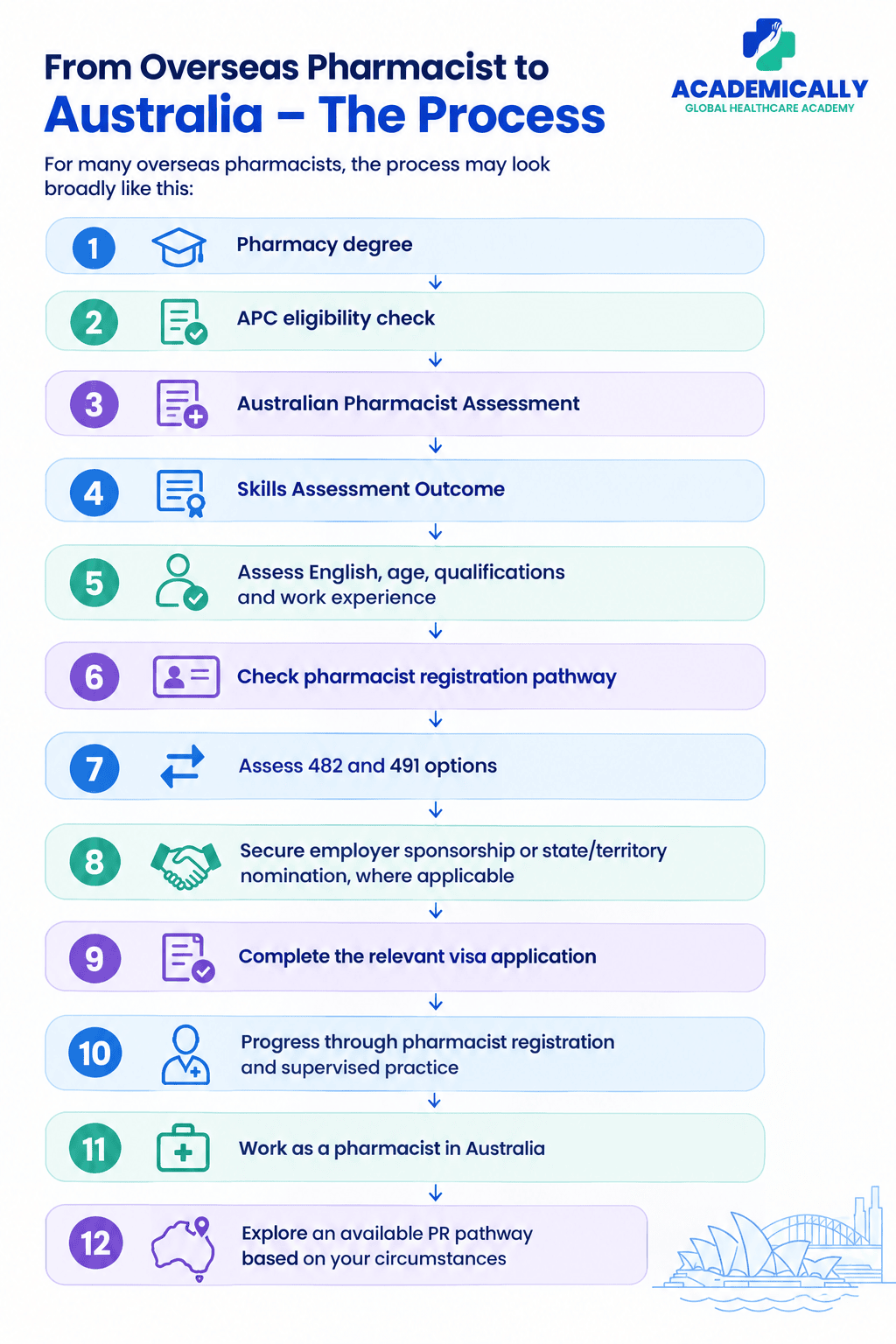
The exact order can vary.
For example, someone who already has an employer may approach the process differently from someone building a points-based state nomination profile.
That is why there is no single “post-Assessment visa route” that applies to every pharmacist.
So, 482, 491 or 189?
For an assessment qualified pharmacist, the better question is not merely which visa sounds most appealing.
It is determined by which pathway best fits your profile.
In simple terms, subclass 482 is most relevant where you have an eligible employer willing to sponsor you; subclass 491 is worth investigating where you have a competitive points profile and can meet a state or territory nomination or eligible-family-sponsored pathway; and subclass 189 should not currently be assumed to be available for the three pharmacist occupations discussed here.
The Bottom Line
Passing the Australian Pharmacist Assessment is a major milestone, but it is not the end of the Australian pharmacist journey.
Your next steps involve putting together several separate pieces: skills assessment, registration, English, employment and migration eligibility.
For the pharmacist occupations discussed here, subclass 482 and subclass 491 are the more relevant pathways to investigate under the current 2026 framework, while subclass 189 is generally not available for these occupations.
The occupation lists, salary thresholds and state nomination rules can change, so, always verify the requirements in force when you are ready to apply.