India has more than 4,000 pharmacy colleges. Australia has just 16 universities with accredited pharmacy degree programs. Do you know what that means for you? It means opportunity.
Australia's pharmacy education system is considerably smaller, while pharmacists remain an important part of the country's healthcare workforce. Pharmacists are currently in shortage, making Australia a booming market for qualified pharmacists.
This opportunity can be financially rewarding too. The median full-time salary for pharmacists in Australia in 2026 is around AUD 101,700 a year. That's approximately ₹69 lakh per year at the current exchange rate!
Let me take you through the key numbers, job opportunities, career pathways, and salaries you need to know.
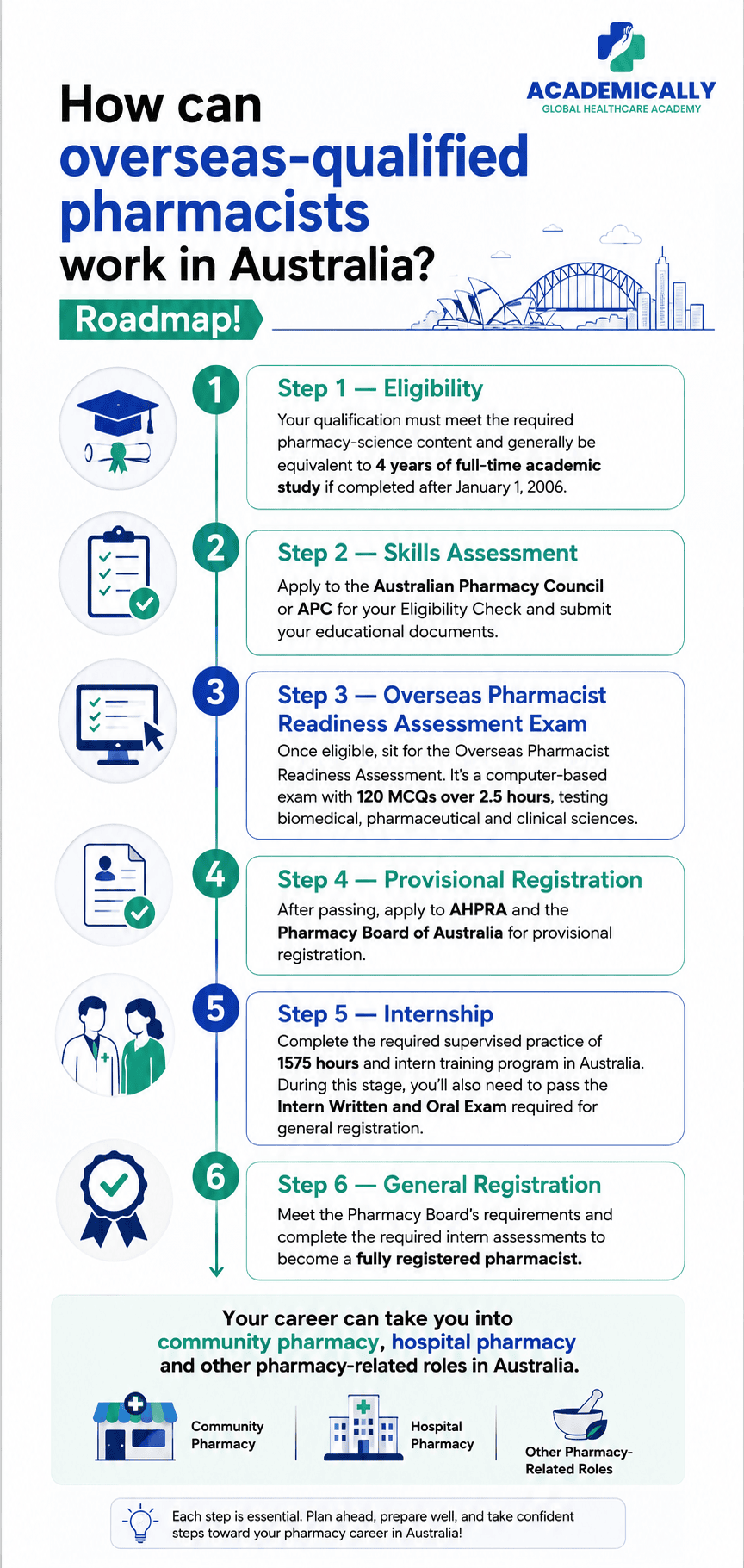
How Can Overseas-Qualified Pharmacists Work in Australia?
If you qualified outside Australia, your first step is to understand which Australian assessment and registration pathway applies to your pharmacy qualification.
The Australian Pharmacy Council assesses overseas-trained pharmacists through different pathways depending on their qualifications and circumstances.
A pharmacy career in Australia can begin with the right preparation for the Australian Pharmacist Exam.
Once you complete the required assessment, registration, practice requirements and obtain pharmacist registration with the Australian Health Practitioner Regulation Agency (AHPRA), you can progress towards practising as a pharmacist in Australia.
Registered Pharmacist Salary in Australia
Your earning potential as a pharmacist can change significantly with your registration status, experience, role and location. The figures below provide the current approximate salary range, so you can get a realistic idea of what different career stages may look like.
| Career Stage | AUD (Annual) | INR (Approx.) |
| Intern Pharmacist | AUD 65,000–75,000+ | ₹44–51 lakh+ |
| Registered Pharmacist | AUD 80,000–100,000 | ₹54–68 lakh |
| Senior Pharmacist | AUD 100,000–140,000 | ₹68–95 lakh |
Community Pharmacist Pay in Australia
Community pharmacy is one of the most common route for registered pharmacists, with pay varying by classification and working arrangements.
Minimum Weekly Pay
| Classification | Minimum Weekly Rate (AUD) | Approx. Weekly Pay (INR) |
| Pharmacist | AUD 1,586.30 | ₹1.08 lakh |
| Experienced Pharmacist | AUD 1,737.40 | ₹1.18 lakh |
| Pharmacist in Charge | AUD 1,778.40 | ₹1.21 lakh |
| Pharmacist Manager | AUD 1,981.60 | ₹1.35 lakh |
Minimum Hourly Pay
| Classification | Minimum Hourly Rate (AUD) | Approx. Hourly Pay (INR) |
| Pharmacist | AUD 41.74 | ₹2,835/hour |
| Experienced Pharmacist | AUD 45.72 | ₹3,105/hour |
| Pharmacist in Charge | AUD 46.80 | ₹3,178/hour |
| Pharmacist Manager | AUD 52.15 | ₹3,541/hour |
These figures are the ordinary-hour minimum rates. Weekend, evening, public-holiday and overtime work can attract higher rates.
Hospital Pharmacist Salary in Australia
Hospital pharmacy offers a more structured career path, with opportunities to progress into clinical and senior pharmacy roles. The hospital pharmacist pay is generally tied to state-based classifications, experience and public-sector awards or agreements, so salaries can vary depending on where you work.
Weekly Salary
| Hospital Pharmacist Classification | Weekly Salary (AUD) | Approx. Weekly Equivalent (INR) |
| Grade 1 – 1st Year | AUD 1,668.95 | ₹1.13 lakh |
| Grade 1 – 2nd Year | AUD 1,778.07 | ₹1.21 lakh |
| Grade 1 – 3rd Year | AUD 1,895.55 | ₹1.29 lakh |
| Grade 1 – 4th Year | AUD 2,105.85 | ₹1.43 lakh |
| Grade 2 – 1st Year | AUD 2,330.11 | ₹1.58 lakh |
| Grade 2 – 3rd Year | AUD 2,470.33 | ₹1.68 lakh |
| Senior Pharmacist – 1st Year | AUD 2,732.69 | ₹1.86 lakh |
| Senior Pharmacist – 2nd Year | AUD 2,806.64 | ₹1.91 lakh |
Annualised Salary
| Hospital Pharmacist Classification | Annualised Salary (AUD) | Approx. Annual Equivalent (INR) |
| Grade 1 – 1st Year | AUD 86,785 | ₹58.9 lakh |
| Grade 1 – 2nd Year | AUD 92,460 | ₹62.8 lakh |
| Grade 1 – 3rd Year | AUD 98,569 | ₹66.9 lakh |
| Grade 1 – 4th Year | AUD 109,504 | ₹74.3 lakh |
| Grade 2 – 1st Year | AUD 121,166 | ₹82.3 lakh |
| Grade 2 – 3rd Year | AUD 128,457 | ₹87.2 lakh |
| Senior Pharmacist – 1st Year | AUD 142,100 | ₹96.5 lakh |
| Senior Pharmacist – 2nd Year | AUD 145,945 | ₹99.1 lakh |
Does Your City Affect Your Pharmacist Salary or Lifestyle in Australia?
Yes, it does! Where you work in Australia can influence both what you earn and how you live. Metropolitan areas such as Sydney, Melbourne and Brisbane offer larger employment markets across community and hospital pharmacy, but they also come with higher living costs and greater competition for jobs.
Regional and remote areas can offer a different balance. Pharmacists may find strong employment opportunities; while some locations may involve additional travel, fewer services and different lifestyle considerations.
Your actual earnings will still depend on factors such as your employer, classification, experience, working hours and employment agreement.
What I’m trying to say is: don’t just ask, “Which city pays the most?”
Instead, ask, “Which city offers the right balance of salary, career opportunities, and lifestyle for me?”
Before you accept an offer, check exactly what the advertised figure represents.
Is it the base salary?
Is superannuation included?
Are overtime, weekend and public-holiday payments separate?
Does the role offer salary packaging, allowances, relocation support or other benefits?
Two jobs that appear similar on paper can therefore have quite different overall value once you compare the complete package.
Is Moving to Australia as an Overseas Pharmacist Actually Possible?
If you’re looking at the Australian pharmacist pathway and feeling overwhelmed by everything involved; from understanding the requirements and choosing the right assessment to figuring out what comes after each step, trust me, you’re not alone.
A clear, structured preparation plan can take a lot of that uncertainty off your shoulders. When you know what to do, when to do it and how to prepare for the next stage, the journey becomes much easier to navigate.
If you’re wondering whether overseas pharmacists are actually making this transition, Academically’s student journeys show that they are.
Take Kruti, a B.Pharm graduate from Gujarat. She moved to Australia in March 2025, joined Academically’s preparation programme and cleared the July 2025 exam on her first attempt. Around the time her result was announced, she also secured her first job in Australia as an assistant pharmacist.
Then there’s Harshwardhan, whose journey shows that even if your first attempt doesn’t go as planned, the pathway doesn’t have to end there. After an unsuccessful attempt in November 2025, he changed his preparation strategy, continued studying alongside a full-time job and cleared the July 2026 OPRA exam on his second attempt. His PASS result was released on 11 August 2026.
And Saba Parveen’s journey highlights another important part of the process. After completing her B.Pharm and clearing the exams in November 2024, she moved to Australia and later cleared the Australian Intern Pharmacist Oral Exam following six months of focused preparation. Her story is a useful reminder that clearing the initial overseas pharmacist assessment is not the end of the journey; internship and registration stages require preparation too.
These journeys are different and that’s exactly the point.
You may be at the beginning of the process, preparing for the exam, waiting to move to Australia, working through your internship or figuring out what comes next after an unsuccessful attempt. Your route doesn’t have to look exactly like someone else’s.
What can make a difference is having the right roadmap for your stage of the journey.
That’s where Academically steps in, to help overseas pharmacists understand the process, prepare systematically for the relevant exams and get guidance on what comes next, instead of trying to figure out every step on their own.
So, if you’ve been asking yourself, “Can I really move to Australia and build my pharmacy career there?”, the experiences of pharmacists who have already taken the journey show that it is possible.
The next step is understanding where you currently stand and what you need to do from here.